A pipe is easy to overlook until it is the wrong pipe. Imagine the trench is open, the crew is waiting and the replacement fitting does not match the specification. The object itself may be ordinary. The consequences of choosing it badly are considerably more interesting. Core & Main has built a business around that gap between buying a component and getting a job done.
- It supplies the parts behind water, drainage and fire protection systems.
- Local specifications give its branch expertise a practical purpose.
- Its metering work now includes networks, software and installation.
The St. Louis company reported $7.647 billion in net sales for fiscal 2025, the year ended February 1, 2026. Pipes, valves and fittings supplied $5.137 billion of that total. There is something pleasingly concrete about those numbers. Much of this business ends up somewhere its ultimate beneficiaries will never see.
01 / The expensive part is the interruption
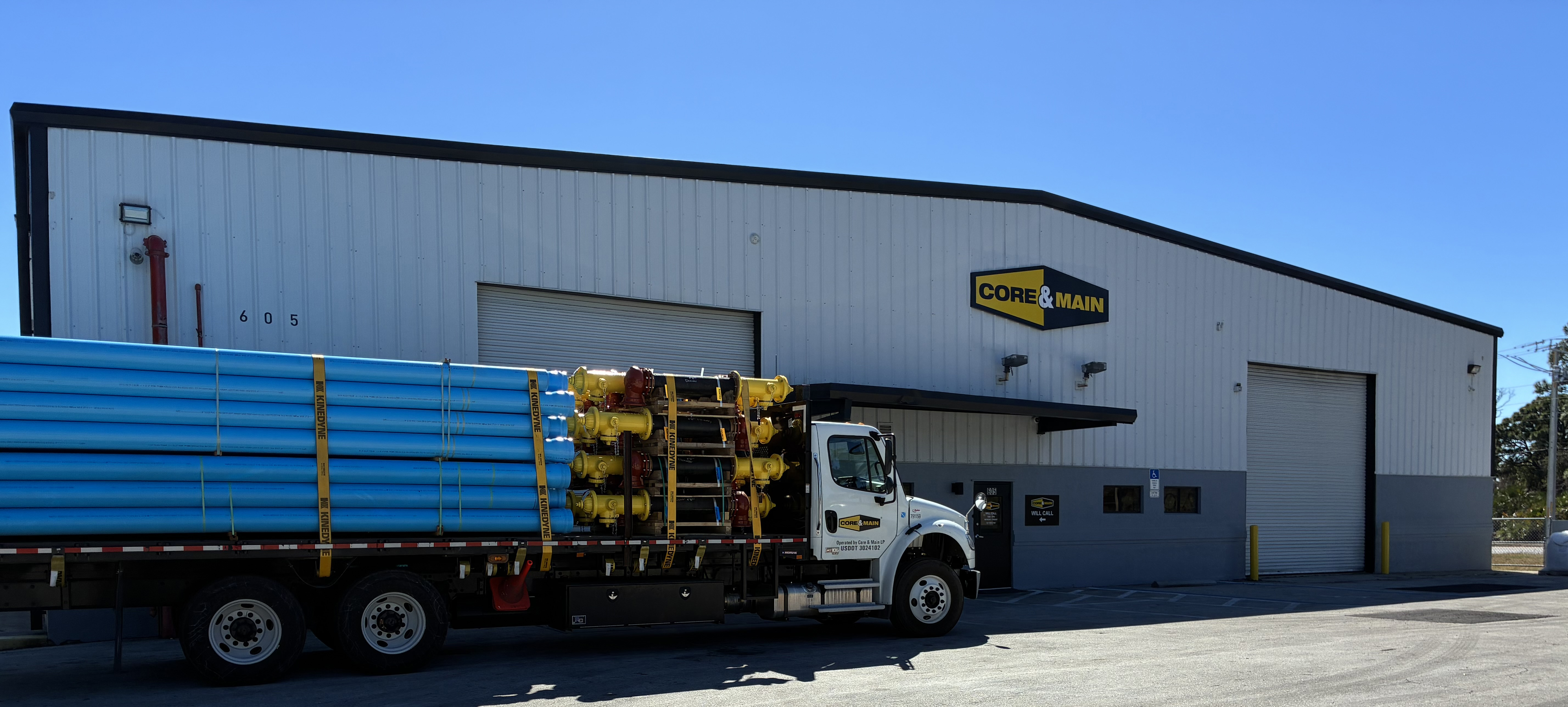
Core & Main sits between manufacturers and the people building or maintaining infrastructure: municipalities, private water companies and professional contractors. Its catalog includes drainage systems, hydrants, sprinkler components and meters. It also rents fusion equipment, fabricates piping and helps coordinate projects. A customer can arrive with a list of parts, or with a project that needs to become a list.
Local rules complicate the transaction. A product must satisfy municipal specifications and engineering requirements. Having a valve in stock is useful only if it is the appropriate valve. The company’s argument for its place in the supply chain rests on that combination: product access, technical knowledge and delivery that fits the work.
02 / Buy big. Know the neighborhood.
The September 2026 investor presentation describes more than 370 branches, over 60,000 customers and more than 5,000 suppliers. Those numbers explain the purchasing opportunity. The operating structure explains the other half: branch managers can adapt their offerings to local needs while drawing on shared resources and systems.
That arrangement is the interesting management idea here. Put purchasing power in one place; keep the knowledge of what customers actually need close to the job. It is an editorial lesson readers can borrow, provided their market rewards local judgment. Central buying cannot substitute for someone who understands the specification.
Ferguson Waterworks is a national alternative, alongside regional distributors and specialist suppliers. Core & Main’s pitch is its dedicated water and fire infrastructure focus, breadth of products and project support. Those capabilities are competitive claims to examine, rather than a promise that every quote or delivery will beat a rival’s.
$7.647 billion total net sales. Percentages rounded.
03 / A new name for an old network
The modern name arrived in 2017, when Clayton, Dubilier & Rice agreed to buy HD Supply’s Waterworks business for $2.5 billion. This was a corporate carve-out with an existing operation: 244 branches in 46 states at the announcement. The oldest legacy distributor in the company’s history dates to 1874.
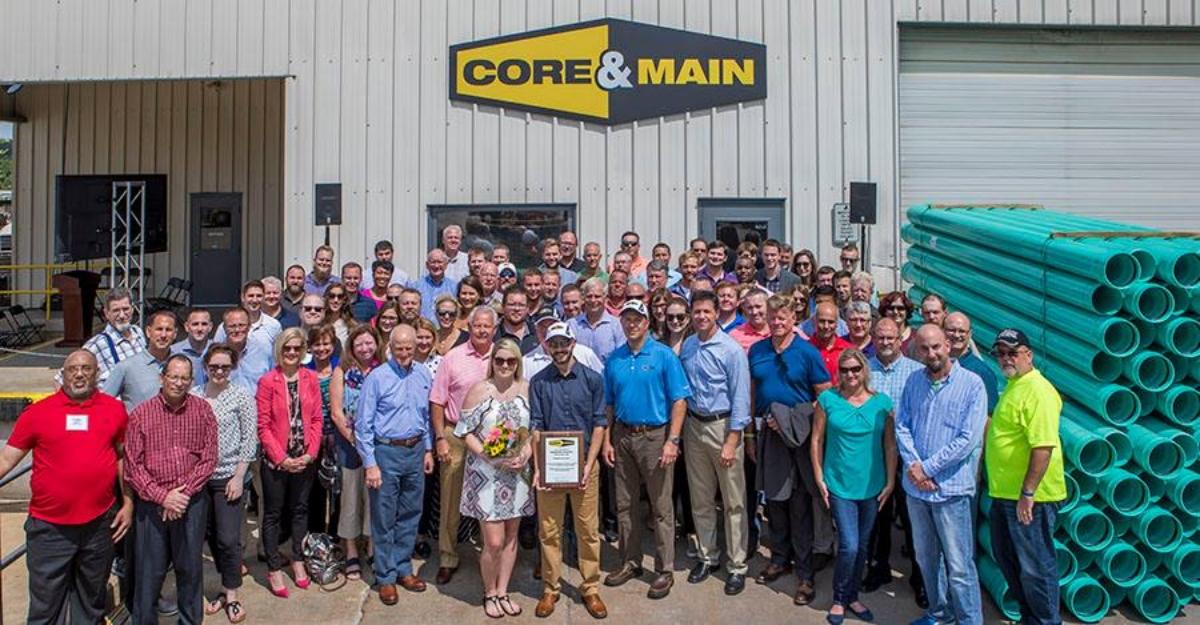
Employees contributed naming ideas. Associate Quinton Carter supplied the submission that became Core & Main, connecting company values, water mains and the ambition to be a customer’s main supplier. A business full of local relationships acquired a name that sounded as though it belonged on a street corner.
The company completed its IPO in July 2021. CD&R investors had exited their Class A and Class B shareholdings by January 2024. Mark Witkowski, previously chief financial officer, became CEO in March 2025. The growth continued through acquisitions and new branches, including expansion into Canada.
04 / Sometimes the straight answer curves
One company case study describes nine diesel fuel tanks at the University of California, San Francisco’s Parnassus campus. Each needed its own fire protection system. Straight piping could not provide the required approach around curved tank surfaces, so the project called for custom curved stainless steel piping.
The constraint came before the solution: geometry defeated the standard approach. That is a useful glimpse of what expertise means here. It is also why a catalog alone cannot explain the business. On an Indiana data center development spanning more than 800 acres, Core & Main worked with Gradex on water, wastewater and storm drainage infrastructure.
05 / The meter comes with a network
In June 2026, Connecticut Water selected Core & Main for an advanced metering infrastructure system. Working with Xylem, the distributor is to deliver more than 100,000 Sensus smart meters and endpoints, communications infrastructure, software integration and installation services. The anticipated benefits include remote readings and faster leak detection.
Here the distributor’s job expands beyond moving boxes. The company also offers metering analysis, installation management and ongoing support, with some services dependent on location. Its free Online Advantage tools handle more everyday needs: pricing, availability, project documents, signed tickets and delivery information. Coordination becomes part of what the customer buys.
“Everyone is in sales”One of Core & Main’s published core principles
06 / Essential does not mean automatic
The economics still require care. Fiscal 2025 sales grew 2.8%, but fourth-quarter sales fell 6.9%, primarily because the comparison contained one fewer selling week. Average daily sales rose just 0.9%. For the full year, net income was $462 million. The distinction between revenue, profit and calendar effects matters.
Municipal budgets can delay work; construction demand can weaken; inventory can arrive too early or too late. These are consequential limits to the model. In September 2026, the company reported second-quarter sales of $2.145 billion, up 2.5%, and reaffirmed its full-year outlook. Infrastructure needs create opportunities. Someone must still win, finance and execute the job.
Core & Main’s appeal is easier to understand from the trench than from the stock ticker. An approved component, an informed person and a workable delivery schedule can remove several problems at once. When that coordination succeeds, the pipe disappears underground. The value was in everything required to put it there.