In 1967, five men in Winona, Minnesota, had a plan for selling nuts and bolts through vending machines. They ordered 1,400 bags of fasteners for a test store. Then the customers arrived. They wanted sizes and quantities the proposed machines could not handle. It was an awkward discovery for a company whose business plan depended on the machine.
- Fastenal supplies the things factories use and the systems that keep them stocked.
- Its advantage is proximity: local teams, connected bins and staff inside customer facilities.
- The useful comparison is total operating cost, including time spent finding and reordering supplies.
Bob Kierlin’s response, as fellow founder Van McConnon later recalled it, was wonderfully unceremonious: “Well, Van, why don’t you just start making sales calls and sell some nuts and bolts?” The company got on with selling. The vending plan went into a drawer.
Fastenal had started with $30,000 and a 1,000-square-foot shop. Its first discovery was that a customer’s inconvenience could be more instructive than a founder’s invention. A business intended to dispense things automatically became a business built around people who would go and ask what was needed.

01 / The cost hiding beside the bolt
Consider a washer. Its purchase price tells you almost nothing about the cost of having it available. Someone must choose it, order it, receive it, count it and notice when the last few disappear. If a worker leaves a workstation to hunt for one, the washer has acquired an entourage.
That is the problem Fastenal addresses. It supplies fasteners, protective equipment, cutting tools and other industrial necessities. Some go into finished products. Others keep machinery running or workers protected. The customers include manufacturers, contractors, public institutions and transportation businesses. These are purchases made to get work done.
A hockey rink makes the breadth easier to picture. Keeping the ice playable involves maintenance equipment, cleaning products, plumbing supplies and protective gear. Fastenal’s NHL partnership, first announced in 2020, applied its supply network to those everyday needs. The work behind the spectacle includes getting ordinary supplies into the hands of facility operators and equipment managers.
The expertise extends beyond a catalogue. Fastenal offers custom manufacturing, engineering support and quality testing. A plant needing a special part or documented inspection has a different problem from someone ordering a box of ordinary screws. Fastenal can participate in both conversations.
A washer’s purchase price tells you almost nothing about the cost of having it available.
Alternatives include Grainger, MSC Industrial Supply and local distributors. Buyers can compare assortment, price and availability. Fastenal makes a particular case for taking responsibility for the stock after it reaches the customer’s building. That changes what a purchasing department is being asked to evaluate.
02 / Put the supplier beside the work
An Onsite is the literal version of that proposition: a Fastenal operation dedicated to a customer, typically within its facility or campus. Fastenal commits personnel, inventory and technology. Its staff can manage the tool crib, replenish supplies and work on improvements with the people who actually use them.
The geography matters. A distributor serving many businesses must balance their needs. A dedicated team can learn one facility’s routines. The commercial relationship reaches past the purchase order into daily operations. For the customer, this can release employees from supply-related tasks. For Fastenal, it creates more opportunities to supply that facility.
There is a trade here for the buyer. A supplier that takes over routine supply work must also learn how the facility operates. Establishing goals, checkpoints and measures of value becomes part of the setup. Counting installed machines alone would miss the point: the customer needs a better working day, with fewer interruptions and a clear account of spending.
The culture fits the arrangement. Fastenal emphasizes local decisions and promotion from within. Its careers material says ideas should come from people close to the customer or process. That is a useful operating principle when the problem is a particular shelf in a particular plant.
03 / The machine finally finds its room
The modern vending program began rolling out in late 2008. This time the setting was different. Inside a workplace, a machine could provide round-the-clock access to predictable supplies while recording who took them. The old idea had found a more useful job.
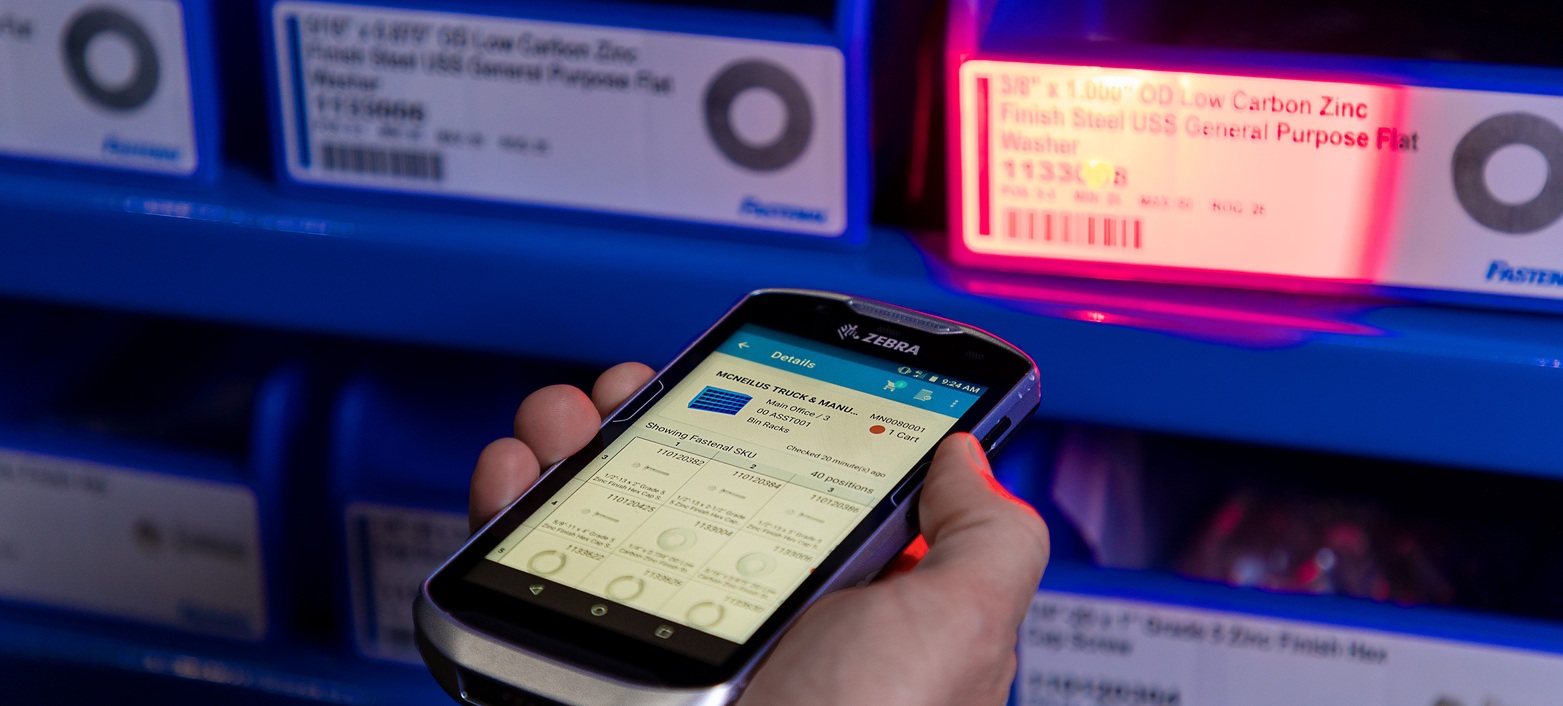
FASTVend uses identification-based access to connect products with individuals and cost centers. Lockers can also track returnable assets. FASTBin answers a different question: how much inventory remains? Depending on the device, RFID, infrared sensors or scales help a local team monitor stock. FASTStock supports scanned replenishment without requiring a sensor in every bin.
Conceptual service cycle. The technology varies by program.
FAST360 presents inventory and spending information to the customer. The distinction is practical: a bin can warn that supplies are running low; a vending machine can help control their use. Neither removes the need for a dependable person and a delivery behind the screen.
04 / Free hardware has a business model
Fastenal advertises vending machines provided without a separate machine charge. The products still cost money. The arrangement makes sense when recurring purchases support the equipment and replenishment work. Buyers should obtain the actual terms for their facility rather than assume every installation has identical economics.
Fastenal’s own spending makes the physical commitment visible. In 2025, company-wide net capital expenditure was $230.6 million, covering more than vending: facilities, equipment, information systems and vehicles also require investment. A customer may see a convenient cabinet. The supplier has to fund the operation behind it.
The results show the scale of that approach. Annual sales reached $8.2005 billion in 2025. In the third quarter of 2026, sales rose 15.5% year over year to $2.4633 billion. Jeff Watts, who succeeded Daniel Florness as CEO in July, inherited a business increasingly focused on larger customer relationships.
05 / Start by following one part
There is something here a smaller operator can copy: follow one frequently used item through the workday. Count the ordering, searching and handling. Put stock near its use. Assign responsibility for replenishment. Measure the result before adding more equipment.
For a purchasing manager, the first useful experiment could be deliberately small: one work area, a short list of recurring items and a baseline for time spent handling them. The point is to make the inconvenience visible enough to decide whether changing it pays.
That logic has limits. Sparse demand may not justify dedicated staffing. Unpredictable items may fit an open shelf better than controlled vending. An alert without follow-through leaves an empty bin. Fastenal’s first customers exposed a mismatch between a machine and their needs. The enduring lesson is to let the work decide where the machine belongs.
Website ↗ The Blue Print ↗ Company news ↗
LinkedIn ↗ X ↗ Instagram ↗ Facebook ↗
Watch the systems workFASTVend demonstration ↗
Electronic bins explained ↗
Creating value in the supply chain ↗