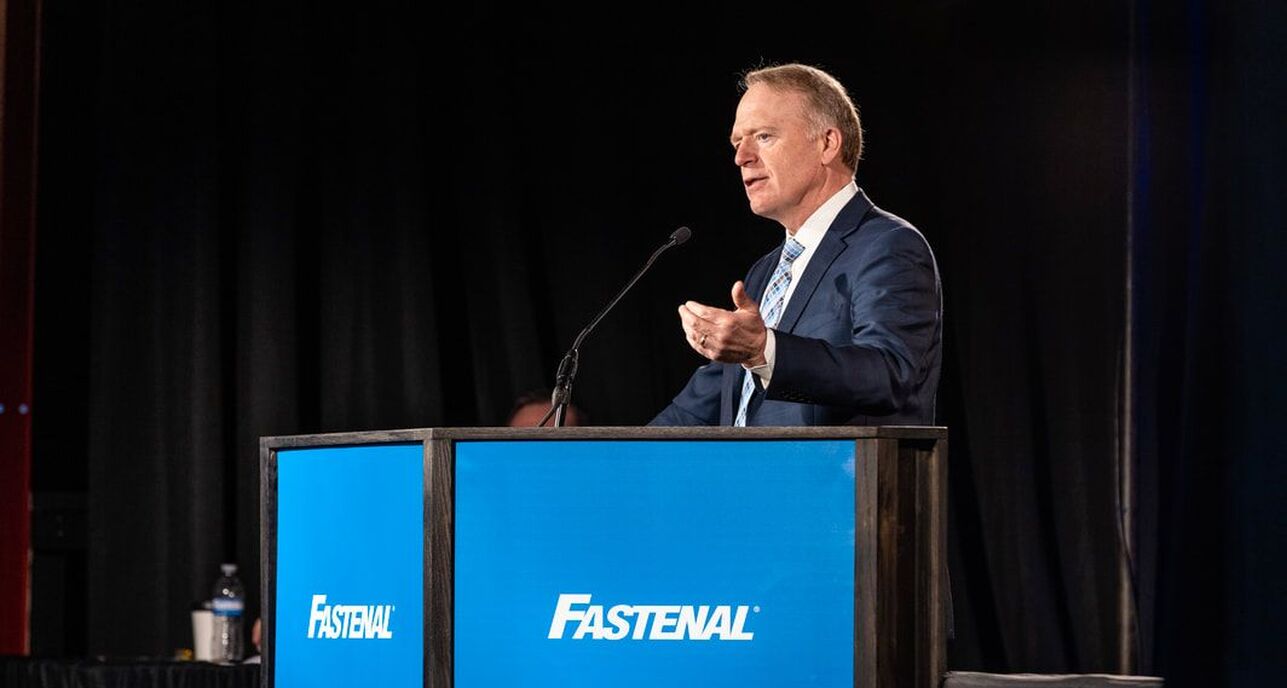
At Fastenal’s 2026 shareholder meeting, Daniel Florness had a problem worthy of executive attention: somebody had brought chocolate chip cookies, and he did not know which box contained them. His morning had already included missing truck keys and a low-fuel warning. Then his wife called to inquire about his suit. Did it have wrinkles? He suggested that his inability to see wrinkles might become an advantage when they were older. The farewell proceedings had found their level.
By April, the succession was already arranged. Jeff Watts would take over as chief executive on July 16. Florness, who had joined the industrial distributor as chief financial officer in June 1996, would leave the board and move into an advisory role. At the meeting, he dispensed with a conventional baton and made a hockey-themed handover to his Canadian successor. The accompanying joke was suitably economical: “the puck stops here.”
It was a fitting exit for an executive whose business was full of small objects with large consequences. A fastener is an unimpressive thing until you need one and cannot find it. Running a distributor means paying attention to that moment, then arranging the people, money and inventory so it happens less often. Florness spent much of his career bringing the decision closer to the person facing it.
The accountant who kept leaving his desk
His preparation began at the University of Wisconsin-River Falls, where he earned an accounting degree in 1986. Ten years at KPMG followed, including work in Minneapolis and New York. That career supplied a useful education in how companies behaved when someone examined their numbers. It also brought him into contact with Fastenal, a distributor headquartered in Winona, Minnesota.
The company puzzled him. As he later recalled, its preference for common sense could look unusual beside the bureaucratic habits he encountered elsewhere. He kept asking questions. Founder Bob Kierlin eventually offered him a job. There is something pleasing about an auditor becoming so interested in a client’s answers that he changes employers.
Florness joined as CFO in 1996. In 2002, he became executive vice president as well. Over time, his responsibilities spread into part of manufacturing, product development, procurement and the contract accounts business. Those assignments matter because they explain the operator beneath the financial title. He was learning where stock came from, how customers bought it and what happened when the arrangements failed.
A balance sheet records inventory as an asset. Out in a customer’s facility, the same inventory can be a cupboard nobody understands, money tied up in surplus parts, or a long walk away from the person who needs it. His career crossed those different views of the same object. The accounting remained useful; the additional responsibilities made it harder to mistake the accounting for the whole business.
He became president and CEO in January 2016, after nearly two decades inside Fastenal. The promotion put a familiar employee in charge of a company that was already reconsidering its operating model. He inherited Kierlin’s emphasis on local initiative and careful spending. Keeping those principles alive would require changing the physical shape of the business.
A smaller map, a closer relationship
Fastenal had built its reputation through local branches. Then it expanded a second way of serving customers: dedicated Onsite operations, often inside their facilities. To someone counting storefronts, consolidation might look like retreat. To a customer gaining a dedicated team, it could feel like the supplier had moved closer than ever.
Florness’s 2023 shareholder letter laid out the arithmetic. The United States and Canadian branch network had peaked at just over 2,600 locations in 2013. By the end of 2023, it stood at 1,441. Fastenal estimated that its access to the manufacturing market within a 30-minute drive had changed from about 95 percent to roughly 93.5 percent. Considerably fewer branches; a comparatively small change in geographic coverage.
There were practical complications. Some customers lacked room for an embedded operation, so a dedicated unit might work nearby or from the back of an existing branch. The model adapted to the available space. A clean organizational diagram is agreeable company, but it cannot manufacture spare square footage.
He explained the underlying attraction in terms of customer work. Time spent procuring, receiving and finding supplies is time unavailable for producing something. With local people observing repeated needs, Fastenal could put products near the point of use and replenish them through monitored bins or vending equipment. The cost of a part could then be considered alongside the labor required to obtain it.
For Florness, ease of use had a domestic benchmark: a toaster. The arrangement should work without elaborate instruction. He particularly enjoyed facility tours where the customer explained Fastenal’s system as confidently as its own employees. That was evidence of a solution people understood well enough to treat as theirs.
Fewer branches.
Still within reach.
within a 30-minute drive
The plain office has a purpose
His explanation of frugality starts with distance. Spending becomes harder to justify the further it sits from the customer. He pointed to his plain office when discussing the idea in 2023. The surroundings were consistent with a business that asked what each dollar did for the people buying its products.
That attitude had a lineage. Kierlin disliked debt, and Florness learned inside the financial discipline the founder established. The interesting question was where restraint made room for investment. Putting people and inventory at a customer’s site required commitment, even while the company consolidated its branch network.
His argument makes the office furnishings almost beside the point. A modest room is easy to imitate. Choosing which expenses genuinely help customers requires knowledge of the work. An inexpensive arrangement that wastes a customer’s time can be costly in ways a purchasing spreadsheet misses.
Nor did local responsibility mean waiting for perfect recruits. In a 2024 conversation, he described a company willing to hire inexperienced people and teach them. Fastenal’s internal university was part of that approach. Employees could accumulate experience within the business rather than arrive with every skill already polished.
The permission to make decisions came with permission to make recoverable mistakes. In his view, learning included acknowledging an error and fixing it. For customers, that placed a useful person within reach. For an employee, it turned responsibility into something more substantial than a word in a recruitment advertisement.
“We’re a supply chain company.”
Daniel Florness, 2024
When the numbers looked better than the organization felt
His public writing could be less comfortable than his conversational manner. In the letter accompanying the 2023 annual report, he described an organization that had become too focused on itself. Strong business conditions had made the problem less obvious in 2022. A weaker market later made it harder to overlook.
He included himself among the employees who could have benefited from rereading Kierlin’s book, The Power of Fastenal People. The prescribed course correction involved helping colleagues and returning attention to the customer. He acknowledged weak execution and discussed changing responsibilities. These were admissions from someone whose professional training might have made a tidy numerical explanation tempting.
The distinction matters in an industrial business. Revenue can move because customers are busier, because prices rise, or because a distributor earns more of the work. Managers still have to decide whether their own organization functions properly. Florness was prepared to say that favorable conditions and good execution had become too easy to confuse.
The company finished 2025 with $8.2005 billion in net sales, up 8.7 percent from 2024. Net income was $1.2584 billion. Those are company results, earned by a large workforce over time. They provide scale for his tenure without turning three decades of shared work into a single executive’s personal scorecard.
In his final full-year shareholder letter as CEO, he returned to developing leaders. His compact formulation brought together personal development, developing others, and three organizational duties: direction, alignment and commitment. Giving authority away required people who could use it, and an organization clear enough about where it wanted to go.
Full-year company results, before the July 2026 CEO handover.
Preparing a company to carry on
Watts became president in August 2024 while Florness remained CEO. The eventual handover therefore had a visible intermediate stage. Both men had joined Fastenal in 1996. Their shared history gave the transition a continuity that a new appointment alone could not supply.
The December 2025 succession announcement set out an advisory period expected to last until early 2028. It assigned that period a practical purpose: transferring knowledge and helping duties change hands. Florness praised Watts’s ability to develop talent and align people around a common goal. The qualities he wanted in a successor echoed the work he had been asking leaders throughout Fastenal to do.
His next chapter also includes other boardrooms. He joined H.B. Fuller’s board in 2018, bringing financial and operating experience to an industrial adhesives company. Waste Connections appointed him to its board effective April 1, 2026. The businesses differ, but both give him places to apply experience accumulated far beyond the finance department.
There is an appealing consistency in the arc. The CFO took on responsibilities outside accounting. The CEO asked local employees to make decisions. The departing leader prepared another longtime employee to take charge. Across those changes, the recurring task was helping someone else handle more of the business.
At the shareholder meeting, the hockey joke let Florness perform one more version of that task in public. Responsibility would have a new address. The advisory work could continue, the board seats could occupy him, and the company could get on with serving customers. Somewhere in the room, there were still cookies to locate.
Continue the conversation
Read, listen and watch: