In 2004, Russell Becker helped Michigan Tech buy a hockey treadmill. Of all the things a future corporate biography might preserve, this is a pleasingly practical one. His old team needed equipment; he helped provide it. Somewhere beneath the language of shareholder returns and leadership development sits a machine on which a player can work very hard while going nowhere.
Becker had played defense for the Huskies from 1984 to 1988. He appeared in 83 games, stayed with the program as a graduate assistant coach and completed his education in civil engineering. In 2010, Michigan Tech inducted him into its Sports Hall of Fame. The university remembered his playing career, his continuing involvement and another pledge for arena improvements in 2009.
The gift offers a useful opening into his life because it concerns preparation. A treadmill supplies no winning goal. It makes room for the repetitive work that might help produce one. Becker’s public career keeps circling that territory: the work people do before they are asked to carry more responsibility, and the institutions that give them a chance to learn.
A working education
His route began in northern Minnesota. Becker grew up in Virginia, on the Iron Range, and went to Michigan Technological University, where he earned his bachelor’s degree in 1989 and master’s in 1991. Both were in civil engineering. The combination of sport and engineering gave his university years two distinct forms of discipline: coordinating with other players and learning how physical things are designed to work.
His first professional job was as a field engineer with Cherne Contracting. He then became a project manager at Ryan Companies, working on the Greenfield Recycled Paper Mill project for Liberty Paper. After that assignment, he joined The Jamar Company in Duluth, part of the APi family. These were jobs with sites, schedules and customers attached. His early career took place close to the work the business was selling.
He arrived at Jamar in 1995 as manager of construction and became its president in 1998. Four years later, he moved to the group as president. In 2004, he became CEO. The sequence matters. Before he was responsible for the collection of companies, he had run one of them. The distance between the central office and an operating business was a distance he had already travelled.
- 1995Joins Jamar as manager of construction
- 1998Becomes Jamar president
- 2002Becomes APi Group president
- 2004Becomes APi Group CEO
Who gets to be a leader?
At APi, Becker has made a broad definition of leadership part of the company’s identity. Its stated purpose, Building Great Leaders, comes with the belief that everyone should have an opportunity to develop. The formulation extends a word often reserved for the people whose names appear in annual reports to the people who turn up at customer sites.
That distinction has practical consequences. A technician, a crew supervisor and a company president have different authority. Each can influence whether a job is done well, whether a colleague learns something and whether a problem is raised early. A development program that reaches only the office leaves a considerable part of a service business outside the conversation.
“Everyone has an opportunity to be a leader, to be proactive and have their voice heard.”
Russell Becker
APi’s history gives the idea a chronology. A Leader Development Rotational Program began in 2003. The first Leader Lab for senior leaders followed in 2004. A veterans rotational program was established in 2008. These are specific arrangements for moving people through experiences, rather than hoping that readiness will arrive conveniently when a position opens.
In a July 2025 podcast conversation, Becker returned to the need for leaders to develop other leaders and to remain willing to change. There is a modest demand hidden inside that argument. Experience gives someone reasons to trust their judgment; it can also give them reasons to stop listening. A company that keeps expanding needs experienced people who can still learn.
His message in APi’s business conduct code adds accountability to the picture. Leadership entails obligations to customers, colleagues and the company. People are expected to follow the code and raise concerns about violations. Development and standards belong together here. Giving someone more responsibility also means being clear about what they owe the people around them.
The business of coming back
APi’s work includes fire and life safety, electronic security, elevators and escalators, and infrastructure services. Much of that work is most welcome when it attracts little attention. A system functions. An inspection happens. A fault is repaired. There is limited theatre in successful maintenance, which may explain why it rarely wins a place in the business pages beside a dramatic acquisition.
For Becker, however, the return visit is part of the commercial logic. APi’s history records a goal, established in 2007, of generating more than half its revenue from service. It adopted an Inspection First approach in 2018. Those milestones describe a business interested in the continuing obligations around installed systems, beyond the day something is built.
An editorial illustration of ongoing service work. Steps and timing vary by system and contract.
The human requirement follows naturally. Customers encounter the business through the person who arrives to do the work. Repeated service depends on technical competence, reliable scheduling and the ability to explain what needs attention. Becker’s emphasis on developing people fits those demands. It is an operating proposition whose quality customers can test at close range.
In his 2024 shareholder letter, he described caring for and investing in teammates as a competitive advantage. That is a claim about how a business works, and it deserves to be read as one. The test lies in whether people receive useful preparation and support, and whether the organization can keep meeting its commitments as it grows.
A larger rink
In October 2019, J2 Acquisition Limited completed its purchase of APi Group for approximately $2.9 billion and took the APi Group Corporation name. Becker continued as CEO. The transaction brought new ownership and a public-company chapter to an organization he had already been leading for years. Martin Franklin and James Lillie became important partners in that next phase.
The co-chairs’ 2019 shareholder letter described being drawn to the management team, company culture and prospects for service-related recurring revenue. For Becker, continuity in the job came with a different setting for explaining it. Public ownership puts strategy on a calendar: results, guidance, questions and another set of results. A philosophy about people has to coexist with that arithmetic.
Then came Chubb Fire & Security. APi completed the acquisition from Carrier on January 3, 2022, at an announced enterprise value of $3.1 billion. The business brought approximately 13,000 employees and a sales and service network spanning 17 countries. It also brought an extensive base of customer sites across Asia Pacific, Canada and Europe.
Chubb’s sales and service footprint at the January 2022 acquisition. A substantial expansion of the places where APi’s leadership approach would have to work.
The scale made integration a daily management assignment. A shared purpose can be announced immediately; common habits require people to understand one another’s work. In the acquisition announcement, Becker emphasized the incoming leadership team and its employee and customer focus. The transaction expanded the organization through which his ideas about development would need to travel.
By the second quarter of 2026, APi reported quarterly revenue of $2.254 billion. It raised full-year revenue guidance to a range of $8.875 billion to $9.025 billion. Those were forecasts for the full year, rather than completed annual results. They give a dated measure of the company’s scale without turning an expectation into an accomplishment.
Back to the places that teach
Alongside the corporate milestones, Becker kept connections with education and hockey. A 2015 account of his Dunwoody College trusteeship described someone interested in the combination of practical knowledge and effort that students brought to employers. He linked his support to the construction industry’s need for talent. Technical education was part of the workforce he knew.
He had joined Dunwoody’s board in 2007, chaired its Advancement Committee and participated in its 2014 Centennial Gala Committee. Both Becker and APi supported the college. That record makes his interest more concrete than a passing endorsement of skilled trades. It put him in an institution concerned with how people acquire the knowledge employers expect them to possess.
The same 2015 portrait placed him behind a hockey bench: assistant coach for Mahtomedi’s varsity team and a coach in its youth association. All three sons played. There is something reassuringly ordinary about this entry in an executive biography. The title may change during the day; a practice still requires someone to show up.
He has also appeared in settings beyond his own industry. In 2023, he moderated a conversation with Minneapolis Federal Reserve President Neel Kashkari at APi’s Global Controllers Conference. The setting connected the company’s financial staff with a wider economic discussion, with Becker in the role of asking questions.
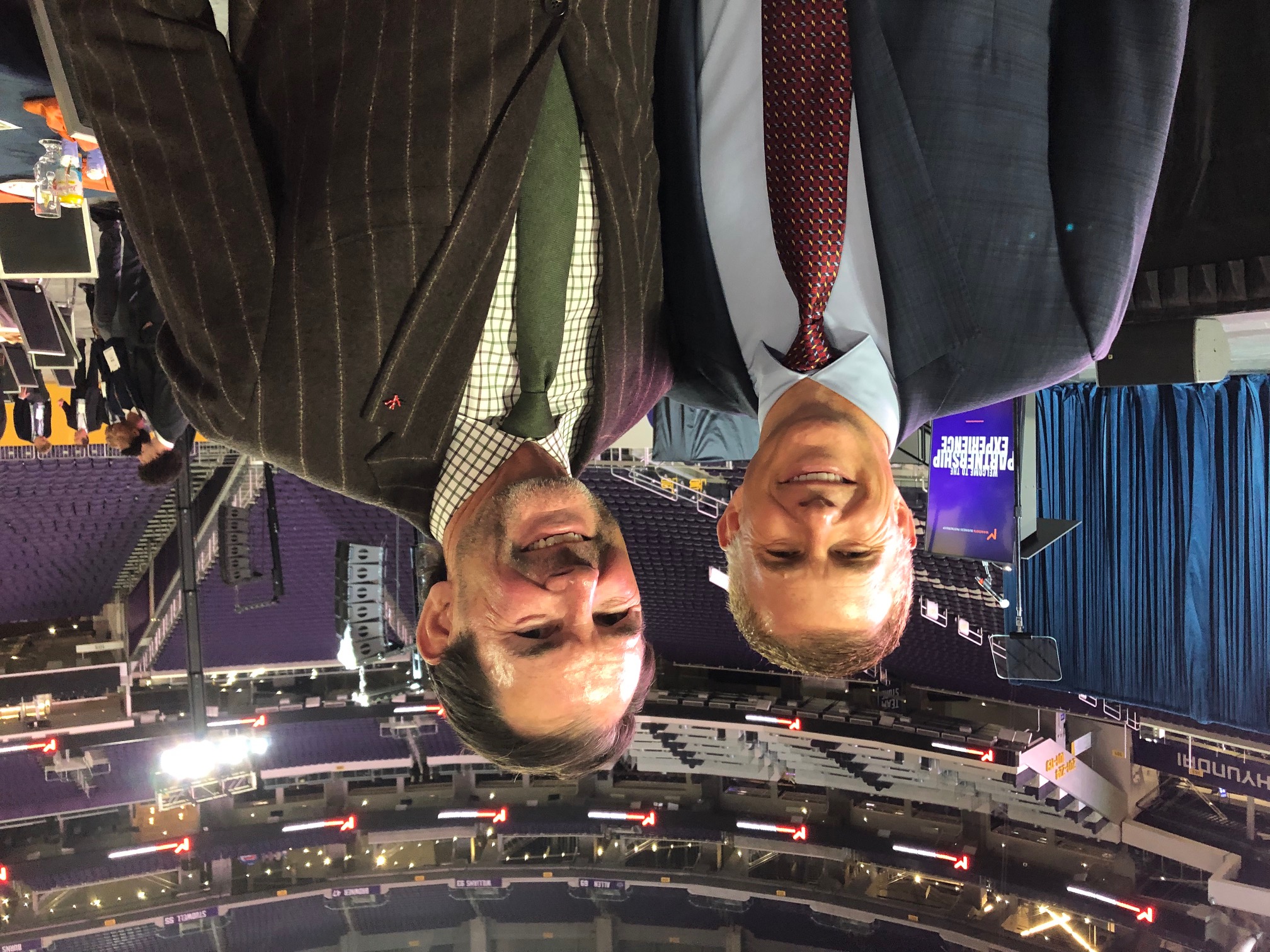
The next shift is in Minnesota
In September 2026, Becker was selected to become chair of the Minnesota Business Partnership the following January. The appointment adds a civic responsibility to his company role. At the gathering where it was announced, he acknowledged his limited appetite for the microphone: “But this is not my jam.” A short speech can be a small public service of its own.
The coming assignment brings the story back to Minnesota, where his career moved from the Iron Range to construction work, operating-company leadership and APi’s headquarters in New Brighton. It also leaves the central question open in a useful way. When a leader moves to another responsibility, who has been prepared to carry the work forward? Becker’s career gives that question a long history, from a graduate assistant’s place beside the rink to the next person waiting for a turn.
Continue the conversation
- APi Group
- Russell Becker on LinkedIn
- Russell Becker on X
- Michigan Tech engineering profile
- Michigan Tech hockey Hall of Fame
- The January 2027 civic appointment
- Building Great Leaders: 2020 conversation
- Building Great Leaders: 2025 conversation
- Watch: Becker with Neel Kashkari
- Chubb acquisition announcement
- Second-quarter 2026 results
- Dunwoody: Spring 2015
- APi leadership development
- APi 2024 annual report
- J2 acquisition announcement
- APi code of conduct