In 1993, Doug Shulman was running a New York operation with a $2.5 million annual budget and a surprisingly practical problem: refrigeration. He was 25, executive director of SHARE-NY, a food cooperative that connected grocery purchases with community service. Expanding the operation meant replacing refrigerated trailers with permanent cold storage. Before there were loan portfolios and tax databases, there was the question of where to put the food.
The arrangement depended on participation. Members bought food through local groups and contributed service in their communities. Shulman had already helped launch Teach for America. Here was another attempt to make an organization deliver something useful while bringing people into a shared undertaking.
It is an unusually earthy opening for a financial executive's biography. Corporate careers tend to acquire a retrospective air of inevitability, as though every internship were a rehearsal for the corner office. Shulman's early work offers a different starting point: an institution had a purpose, a budget and some awkward physical constraints. Someone had to make those things agree.
More than three decades later, he chairs OneMain Financial and serves as its chief executive. Between those jobs sit a securities regulator, the Internal Revenue Service and a global bank. The connection is a question rather than an industry: what happens when an institution's promises reach the person trying to use it?
“What we're really about is building community.”
Doug Shulman · SHARE-NY · 1993
A price people could actually see
Shulman grew up in Oakwood, Ohio, and graduated from Oakwood High School in 1985. He earned a bachelor's degree at Williams College, a master's in public administration at Harvard's Kennedy School and a law degree, magna cum laude, at Georgetown. His working life moved through consulting, investment and entrepreneurship. The resulting résumé requires a little more room than the usual business-card narrative.
At NASD, which he joined in 2000, he worked on the machinery behind financial markets. His responsibilities included technology and corporate development; he eventually became vice chairman. He helped lead the divestitures of Nasdaq and the American Stock Exchange and worked on corporate-bond transparency.
One important piece was TRACE, the Trade Reporting and Compliance Engine. Introduced in July 2002, it made corporate-bond transaction information available through a reporting system. In a market where securities did not all trade on a central exchange, access to prices mattered. A buyer could know more about what other buyers had paid.
There is a useful distinction here between creating a financial product and changing the conditions under which people encounter it. Shulman's work frequently occupied the second territory. Databases, reporting requirements and operating procedures rarely produce an exciting photograph. They can still determine who gets useful information and who must negotiate in the dark.
- 2000NASDMarkets & regulation
- 2008IRSPublic administration
- 2014BNY MellonClient service delivery
- 2018OneMainConsumer lending
Washington, with the clock running
On March 24, 2008, Shulman became the 47th commissioner of Internal Revenue. George W. Bush had nominated him; he continued serving under Barack Obama. Within months, the financial crisis turned an already complicated administrative job into a delivery problem with a running clock.
The IRS had its regular responsibilities and a growing collection of economic-relief provisions to administer. In a 2010 interview, Shulman described the need for time to prepare, workable policy and enough people and funding to carry it out. The observation lacked the glamour of a sweeping Washington declaration. It also described the ingredients without which sweeping declarations tend to remain declarations.
He pursued offshore tax compliance, including a voluntary-disclosure initiative that brought in roughly 14,700 disclosures in its 2009 round. His interests also extended to the less theatrical business of improving the agency's information systems and its dealings with taxpayers. Enforcement and service were both parts of the job; each depended on what the organization knew and how quickly it could act.
At Johns Hopkins in 2011, he described the agency as a financial-services institution with 100,000 employees. That description brought a government bureaucracy into the language of operations. He talked about data, technology and staff, alongside the consequences for the public. He also found room for a joke about a tax code resembling War and Peace in the original Russian. Tax administration has a limited comedy circuit; one takes the available material.
The trouble with asking twice
A White House briefing in June 2009 supplies a particularly clear example of the work. Shulman appeared with Education Secretary Arne Duncan to discuss simplifying the federal student-aid application. Families faced an elaborate financial questionnaire while the government already held some of the information they were being asked to supply.
The proposed cooperation between the Education Department and the IRS would let applicants use tax information to reduce that burden. To a family, the relevant outcome was an easier route through the application. The organizational boundary between departments was somebody else's administrative problem.
Duncan praised the IRS team's speed and credited Shulman's leadership. The moment connected two stretches of his career: the early education work and the later responsibility for a national financial institution. It also showed how much of public service can lie in getting two large organizations to exchange the right information.
The lesson is narrower, and more useful, than a declaration that technology fixes bureaucracy. A form can be digitized and remain exasperating. A process improves when somebody removes a task, clarifies an instruction or makes existing information usable. Shulman's work on student aid offers an example of that distinction. The point of connecting databases was to spare families another round of entering numbers.
“Efficiency and fairness must be our underlying equilibrium.”
Doug Shulman · remarks at Johns Hopkins · 2011
The institution answers back
A career in large institutions also brings responsibility for what goes wrong inside them. Shulman finished his IRS term in November 2012. In May 2013, he returned to Congress as a former commissioner during hearings into the agency's handling of applications for tax-exempt status.
The controversy concerned inappropriate criteria used to select applications for additional scrutiny, including those of conservative groups. Shulman denied personal responsibility for making the list and expressed regret that the conduct had occurred during his tenure. Lawmakers questioned what he knew and the assurances he had previously given.
That episode belongs beside the modernization work. A leader can set priorities and still face questions about practices elsewhere in the organization. The distance between the executive's view and the customer's encounter is precisely where oversight matters. A better database cannot, by itself, settle questions of fairness or accountability.
The same tension surfaced during his time at OneMain. In May 2023, the Consumer Financial Protection Bureau ordered the lender to provide $10 million in consumer redress and pay a $10 million penalty. Its findings concerned optional add-on products, misleading sales practices and interest that had not been refunded after cancellations.
OneMain disagreed with the bureau's conclusions while agreeing to the settlement. It said it would extend the full-refund period for optional products from 30 to 60 days and change refund handling. The case concerned the company; it was not a finding against Shulman personally. For a business promising responsible access to credit, however, the details of a sale and a cancellation are central tests of the promise.
A lender with more than one door
After the IRS, Shulman advised McKinsey and then worked at BNY Mellon from 2014 to 2018, serving as senior executive vice president and global head of client service delivery. In September 2018, he became OneMain's president and CEO. He added the chairmanship in December 2020.
OneMain's focus is nonprime consumers, people whose credit profiles can limit their borrowing options. Shulman inherited an established personal-lending business with a substantial branch network. The strategic question became how to extend what the company knew about those customers into other products and ways of doing business.
A 2019 strategic review helped steer the company toward credit cards and auto finance. By its December 2023 investor day, OneMain was presenting a broader business built around new products, channels and digital capabilities. Shulman described the company's aim as helping customers meet immediate needs while planning ahead. That aspiration has to coexist with underwriting, repayment and the cost of providing credit.
The company completed its acquisition of Foursight Capital on April 1, 2024. Foursight brought an auto-finance operation that purchased and serviced retail installment contracts through dealers. The acquisition added a different setting for meeting a borrower: the point at which someone buys a car.
A personal loan, a card purchase and a car loan happen at different moments in a household's life. Bringing them under one company creates opportunities for repeat relationships. It also increases the number of places where execution can disappoint. The strategic diagram may have three neat boxes. The customer experiences a payment date, an application or a conversation.
The branch survives the software
Shulman's account of technology has left room for a human being at a desk. During OneMain's July 2020 earnings discussion, he described remote loan closings that still involved income verification, a budgeting exercise and conversations with employees. Customers could upload documents and use video-assisted interactions. The channel changed; the lending process still required work.
That approach continues in his more recent explanations of the business. In May 2026, he described investment in automation that could put vehicle information into employees' hands and reduce routine tasks. His stated purpose was to give branch staff more time for customers. The branch remained part of the model alongside telephone and digital service.
It is a practical position for an executive whose career has repeatedly involved information systems. Software can move a document quickly. A member of staff can help someone understand what the document means. Whether the combination works depends on the actual experience, including the moments when a borrower has a question or a payment becomes difficult.
The next person in line
Education has remained in the picture. Shulman joined the Carnegie Foundation for the Advancement of Teaching's board in January 2023. He said he wanted to support improved educational outcomes and address persistent inequities. The appointment returned him to a field he had entered near the beginning of his career.
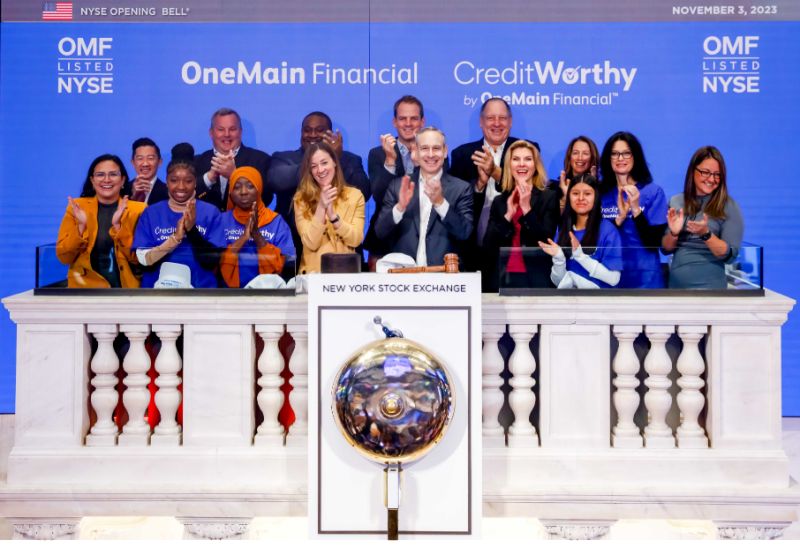
Later that year, he joined scholarship winners from OneMain's Credit Worthy financial-education program to ring the New York Stock Exchange's opening bell. It was an apt meeting of his worlds: students on a platform built for capital markets, with a consumer lender marking its listing anniversary. For once, the institutional machinery came with a bell.
The present business remains measurable. For the second quarter of 2026, OneMain reported $26.9 billion in managed receivables and $152 million in net income, compared with $167 million a year earlier. Shulman emphasized underwriting, innovation and execution. The figures show both scale and the ordinary resistance of running a lender: a larger operation does not make every result rise.
Read across the career, the recurring work becomes recognizable. Make information available. Get organizations to cooperate. Give employees usable tools. Check whether the customer receives what the institution says it offers. His jobs have changed; the practical questions have proved portable.
The young cooperative director had to make a community project function. The chairman faces the same kind of demand at a different scale, with shareholders, regulators and borrowers all entitled to examine the result. Somewhere beyond the strategy presentation, another person is waiting for the process to work.
Keep reading. Keep watching.
- OneMain leadership biography
- Doug Shulman on LinkedIn
- Watch: NYSE Floor Talk with Doug Shulman
- Watch: 2026 Milken consumer-credit panel
- The 2010 interview on tax administration
- The 2009 student-aid briefing
- The CFPB’s 2023 action
- OneMain’s response to the settlement
- Second-quarter 2026 results
- OneMain on Instagram
- OneMain on X
- OneMain on Facebook