Friends thought Web Sun and Arif Nathoo would get along. They introduced them. In 2014, the two founded Komodo Health. Twelve years later, Sun became co-CEO alongside Nathoo. It is a pleasingly modest beginning for a relationship that would eventually require an executive leadership announcement: some people knew two other people and thought they should talk.
Introductions happen constantly in business. Most produce a pleasant conversation and a new contact. This one acquired employees, investors, customers, and a vocabulary involving dragons. It also survived the less entertaining consequences of starting a company: the work of expansion, the pressure of raising money, and decisions that affected people’s jobs.
Sun’s public story is threaded through that partnership. His responsibilities have included operations, business development, sales, marketing, and people. These are the parts of company building that bring a founder into contact with other people’s expectations every day. A product needs customers. A growing organization needs colleagues who can work together. Someone has to keep both conversations going.
An apprenticeship in other people’s organizations
Before Komodo, Sun spent nearly eight years as a vice president at Campbell Alliance. His work included corporate development, brand management, marketing, and commercial effectiveness. He later became a managing director at Zephyr Health, overseeing its non-engineering functions. Both roles put him close to the practical machinery of an enterprise: decisions, budgets, clients, and the distance between a proposal and its execution.
His education had already covered considerable ground. At Rutgers, he studied molecular biology and biochemistry, biological sciences, and psychology. At New York University’s Stern School of Business, he earned an MBA covering marketing and finance, and international business. The sequence took him from scientific disciplines to the study of how organizations make and spend money.
Consulting offers a particular vantage point on a company. You see the questions its leaders will pay to answer. You also see the meetings, handoffs, and repeated work required to get there. Sun and Nathoo’s founding idea grew out of their experience with cumbersome enterprise analytics workflows. Building software around those workflows meant taking responsibility for something clients would keep using after the presentation ended.
In a 2024 reflection on the company’s beginnings, Sun returned to collaboration and shortening the time required to reach an insight. The emphasis is revealing. He talks about the way work moves through a business. The opportunity he saw involved giving teams a shared technology experience, with fewer obstacles between a question and a useful answer.

The dragons get a room
By early 2020, the company had enough people for an introduction to become a logistical undertaking. Komodo brought 226 employees from around the country to Las Vegas for its annual company week. Employees were called dragons. A growing business had acquired both a headcount and a species.
The gathering mixed working sessions with an internal version of Shark Tank. Colleagues proposed ways to improve the organization. There were departmental dinners and karaoke, with party hats and feather boas. People could finally attach faces to names they knew from Slack. For a company spread across locations, the ordinary act of meeting had become an event worth organizing.
“You are part of the team - no matter where you are.”
Web Sun, Komodo Week, 2020
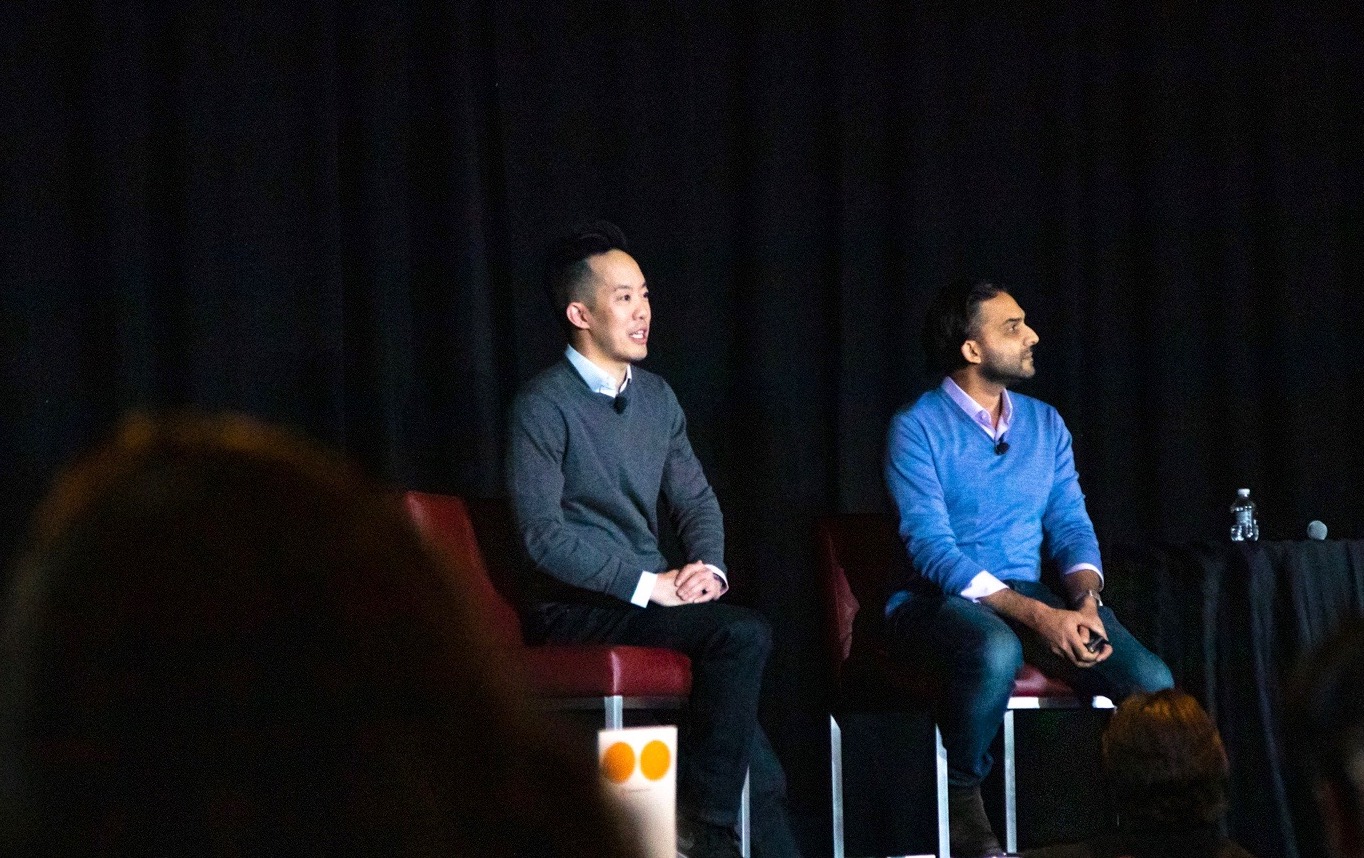
Sun’s message was about membership across distance. It is a simple sentiment with a substantial operating question underneath it: how do people in different places experience the same company? His later First Builders conversation would return to building across two coasts and two talent pools, and to the changes required as a team grows from a few dozen people into hundreds.
A nickname makes belonging easier to express. The rest takes work. The Las Vegas gathering included questions for the leadership team and sessions about different functions inside the business. That combination matters: a shared identity has more substance when people can understand what colleagues do and put questions to the people making decisions.
The money, and the responsibilities attached
In January 2021, Komodo announced its acquisition of cloud software company Mavens, alongside news of a $44 million Series D. Mavens brought operations in the United States, the United Kingdom, and India. A partnership begun by two founders was becoming an organization with a wider geographic footprint and more software to bring together.
In March came a $220 million Series E led by Tiger Global Management, with Casdin Capital and existing investors participating. The round put Komodo’s valuation at $3.3 billion at the time. That was a company valuation, a price attached to an investment round. The work Sun described afterward was concrete: expanding technology, developing applications, and hiring across functions.
Investment led by Tiger Global Management, with Casdin Capital and existing investors participating.
There is an interesting tension in the company’s financial story. An investor had described Komodo as an “anti-unicorn,” praising the founders’ attention to customers and capital efficiency. Earlier rounds had passed without public announcements. By 2021, the company had a valuation that inevitably attracted attention. Quiet building and conspicuous numbers had arrived in the same room.
The numbers did not make the business exempt from difficult decisions. In December 2022, Komodo announced a restructuring that reduced its staff by 9 percent. Sun and Nathoo described an uncertain market and a need to operate efficiently. The change belongs beside the funding milestones. Growth produces responsibilities to employees; a contraction makes the consequences of those responsibilities painfully visible.
Sun discussed fundraising and layoffs in a 2023 founder interview. Those subjects complicate the tidy version of an entrepreneurial life. Raising money, hiring people, and later reducing staff are connected decisions within the history of the same organization. A profile that stops at the investment round leaves the people carrying out the plan stranded outside the frame.
- 2014Sun and Nathoo co-found Komodo.
- 2020226 employees gather in Las Vegas.
- 2021A $220 million Series E follows the Mavens acquisition.
- 2026Sun becomes co-CEO alongside Nathoo.
A different question for the AI age
By 2025, the founders were introducing Marmot, Komodo’s AI analytics platform. Its launch emphasized the ability to inspect generated code and reproduce results. These are product choices with organizational consequences. A team asked to use an answer in its work also needs a way to examine how that answer was produced.
Sun has since criticized what he calls “pilot purgatory”: organizations running experiments without a clear view of the operating change they want. His concern is that proving a technology works can become an activity in its own right. A demonstration can finish successfully while leaving the business no closer to deciding how people will use it.
That argument fits his commercial background. A consultant’s assignment and an enterprise software purchase both begin with someone authorizing an expenditure. The value eventually depends on what happens afterward. Sun’s question puts attention on the customer’s organization: its goals, working habits, and willingness to change a process. The demonstration earns its place by helping with that work.
There are other people involved in getting from product to customer. Komodo’s partnership with Databricks received an industry partner award in 2025. The same year, Sun welcomed marketing executive Mark Jewett, whose background included Microsoft, Tableau, and Informatica. As Komodo’s technology changed, the company was also adding relationships and experience around it.
Sharing the title, changing the job
On June 16, 2026, Komodo announced Sun’s move to co-CEO and Miles Ennis’s appointment as president. Ennis had joined as chief revenue officer in July 2024 and become chief operating officer in September 2025. His new remit included commercial execution, operations, product strategy alignment, and marketing.
Sun praised Ennis’s ability to connect strategy, product innovation, customer needs, and execution. The sequence describes a founder’s recurring challenge rather neatly. An idea has to pass through each of those stages, with people responsible for the passage between them. The new structure put another experienced executive in charge of much of that coordination.
The co-CEO title also gives a formal shape to a partnership that had already lasted twelve years. Nathoo’s responsibilities center on data science, engineering, and product development. Sun brings the commercial and operating experience. Their shared history sits within a larger leadership team now. The friends who made the introduction could hardly have supplied an organization chart with it.
A second set of teammates
Outside the company, Sun has described a different responsibility. In a June 2024 conversation, he said he had three children and coached his six-year-old’s basketball team. After a hard working week, time with his family helped him return with renewed energy. The detail gives a scale to a life otherwise measured in funding rounds and executive appointments.
He has also advised startups, including Reify Health and Heads Up Health. The work extends his connections beyond the organization he founded. Public recommendations from colleagues describe someone willing to teach and invest in other people’s development. That is a useful description of a founder whose responsibilities have so often involved bringing people into the work.
The basketball court offers a rather different audience for an executive. Children have their own priorities. A co-CEO title is unlikely to settle possession of the ball. Sun’s account gives family life a practical place in his story: there is work he cares about waiting outside the company, with teammates who know him in another role.
Continue the conversation
- Web Sun on LinkedIn
- Komodo’s leadership team
- Listen: a decade of company building, First Builders
- Read: Sun on founding, learning, and family
- The June 2026 leadership announcement
- The 2021 Series E announcement
- The December 2022 restructuring
- Watch: Sun in conversation with NYSE
- Explore Komodo’s YouTube channel