A clean hospital bed is an achievement that rarely gets a round of applause. Someone has changed the linen, washed the patient, checked the skin and dealt with the stool. Then, perhaps, someone has done it again. For a bedridden patient with fecal incontinence, this ordinary sequence can become a demanding part of care. Consure Medical built its business around what happens before the next change of sheets.
- The task: divert stool away from vulnerable skin.
- The products: Qora SMK and powered Qoramatic.
- The business lesson: the nurse’s daily routine belongs in the design.
The attraction is easy to understand. Stool management sits where infection control, wound care and nursing workload meet. A collection device is a physical object; the problem surrounding it is a procession of tasks. A hospital can count the bags it buys far more easily than the attention consumed by changing, cleaning and checking.
A problem that travelled
Nishith Chasmawala and Amit Sharma met through the 2008 Stanford-India Biodesign fellowship. They brought medical device experience to a program built around observing clinical needs. A Stanford case study describes their interest in families caring for relatives at home in India, where fecal incontinence posed an intimate, persistent difficulty.
The original ambition required an awkward balance. The device had to manage stool effectively and be simple enough for a family caregiver. It also needed credible testing. Consure enlisted clinical advisers, including specialists at the All India Institute of Medical Sciences, and planned a phased evaluation. Hospitals offered an environment where the team could study patients with safeguards and controls.
There is a useful discipline here: begin with the work someone has to perform, then decide what to build. Incontinence supplies already existed. The founders were asking whether a different method of diversion could improve the experience of using them. That is a more demanding question than whether another bag will fit on a shelf.

The balloon leaves the picture
Qora SMK uses a pliable, self-expanding diverter placed through a hygienic applicator. Stool travels through a sheath into an external collection bag. The original FDA description explains that the diverter can collapse and expand with surrounding anatomy. A balloon does not hold it in place. The original system received US 510(k) clearance in 2014; documents for Qora line extensions followed in 2016.
Qora also provides access for stool sampling and fluid delivery. The company markets it for patients whose care calls for manual intervention and flexibility. Its position in the market is specific: an alternative to absorbent products, rectal tubes and balloon-retained systems for eligible bedridden patients.
Qoramatic adds a powered hub that coordinates irrigation and suction. A soft receptacle connects to tubing and a drainage bag. Scheduled flushing is intended to keep the pathway clear while suction moves stool away. The bag accommodates irrigation fluid as well as collected output. It is a modest-looking assembly with a substantial assignment.
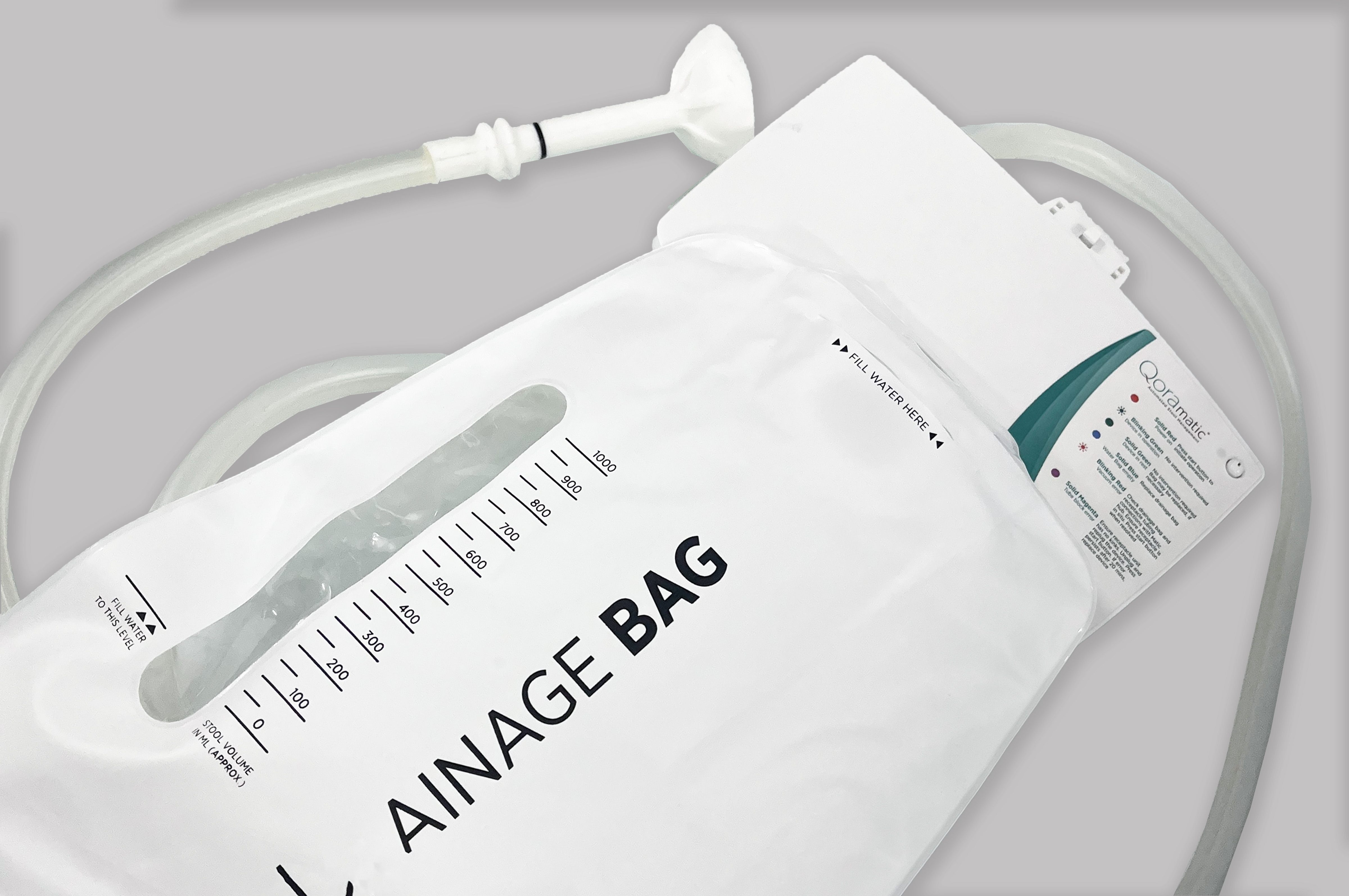
- 01Soft receptacle
- 02Transit tube
- 03Powered hub
- 04Drainage bag
Automation still involves care. Qoramatic’s instructions require periodic checks of its indicator and assessment of the drainage bag every four to eight hours. They also describe leakage and obstruction as possibilities. Those details belong in any purchasing conversation. A device’s everyday maintenance is part of its performance.
The redesign had to fit the shift
Chasmawala has described an early adoption obstacle: nurses needed too much education to use the first-generation product effectively. Consure responded by borrowing familiar forms from equipment they already handled. In his account, “the form factors reflect what nurses are used to.” The lesson applies well beyond hospitals. Familiarity can be an engineering asset.
A device’s everyday maintenance is part of its performance.
The adoption question
The company’s public team spans design, quality, regulatory work, operations and sales. Its account of development gives nurse collaborators a prominent role. This is the expertise the business needs: translating a clinical idea into something that can be manufactured, evaluated, taught and supplied repeatedly.
The hospital buys a calculation
Consure sells medical devices and associated consumables to institutions. The buying process extends beyond a clinician liking the demonstration. The School of International Biodesign lists contracts with purchasing groups Vizient, Premier and HPG, plus distribution relationships with Medline, Cardinal Health and Owens & Minor. Its figure of more than 5,000 accessible US hospitals describes a route to buyers, rather than installations.
The financial wager is that better diversion can justify its supply cost through less repetitive work and fewer complications. Consure advertises nursing savings of up to 174 minutes daily. That is a company claim, not a time allowance every ward can bank. The useful comparison is a local evaluation of staff time, consumables, leakage and patient outcomes.
Consure’s advertised maximum nursing-time saving. Actual benefit depends on the care setting and comparator.
Investors have financed the attempt. VCCircle reported $750,000 of early backing in 2012, a $4.70 million Series B in November 2015 and approximately $481,225 of further funding in April 2020. Accel independently dates its first investment to 2015. These are financing figures, not the price of a device or the total cost of its development.
Twenty patients, then the next question
A December 2017 publication evaluated the system in an uncontrolled pilot involving 20 patients at a Tucson hospital. It also considered company-provided bench tests. The report suggested lower pressure and forces on rectal tissue than balloon-based comparators. It offers a clinical foothold; its small, uncontrolled design limits broad conclusions about comparative outcomes.
Eligibility matters just as much. Qoramatic is intended for liquid or semi-formed stool in bedridden adults, with uninterrupted use capped at 29 days. Its instructions exclude conditions including recent rectal surgery, gastrointestinal bleeding and suspected impaction. A non-balloon design still carries rectal-device risks.
For another inventor, the transferable habit is to observe the whole job: setup, maintenance, training and procurement. For a hospital, the practical next step is a clinical evaluation with an agreed comparator and measures. Consure’s proposition becomes persuasive when a ward can show what changed between one clean bed and the next.
Follow the work
Explore the devices, watch them explained, or follow the company’s updates.