Three months into his first job, Matt Stava got a call from Milwaukee. On the other end was an Andersen Consulting partner whose professional territory included Budweiser, Coors and Heineken. Stava remembers him as the “beer partner”. There are less inviting introductions to the working world.
The call led to work at Anheuser-Busch and, while he was still young, conversations with chief information officers and senior executives. He helped sell projects, then helped get them running. Responsibility arrived before a long apprenticeship could make it feel routine. That early exposure became a career highlight he would still talk about years later.
Today Stava is founder, chief executive and chairman of Spinnaker Support, a business built around giving enterprises more choice in maintaining their software. In April 2026, he and his wife, Kelly, pledged $2.5 million toward an entrepreneurship hub at the University of Kansas. Put those episodes beside one another and an appealing pattern emerges: someone opened a door for him; he has found several ways to prop doors open for other people.
A supply chain education
Stava graduated from Kansas in 1994. His degree was in business administration and finance, and his early professional work concerned supply chains: the arrangements that let materials, information and finished goods get where they belong. At Andersen Consulting, now Accenture, he worked on their architecture and restructuring. It was a practical education in how a large business actually moves.
He later joined Solutions Consulting to establish and lead its supply chain practice. The firm was subsequently acquired by Perot Systems. In 2002, he co-founded Spinnaker Management Group, which developed from a supply chain consulting business into a holding company with multiple practices. His route into entrepreneurship ran through clients’ operations, with all their dependencies and inherited decisions.
That background helps explain the kind of technology question he would make a business of asking. A system can be unfashionable and still perform useful work. Replacing it takes money, attention and coordination. Anyone who has reorganized a supply chain knows that changing one component has a habit of introducing itself to every other component.
The useful life of an unfashionable system
Spinnaker Support began in 2008 around JD Edwards software maintenance. Its origins were specific: after SAP disbanded TomorrowNow, Spinnaker Management Group acquired JD Edwards maintenance assets formerly associated with that business. Stava later described taking time to understand the legal boundaries and build support processes before launching. Respect for software owners’ intellectual property became part of the proposition.
He was entering a market in which customers wanted alternatives to the original vendor’s maintenance contract. Some wanted to migrate. Others were content with the software they had, including systems customized over years. For those customers, another upgrade could look less like progress than a large meeting they would prefer someone else to attend.
The early expansion was tangible. In March 2012, Spinnaker acquired customer contracts from Versytec, a JD Edwards specialist in New Hampshire. The deal brought its JD Edwards support roster to about 160 customers. Around this period, the business also broadened beyond its initial JD Edwards focus into SAP and Oracle offerings.
- 1994Kansas graduate
- 2002Management Group
- 2008Support begins
- 2021Dobler joins
- 2026Giving back to KU
By 2014, Stava reported that Spinnaker had served subsidiaries of 287 ultimate parent organizations across 33 countries. Those are historical figures, useful for understanding the distance from a narrow maintenance operation to an international service business. The customer problem had proved portable.
By 2016, his argument extended across applications, databases and middleware. He described innovation as including the management of older and newer technology together. That is a less glamorous sentence than a product launch tends to require, but it has the advantage of sounding like the work an enterprise technology department actually does on a Tuesday.
More engineers, fewer handoffs
In September 2021, Spinnaker acquired Dobler Consulting, an existing business partner with database and managed services expertise. Stava’s explanation concentrated on capability: experienced engineers, deeper coverage of existing products and additional database practices. The transaction more than tripled Spinnaker’s managed services staff, according to his announcement.
He also pointed to Dobler’s reporting technology, SpectrumDB 360, as a way to improve customers’ view of their database environments and service records. The acquisition’s logic was unusually concrete. A broader bench could handle more of a customer’s environment, and a clearer view of that environment could improve the conversation about what to do next.
This matters in a support business because customers rarely experience their technology in tidy vendor categories. An application problem can involve a database, operating system or configuration. Every additional handoff introduces another opportunity for an excellent explanation of why the problem belongs to somebody else. Bringing expertise together addresses that very ordinary frustration.
Partnerships remained part of Stava’s approach. In 2025, he described working with systems integrators whose customers could benefit from Spinnaker’s support and advice. He wanted a few more useful relationships, rather than a large collection of partner names. Some partners did not publicly advertise Spinnaker’s involvement. For the customer, the relevant question was whether the work got done.
Inside the company, Stava describes a preference for clear goals and employee autonomy. He wants to hear about obstacles, while leaving people room to handle their work. He has pointed to staff moving from coordinator roles into management and, in some cases, vice president positions. Career progression is one of the outcomes he says he enjoys most. The resemblance to his own early experience is hard to miss. A young consultant was once trusted with senior clients; the founder now describes satisfaction in watching other people take on larger responsibilities. That makes the organization’s growth personal in a way a revenue chart cannot capture.
“Customers are looking for options.”
Matt Stava, at the South African launch
Johannesburg adds a new chapter
In 2026, that international business acquired a more visible South African presence through a partnership with African Rainbow Capital. At the Johannesburg launch, Stava appeared alongside local leadership and investors. The conversation concerned the costs of enterprise software and the freedom to decide when modernization made business sense.
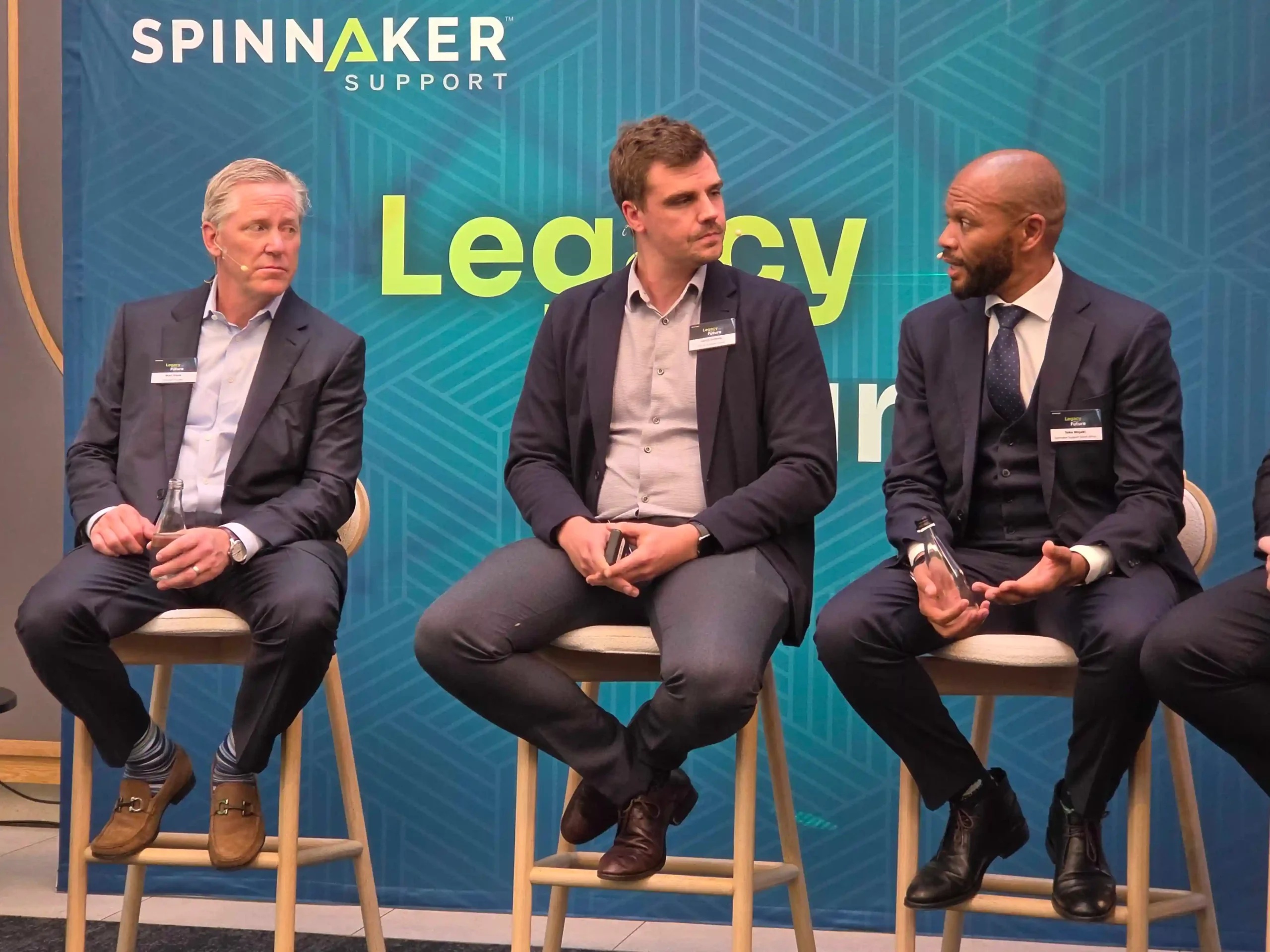
South Africa also offered engineering talent. Stava talked about building an operations and service delivery center that could serve Africa and Europe. The ambition gave the expansion a second purpose: finding customers and finding people qualified to support them. His supply chain instincts were still recognizable in the geography.
The company’s own operations required attention, too. In August 2026, Stava appointed Rex Young as chief information officer. Young’s responsibilities included modernizing internal platforms, improving data and analytics, advancing AI and strengthening cybersecurity. A business selling continuity to others still has to keep updating the machinery behind its own service.
A month later, Spinnaker announced PostgreSQL support and migration services, including migration work powered by HexaCluster. The company said it served more than 1,300 organizations in 104 countries. Its PostgreSQL enterprise distribution was still in development, a distinction that matters: the announced support and migration offerings were separate from the distribution being built.
The new database work gives Stava’s argument a forward direction. Supporting an existing Oracle environment and helping assess a move to PostgreSQL can belong to the same customer relationship. The ability to keep operating creates room for a deliberate change. The destination still needs engineers, planning and somebody willing to answer the telephone afterward.
Room outside the office
Stava’s life in Colorado includes golf, skiing and family time. His public record also includes leadership in scouting. In 2022, as council president, he discussed the Denver Area Council’s change of name to the Greater Colorado Council and its effort to welcome more families. The organization then described a reach of more than 11,000 scouts and 4,000 volunteers.
The role concerned a different kind of development from enterprise software: young people learning responsibility, citizenship and self-reliance. His interest in institutions that help people acquire confidence has an obvious counterpart in the Kansas pledge, though one should resist turning every leisure activity into a leadership seminar. Sometimes a round of golf can simply be a round of golf.
There is a lighter glimpse in his own account of an EMEA team visit to London. The group celebrated with a dinner cruise on the Thames, and Kelly joined the trip. He wrote appreciatively about combining work and personal time. A global organization produces travel schedules; occasionally, it also produces a good evening on a boat.

Building the next opening
The Kansas hub is intended for students across the university, including people outside the business school. Stava emphasized both the physical space and the programs needed to help students start companies. His hope was for opportunities beyond those available during his own education.
Matt and Kelly Stava’s pledge toward KU’s entrepreneurship hub.
“I have started companies with some success,” he said. The modest phrasing is refreshing from someone whose job description includes chairman. He connected the gift to gratitude for the people and institutions that helped shape him. The hub offers a practical form for that gratitude: space, programming and permission to attempt something.
His career began with access to a room full of people more experienced than he was. His business gives technology leaders more say over their next investment. His family’s pledge gives students a place to begin. Across those different settings, the recurring gift is room to make a consequential decision - and enough support to live with what follows.