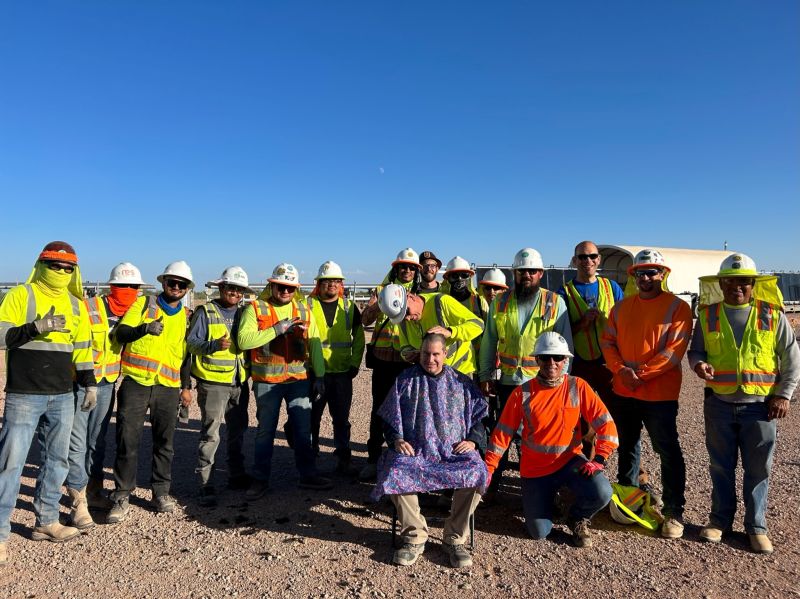
Matt Campbell put his hair on the line for a solar construction target. In November 2023, the Terabase Energy co-founder and CEO told the story: he had promised his engineers a shaved head if they reached their production targets. They reached them. The team then proposed a more demanding target, with his eyebrows included in the bargain. Campbell declined. Even an entrepreneur is entitled to retain a little negotiating power above the eyes.
The photograph is pleasingly ordinary. Campbell sits in a chair, a cape around his shoulders, surrounded by the project crew. Behind the joke sits a serious question. Can the construction of a solar power plant become more like manufacturing? His company had just completed its first commercial deployment of Terafab, an automated field-factory system. An installation milestone had become a group celebration, with the chief executive supplying the entertainment.
Fifteen years, then a basement
Campbell’s career gave him a view across the solar business. Before SunPower, he worked in venture capital, software and semiconductors. He holds a BA from the University of Wisconsin and an MBA from the University of California, Berkeley. At SunPower, where he spent 15 years, his responsibilities ranged through project development, product development, manufacturing, acquisitions, joint ventures and operations.
The experience covered more than 200 projects in 20 countries, representing over $10 billion in project investment. Those numbers describe a career spent dealing with solar as a business that must get things done. A promising design has to survive procurement. A manufacturing decision has consequences on site. Operations eventually deliver a verdict on the choices made much earlier.
He joined SunPower in 2004. By 2019, as the company moved away from utility-scale solar, Campbell believed the opportunity in large plants remained. Terabase emerged in Berkeley. His own account places its beginnings in his basement, a setting considerably smaller than the installations he wanted to help build.
There was useful work to do before a robot could move anything. An early assignment supplied digital and engineering services for an 800-megawatt solar project in Qatar. The scope matters: Terabase helped with the project’s development; this was no claim that a basement startup had robotically installed an entire power station. The early business put its knowledge of solar design to work while the machinery was still ahead.
“When you go to a solar site, the means and methods were all available in the 1950s.”
Matt Campbell, on solar construction
The factory comes to the field
Campbell’s observation about old construction methods carries a particular irony. A solar module can leave a sophisticated production line and arrive at a site where the next job is intensely practical: move it, attach it, check it and repeat. The panel’s price can fall while the work around it remains demanding. His attention shifted toward that surrounding work.
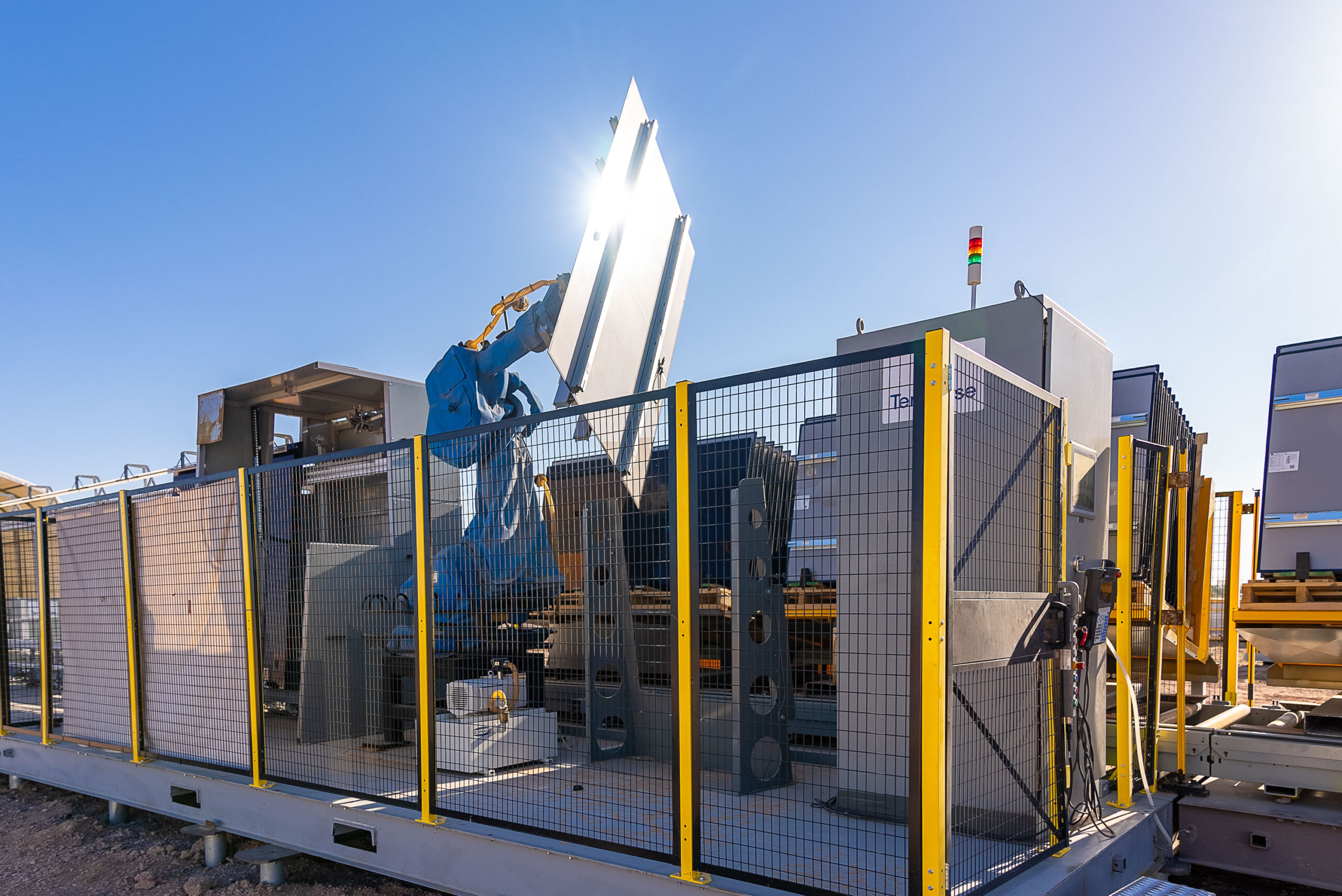
Terafab brings an assembly operation to the solar site. Its design connects a field assembly line with installation rovers, material management and a digital view of the project. Instead of treating each machine as an independent attraction, the system tries to organize how components become finished assemblies and how those assemblies reach their places in the field.
The path included a 2022 demonstration in Texas, where the equipment built a 10-megawatt portion of a 400-megawatt site. Terabase launched Terafab in May 2023 and opened its manufacturing facility in Woodland, California. A factory making equipment for other factories is an amusingly recursive business. These later factories happen to move between construction sites.
The first commercial deployment followed at White Wing Ranch in Arizona, with developer Leeward Renewable Energy and contractor RES. Terafab installed 17 megawatts of the 225-megawatt project. Terabase reported a 25 percent improvement in labor productivity compared with manual installation and the return of all photovoltaic module packaging for manufacturer reuse. Those were project-specific results, giving Campbell’s proposal something more concrete than a diagram.
The calculations come along for the ride
A construction system needs to know what it is building. Campbell’s company therefore developed beyond a single piece of hardware. In 2021, Terabase announced an agreement to acquire PlantPredict from First Solar, following its integration of operational technology company REPlantSolutions. The combination extended its work into energy prediction and plant operations.
PlantPredict models how much electricity a solar installation is expected to produce. That calculation helps inform the decisions made before construction. Terrain, shading and equipment choices have consequences for a plant’s output. The modeling software gives engineers a way to examine those consequences while changes can still be made on a screen.
Construct, Terabase’s construction management software, addresses the next stage. The completed White Wing Ranch deployment used it alongside Terafab. Plant controls and SCADA - supervisory control and data acquisition - belong to the operating plant. Campbell’s business stretches across these stages because the physical project stretches across them, too.
It is easy to admire the robot and lose interest in the records. The records help explain whether the robot’s work fits the job. What has arrived? What has been assembled? What remains? A power plant contains a great many opportunities for people to disagree about the answer to a small question.
- 01ModelPlantPredict
Expected energy yield - 02CoordinateConstruct
Construction progress - 03AssembleTerafab
Field construction - 04OperateControls + SCADA
Plant monitoring
The ground gets a vote
The phrase “field factory” contains the difficulty. A factory suggests a place where conditions can be arranged. A field offers fewer courtesies. Campbell has described the challenge of taking automation outdoors, where a working system must deal with circumstances that an indoor production line can often avoid.
His own excursions have occasionally made the point rather directly. At a company offsite, he drove a rover into flooded mud. The outing ended with a trip to Target for replacement clothes. There are many ways to demonstrate an interest in field operations; this one left little room for ambiguity.
He is clear about the intended connection between computation and machinery. “AI can’t build things. It needs arms and eyes.” A model’s usefulness depends on what the system can observe and what its equipment can actually do. On a construction site, the physical action still has to happen.
The early assembly approach also left room for human skill. Campbell described machines taking on large components while people handled finer assembly tasks. Moving a panel and connecting small cables demand different abilities. Designing the work means deciding which task goes where, rather than assuming that every task becomes easier when a robot is assigned to it.
“Our plan was robotics from the beginning.”
Matt Campbell, on Terabase’s direction
A larger cheque, the same practical test
The capital behind the business grew. A July 2023 financing brought $25 million, led by Fifth Wall with participation from EDP Ventures and existing investors. In March 2025, Terabase closed a $130 million Series C led by SoftBank Vision Fund 2, bringing total funding above $200 million. The company said much of the new money would support manufacturing scale-up for Terafab.
For Campbell, investment creates the means to build more equipment and deploy the broader platform. It also enlarges the work of execution. A machine that works at one site becomes the starting point for the next site. Manufacturing, mobilization and coordination have to hold together as the number of deployments grows.
On March 19, 2026, Terabase announced that Terafab V2 had completed field testing and was ready for commercial shipment. The announcement followed first-generation deployments across five power plant projects. Its planned expansion of manufacturing capacity was another step in the company’s attempt to turn field experience into a repeatable construction business.
There is a useful distinction between completing field tests and fulfilling a production ambition. Campbell’s story has both. The completed work provides experience; the next generation asks the team to apply it. A chief executive can describe the destination, but equipment, customers and project schedules determine the pace.
Cheap power has to be built
Campbell has long discussed solar electricity at one cent per kilowatt-hour as a cost goal. He connects cheaper power with uses beyond supplying the grid, including green hydrogen and synthetic fuels. It is an ambition that makes construction efficiency part of a larger economic argument: what becomes possible when electricity costs less?
In a 2026 conversation, he set out another challenge: physically building a gigawatt of solar in ten weeks, provided the permits and other prerequisites are in place. The caveat deserves its place beside the number. Faster assembly cannot wish away the work required to make a project ready for construction.
By September 2026, his public conversations were still reaching into the details. A SunCast discussion examined the connection between a module and its supporting structure, a small interface with consequences for automation and long-term reliability. The business keeps returning him to the point where an idea must attach to something real.
Campbell calls himself an optimist. His career gives that optimism a practical setting: years of projects, a basement beginning, software acquisitions, factory equipment and a crew willing to test the terms of a haircut wager. The ambition remains large. The work arrives in components, decisions and repeated actions. He has kept his eyebrows. The engineers have plenty else to aim for.