Northern California · The operating life
The old Cool Earth Solar machines looked as though the county fair had acquired a research budget. Huge white tubes hovered above the grass, their skins tightened by air, their curved surfaces bending sunlight toward narrow strips of photovoltaic material. They were part power plant, part parade float and entirely serious. Rob Lamkin, the company's CEO, stood beside them with the calm of someone who had spent enough time around turbines, financing agreements and construction schedules to know that an unusual silhouette is merely the opening argument.
Lamkin did not come to clean technology by way of a slogan. He came through the machinery of the Western power market. At the Northern California Power Agency, he rose through roles that included responsibility for generation assets. At Mirant, he helped complete the acquisition of 3,100 megawatts of gas-fired plants from Pacific Gas & Electric and managed the assets. At Calpine, his brief stretched across development, construction, finance, trading, marketing and operations. More than 10,000 megawatts of new capacity were developed under his direction in those earlier executive years; more than 6,000 reached commercial operation.
Those numbers are not décor. They explain the recurring tension in Lamkin's career: the appetite to try something strange, checked by the operator's insistence that electricity must eventually arrive at a meter.
An operator's scale · earlier power-sector roles
An engineer learns to be all in
After the large-company years, Lamkin founded Radiant Energy to develop cleaner generation, with an emphasis on solar and geothermal projects. In July 2007, Radiant merged with Cool Earth Solar, and Lamkin became CEO of the combined company. He later described a conversion: he had been agnostic about solar technologies, then became “all in.” The reason was not fashion. It was abundance.
Solar energy is the only thing we have in near enough abundance to solve the energy problems that we have.Rob Lamkin, 2009
Cool Earth's wager began with a materials question. Conventional photovoltaic systems used a large surface of refined solar material. What if a cheap, plentiful film could gather a much wider field of light and focus it onto a small cell? Early round collectors were described as solar balloons. Later versions became 24-foot inflated tubes. The thin plastic did structural and optical work at once, while the concentrated light reduced the required photovoltaic area.
The effect was delightfully odd. In an interview, Lamkin said the company could use one four-hundredth of the solar-cell material needed to produce the same electricity as conventional photovoltaic technology. The ambition behind the whimsy was austere: less mass, cheaper materials, lower power costs and a design that could occupy rolling or previously disturbed land without forcing the landscape into a billiard table.
Lamkin was also plain about what the design was not for. Rooftop solar mattered, he said, but these collectors were meant for the ground and for clusters large enough to behave like a power plant. He wanted technology that could meet a very large energy problem, not an object that merely looked clever. There is something bracing in that distinction. Novelty may win a second glance. Scale sends an invoice.
The photograph meets the spreadsheet
Money arrived. Cool Earth raised a $21 million Series A in 2008. The plan described at the time began with a one-megawatt installation of roughly 1,000 concentrators across eight acres, with a far larger plant somewhere beyond it. Lamkin took what he called a “stump speech” to investors. He also acknowledged the less theatrical demands: pumps, replacement film, field crews and maintenance across acres of equipment.
Then the economy contracted and renewable financing became harder. Lamkin's answer was neither bravado nor retreat. Capital still existed for sound projects, he argued, but the threshold had risen.
It just means you have to work a lot harder to make your technology pencil out.Rob Lamkin, 2009
“Pencil out” is operator language. It compresses physics, manufacturing yield, land, insurance, debt, labor and electricity prices into two words. It also resists the romance of a breakthrough. A machine can be ingenious and still fail the pencil. A dull-looking system can pass it and power a warehouse for decades.
Cool Earth kept testing. In 2013, it entered a five-year cooperative research agreement with Sandia National Laboratories. The Livermore Valley Open Campus hosted the company's first public deployment. Sandia researchers would measure, characterize and validate the inflated concentrated-photovoltaic units. One machine fed electricity into the campus grid while officials and engineers gathered in the California sun.
Radiant Energy merges with Cool Earth Solar; Lamkin becomes CEO.
A $21 million Series A finances the concentrated-solar push.
Sandia and Cool Earth begin public field testing in Livermore.
The company ends development of the inflated CPV product.
Cool Earth installs solar panels, batteries and EV charging.
A year later, speaking about collaboration between entrepreneurs and national laboratories, Lamkin credited the people inside the institution who carried the work through its procedures. “Without a champion inside the lab, the deal would not have gotten done,” he said. It is an observation with a wider use. Partnerships happen between logos only in press releases. In practice, a person answers the email, finds the form and keeps the meeting on the calendar.
Prove it right, or prove it wrong
The field test carried an honest risk. Conventional flat-panel costs had fallen sharply since Cool Earth began. The unusual system was no longer competing with the solar industry of its founding year. It was competing with an industry that had learned to manufacture familiar panels more cheaply and in vast quantities. Lamkin framed the deployment as a verdict: the company would prove itself right or wrong.
The verdict was not the one drawn in the early simulations. Cool Earth discontinued development of its concentrated-photovoltaic product before the Sandia project concluded. No commercial rollout of the inflated system was planned. The lovely white tubes did not become a new species of power plant.
This is the point at which startup stories usually turn coy. They prefer an arrow rising up and to the right, even when the real line has wandered through a thicket. Lamkin's record offers a more useful shape. The technology stopped. The company did not. Cool Earth moved toward conventional commercial and residential photovoltaic systems, adding batteries and electric-vehicle charging. The purpose survived contact with evidence because the purpose was larger than the device.
Do not confuse fidelity to a problem with fidelity to a mechanism. Cool Earth kept working on affordable clean power after its signature mechanism changed.
From the grid to the roof
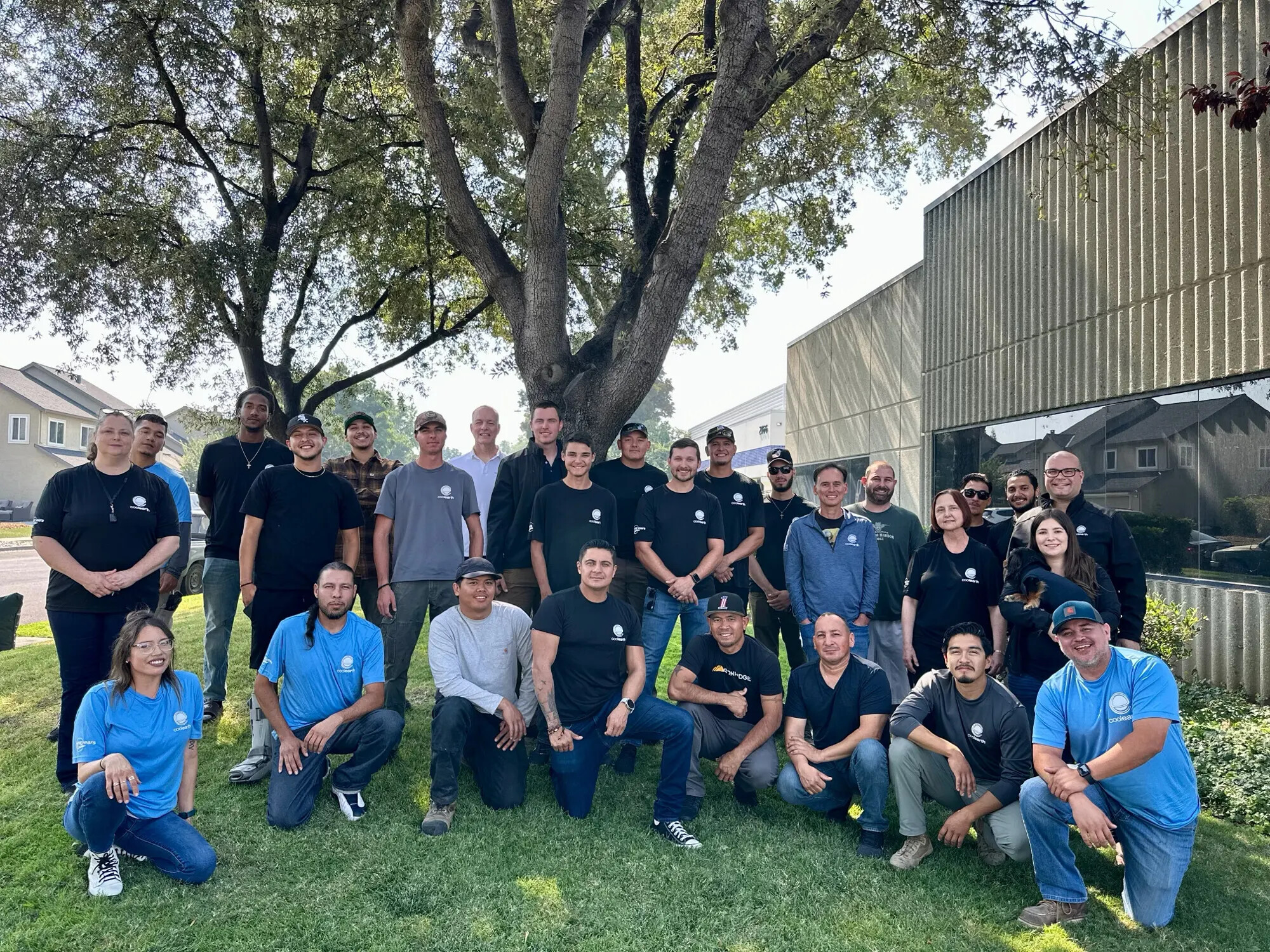
Today's Cool Earth Solar is less likely to be mistaken for an art installation. It designs and builds solar for homes and businesses, works with energy storage and installs EV charging. Its projects belong to the practical geography of Northern California: roofs, parking areas, warehouses, factories and customer bills. Lamkin remains CEO, founder and contractor of record, holding California solar and electrical licenses.
The work spans a remarkable distance. Early in his career, he managed the assets of a public-power agency. In corporate roles, the unit of conversation was thousands of megawatts. In the experimental years, it was the concentration ratio of curved film and the weight of a tube. Now it can be the available square footage on a commercial roof or the battery that keeps a customer's essential circuits available.
There is family in the frame, too. In 2015, Lamkin posted about the pleasure of having his son Jacob and Jacob's friend Sam work on a Cool Earth solar project for the summer. Jacob later became the company's engineering and project manager. Rob's company biography mentions his wife, Jill, and daughter, Jessa, whose musical performances he enjoys, along with tennis, the gym and the occasional craft beer with his son and friends. It is an agreeably terrestrial list for someone who has spent a career harvesting a star.
Lamkin once said that a passion for clean energy was a prerequisite for hiring at Cool Earth. Passion, in this story, does not resemble endless enthusiasm for one's first answer. It looks more like attention over time. Measure the unit. Listen to the lab. Read the cost curve. Keep the capable people. Change what the evidence requires.
The beauty of useful things
In one early conversation, Lamkin spoke about why wind turbines are beautiful. Infrastructure rarely receives that compliment. It is usually assessed as capacity, cost, noise, output or inconvenience. Beauty enters when the machinery becomes legible as an answer: moving air becomes power; sunlight becomes current; an empty roof becomes part of the grid.
The inflated collectors possessed that beauty for a while. They made a physical argument about doing more with less. They also encountered the sterner beauty of a fair test. Sandia supplied instruments and independent technical judgment. Cool Earth supplied a technology it was willing to expose to them. The result included an ending, which is one of the things an experiment is allowed to produce.
Nearly two decades after Lamkin became CEO, the company still carries the name Cool Earth Solar. The “how” has altered considerably. The “why” has not. Affordable, abundant clean energy remains the proposition. The lesson worth stealing is quiet and durable: a founder may have to surrender the shape of an idea to preserve its reason for existing.
Solar balloons made people stop and look. The harder work came after they had looked: financing, testing, revising, installing and returning the next morning to see what the meter said.