01 · Who they are nowInside the desert assembly line
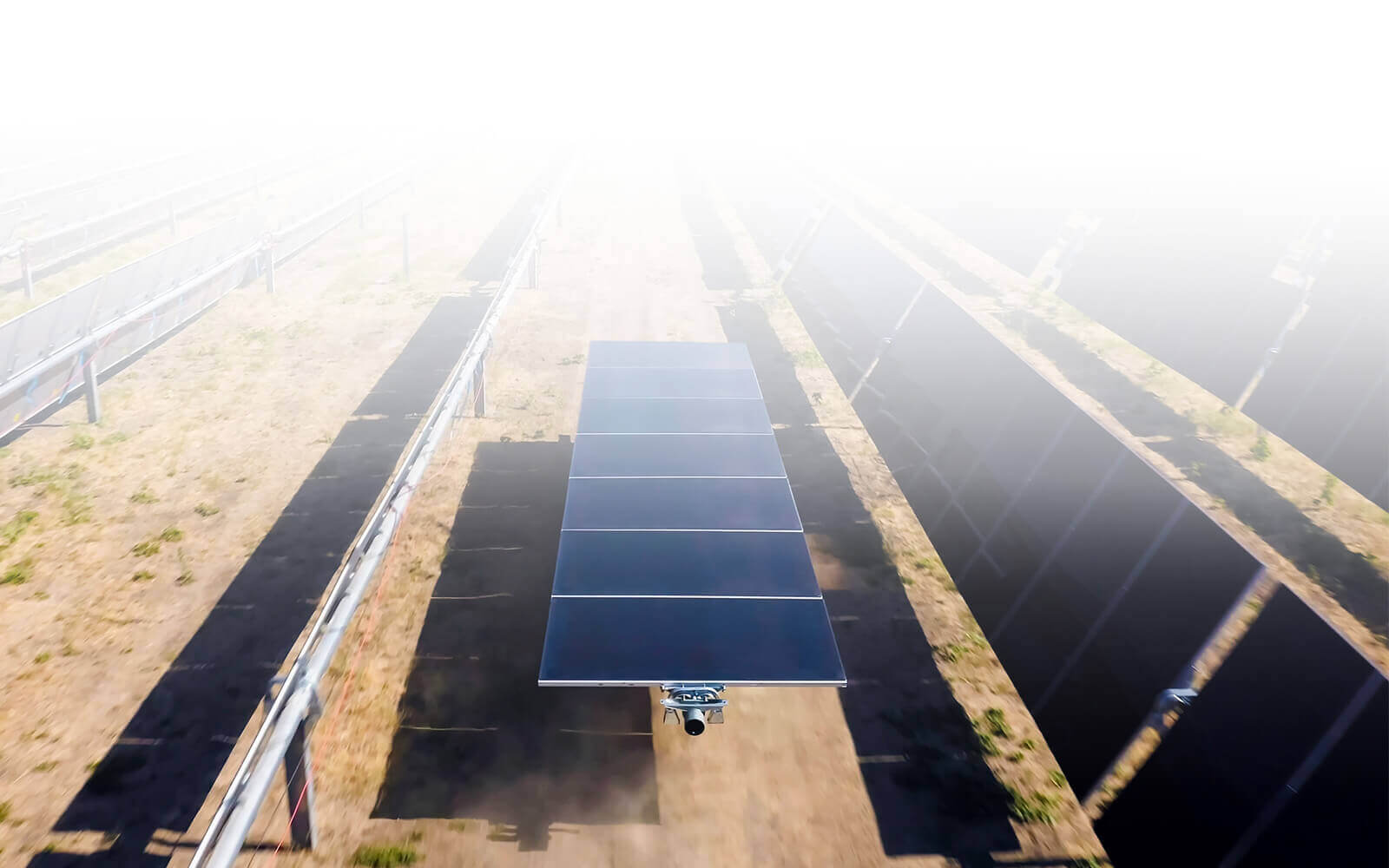
Picture a stretch of Texas scrubland. Twenty trucks, a mobile factory tent, a row of robotic arms bolting solar modules to steel torque tubes at a pace that would make a Toyota line manager nod. Trackers roll off the end of the line, get driven a few hundred yards, and are planted into the ground. This is Terafab. It is what Terabase Energy actually does for a living.
The company sells software, too - Construct, the GIS-native platform now managing 25 gigawatts of solar projects. And SCADA, the unsexy plumbing that keeps 10 GW of operating plants from drifting offline. But the field factory is the part you point at when someone asks what Terabase is. It is a solar farm building a solar farm.
02 · The problem they sawSolar got cheap. Building solar did not.
Here is the inconvenient truth at the heart of the energy transition. Solar modules have dropped roughly 90% in price over a decade. The cost of installing them - the steel, the labor, the trucks, the trenching, the heat exhaustion - has dropped a great deal less. EPCs still run plants from spreadsheets. Site supervisors still chase clipboards. The bottleneck moved from the panel to everything around it.
Multiply that bottleneck by a target of generating a few terawatts of new solar this decade and a problem appears: there are not enough qualified construction crews on Earth to hand-build that much hardware on schedule. Something has to give. Terabase's bet is that it should not be the schedule.
03 · The founders' betFive SunPower veterans, one large room
Matt Campbell spent 15 years at SunPower. Project development, manufacturing, M&A, more than 200 projects, 20 countries, roughly $10 billion of investment. He has seen what the inside of a solar EPC project actually looks like. So have his co-founders: Amine Berrada, Chris Baker, Dan Cohen, and Pierre Gousseland. In 2019 they decided the industry's next decade would be defined not by cheaper modules, but by software and automation in the field.
Most cleantech founders pitch hardware or software. Terabase pitched both. That is unusual, mildly annoying to investors who prefer clean theses, and - in retrospect - obviously the right call. You cannot automate a construction site you cannot also measure, and you cannot measure one you cannot also instrument.
04 · The productField factory, digital twin, and a lot of SCADA
Terafab is the showstopper. A mobile, on-site automated assembly line that bolts modules to trackers under a tent, then deploys them with a rover. It removes the worst parts of solar construction - the heat, the awkward overhead lifts, the variability of torque - and replaces them with repeatability.
Construct is the brain. A GIS-native, AI-powered platform that knows where every pile, panel, and inverter belongs on a site, tracks installation progress in real time, and gives the home office something better than a Friday email update.
SCADA & Plant Controls are the nerves. Once a plant is built, Terabase's monitoring stack keeps it running across 10 GW of installed capacity. Engineering tools handle the up-front design. ReadyMount is the weather station that comes with everything else.
Terabase by the gigawatt
Source: Terabase Energy public statements, 2025-2026. Bars are visual; the gigawatts are real.
A short timeline of a fast company
05 · The proofCustomers who buy it twice
EDP Renewables - one of the world's largest renewables developers - now runs 2 GW of project work on Construct. That is not a pilot. That is a deeply unsexy and deeply important act of corporate trust: an EPC committing a measurable percentage of its U.S. pipeline to a platform built by a company most people outside solar have never heard of.
Then there is SoftBank's Vision Fund 2, which led the $130M Series C in March 2025. SoftBank's track record in cleantech is mixed at best, and the fund has been notably picky since 2023. Writing a check that large at this stage suggests Terabase did something rare: it showed real revenue from real projects in real dirt.
EDP Renewables - 2 GW on Construct, and counting.
SoftBank Vision Fund 2 led the Series C in March 2025.
Fast Company Most Innovative Companies, 2026.
10 GW of operating solar runs on Terabase SCADA.
06 · The missionLess heroism, more leverage
Most clean energy stories love a hero. The lone inventor. The dramatic breakthrough. Terabase's mission is the opposite of that. It is about removing heroism from solar construction - the heroic schedule, the heroic crew, the heroic Excel file - and replacing it with leverage. Software, robots, and a lot of careful instrumentation.
The vocabulary the company uses is telling. "Digital field factory." "Project lifecycle." "Construction productivity." This is not the language of moonshots. It is the language of an industrial company that intends to be around when the moonshots are over.
07 · Why it matters tomorrowThe boring middle of the energy transition
The next decade of solar will not be won by a better cell chemistry. It will be won, or lost, on what happens between the module shipping container and the energized substation. That gap - call it the construction gap - is where Terabase has decided to live.
If they are right, the cost curve for utility-scale solar bends downward for another decade. If they are wrong, the industry hits a labor wall it cannot software its way out of. Either way, the experiment runs in public. Every truck that rolls out of a Terafab tent is a data point.
Back to the desert. The mobile factory hums. A panel that was a cardboard-wrapped rectangle thirty minutes ago is now a working slice of a power plant, bolted, tilted, and pointed at the sun. Nobody had to lift it overhead. Nobody had to torque it by hand. A laptop somewhere in Berkeley already knows it is there. The terawatt era will not arrive in a ribbon-cutting. It will arrive one Terafab shift at a time.
The Rolodex
- Websiteterabase.energy
- LinkedInlinkedin.com/company/terabase
- Twitter / X@terabaseenergy
- Facebookfacebook.com/TerabaseEnergy
- Series C News$130M Series C announcement
- Crunchbasecrunchbase.com/organization/terabase-energy
- InterviewWatt It Takes with Matt Campbell
- Product DemoTerafab on YouTube