A council can have too many candidates and still struggle to hire. Westminster’s managers were spending hours sorting through unsuitable CVs, while hiring outside agreed contracts made recruitment spending harder to control. The inbox was busy. The system was not doing its job. Matrix found its opening in that gap: the work of making other people’s recruitment work.
In an account published in August 2022, Matrix reported that Westminster City Council had saved more than £4 million, or 4.6%, since their partnership began in 2017. Its intervention combined procurement software, rate benchmarking, supplier management and an onsite account manager. The company also limited the CVs agencies could submit. For an overwhelmed hiring manager, a shorter pile can be a useful product feature.
That is the appealingly unglamorous centre of Matrix. The British workforce business operates between employers and the organisations supplying their workers. It sells a way to organise the transaction: who can submit a candidate, who approves the appointment, what gets checked and how the spending becomes visible. Today, that proposition extends into background screening, payroll and buying projects with defined deliverables.
Cumulative recruitment savings reported since 2017.
4.6% in the published customer account.
The recruiter behind the recruiters
Matrix calls its approach a neutral-vendor managed service. Translated from procurement language, the employer gets a coordinator for a network of recruitment suppliers. Matrix Workforce combines that service with technology for managing contingent, temporary and blended workforces. The buyer can seek workers through multiple agencies while maintaining a common process for approvals, reporting and supplier oversight.
The distinction matters because buying labour involves competing interests. Hiring managers want somebody quickly. Finance wants predictable charges. Procurement wants suppliers treated consistently. Candidates want a clear route to starting work. Matrix’s proposition gives these groups a shared operating process, backed by staff who deal with the exceptions. A platform can flag an unfilled order; someone still has to work out why nobody suitable is arriving.
This is an established market with plenty of company. ESPO’s MSTAR4 framework lists Matrix alongside Comensura, Guidant Global, Neuven, Reed, Hays and others. The framework accommodates different delivery models, including managed services, vendor-management software, talent pools and Statement of Work procurement. Neutrality alone is therefore a starting description. Matrix’s more specific pitch is the combination of its own software, operational service and adjacent screening and procurement capabilities.
- 01Define the roleRequirement + approval
- 02Open the competitionApproved supplier network
- 03Check and engageScreening + onboarding
- 04Track the workHours + spend + reporting
Westminster needed a change of habits
The council’s later account of the relationship makes the original problem more precise. Hiring was decentralised, agency mark-ups varied and budget holders lacked a consolidated view. Some managers dealt directly with agencies. Introducing a central route meant changing everyday behaviour as well as putting software on a screen. Training and support were part of the implementation.
By its 2025 account, almost all contingent hiring flowed through the Matrix route. Live reporting let managers examine costs and compare spending over time. An onsite consultant helped sharpen job specifications and encouraged platform adoption. That combination explains why the story is more interesting than a dashboard launch: the organisation was changing how a purchase happened, who could see it and who was available to help.
“There are clear processes now with proper approvals, audit trails and checks.”
Harbinder Manku
Corporate Contracts Manager, Westminster City Council
The practical lesson is to inspect the route a hiring request takes before shopping for features. Where can a manager bypass the agreed process? Who notices a different agency margin? Who improves a vague job brief? A buyer can copy those questions without copying Matrix’s entire service. The software becomes useful when the answers change actual behaviour.
One screen, several ways to buy help
Matrix Prism is the proprietary platform behind the expanding proposition. Its public product illustration shows a hiring desk with orders to approve, candidates awaiting feedback, placements and timesheets. The demonstration customer is named Fictional Facilities Management, an unusually candid tenant for a software screenshot. The message is straightforward: outstanding work should be visible before it turns into somebody else’s emergency.
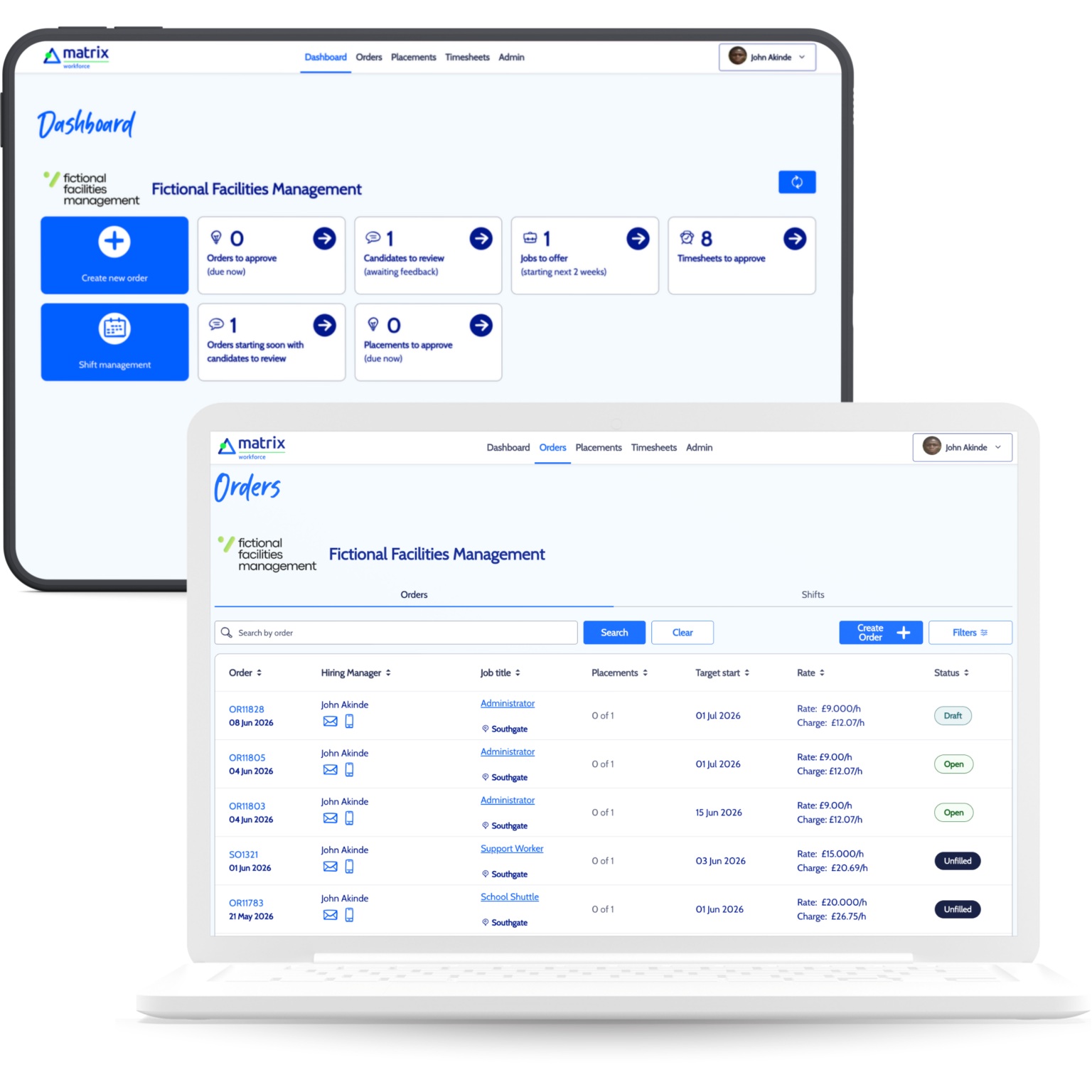
Matrix offers the platform through a standalone VMS/SaaS route for organisations retaining operational control, as well as through a managed programme. Customers can begin with an individual service and add capabilities. This makes its business a mixture of contracted expertise and software, with screening and payroll among the additional services. The buying decision turns on how much work the customer wants to keep internally.
For repeat recruitment, Matrix Talent Pool helps employers create branded candidate communities. Previous workers and interested applicants can remain connected before the next vacancy opens. Payroll and umbrella services cover another part of the transaction: administering worker payment and engagement. The commercial appeal is continuity across tasks that might otherwise sit with separate providers and teams.
Barnet puts numbers on the moving parts
Matrix’s Barnet Council case study offers a useful distinction between kinds of savings. It attributes £200,000 in agency-charge savings to Talent Pool and £800,000 to supply-chain efficiencies through the managed service. It also reports a 98.84% order-fulfilment rate for the 2024/25 financial year. Those measures address different questions: how candidates are found, how suppliers are managed and whether requests get filled.
These are customer examples published by Matrix, rather than a promise about the next contract. A buyer assessing value should separate management and software charges, implementation effort, screening costs and supplier economics. Then measure the resulting service against a baseline. A cheaper agency margin means little if vacancies sit empty; a high fulfilment figure means less if the appointments do not fit the work.
The lesson also has conditions. A central process needs managers willing to use it and suppliers willing to participate. An employer making a handful of straightforward hires may have less reason to commission a broad managed programme. Matrix’s standalone software and modular services accommodate that distinction. Its fullest proposition makes the most sense where volume, multiple suppliers and organisational complexity create enough coordination work to justify it.
The £14 million move into checking
Bridgepoint Development Capital invested in June 2020, backing technology investment and selective acquisitions. In 2023, Matrix moved into a closely related problem: whether the person being hired had been checked properly. It agreed to acquire Security Watchdog from Capita at an enterprise value of £14 million, on a cash-free, debt-free basis. The transaction completed on May 31.
Capita disclosed that Security Watchdog had generated £27.7 million in revenue and £1.5 million in profit before tax in 2022. Those numbers belong to the acquired business. For Matrix, the strategic logic was to bring specialist screening closer to recruitment and onboarding. For Capita, the sale served a programme of disposing of businesses outside its core priorities.
Security Watchdog’s services span identity, employment and qualification verification, criminal-record checks and other screening requirements. Bringing that capability into Matrix expands what the company can sell to both new and existing customers. It also adds specialist judgement. Matrix’s privacy notice says AI may help validate and automate operational tasks, but screening-outcome decisions are undertaken by humans. Automation has a stated boundary here.

From buying time to buying a result
The next extension is Matrix Milestone, which helps organisations procure services, goods, works and projects. Its Statement of Work approach centres on specified deliverables, milestones and supplier accountability. That changes the purchasing conversation: the organisation must articulate what a completed piece of work looks like, then monitor progress against it.
Milestone reports more than 3,000 accredited suppliers and a supplier base that is 92% SMEs or very small enterprises. The numbers describe its procurement network, not the staffing network as a whole. In July 2026, Matrix announced that Milestone had become the exclusive delivery partner for Ardal’s NEUTAPS framework, covering technical and professional services. It is another route into public-sector purchasing, where the method of buying matters alongside the supplier selected.
Outcome-based purchasing carries its own discipline. A milestone cannot rescue an ambiguous brief. Buyers need clear acceptance criteria and someone able to judge delivery. The broader inference from Matrix’s expansion is that the company wants to coordinate more of the decisions surrounding work, whether a customer buys a temporary worker’s time or a supplier’s finished project.
A talent pool starts before the application
Matrix’s purpose is “Connecting people to work.” Its social-value activity gives that phrase practical content through career coaching, employability workshops and work with community partners. The company describes support for people who can face barriers to employment, including forces leavers and people with convictions. Those activities operate before a candidate becomes a neat row in a recruitment database.
Inside the company, its careers page describes hybrid working for most roles, paid volunteering days, mentoring and wellbeing champions. These are employer-stated practices, but they fit a business whose service depends on people helping other people navigate complicated processes. The onsite consultant and the community workshop belong in the same picture as the software.
Matrix’s ambition now stretches across what it calls Total Workforce Management. The useful test remains smaller and more concrete: can the hiring manager see the next action, can finance explain the bill, and can the worker get started? If those answers improve together, the coordination has earned its place.