Ken Richards had a peculiar problem. His recruiters could find a candidate, prepare a résumé, and still lose minutes persuading their software to submit it. In Ceipal’s account of Quality Staffing of America, that last step could take five minutes. The firm already had an established applicant tracking system. The trouble was what happened when people tried to use it.
- Find the friction. Slow submissions and integration fees made routine recruiting expensive.
- Connect the work. Ceipal links sourcing, vendors, onboarding, and workforce administration.
- Test the whole trip. A useful demo should reach the timesheet and invoice.
Search was unreliable. Support tickets dragged on. Annual contracts made unused seats hard to shed. Richards found Ceipal through word of mouth; a demo persuaded him to switch. The published case study reports annual spending falling from $40,000 to under $10,000, with workflow efficiency rising more than 50%. These are one customer’s reported results, rather than a forecast for every buyer. But they locate Ceipal’s appeal precisely: in the cost of getting ordinary work done.
Follow the placement, not the feature list
Ceipal sells software to staffing firms and enterprise hiring teams. Its ATS handles candidate records, job posting, searching, matching, communications, and placements. Recruiters can search job boards and their own database from the same application. That matters because a candidate already found by one recruiter should not require another expensive search by the next.
Then comes the vendor management system, associated with the Procurewise name. This is the machinery for coordinating staffing suppliers, work orders, contingent workers, and spending. Workforce Management carries the operation into employee records, onboarding documents, timesheets, leave, expenses, and invoicing. Ceipal’s expertise sits across those handoffs. The sale continues after somebody accepts the job.
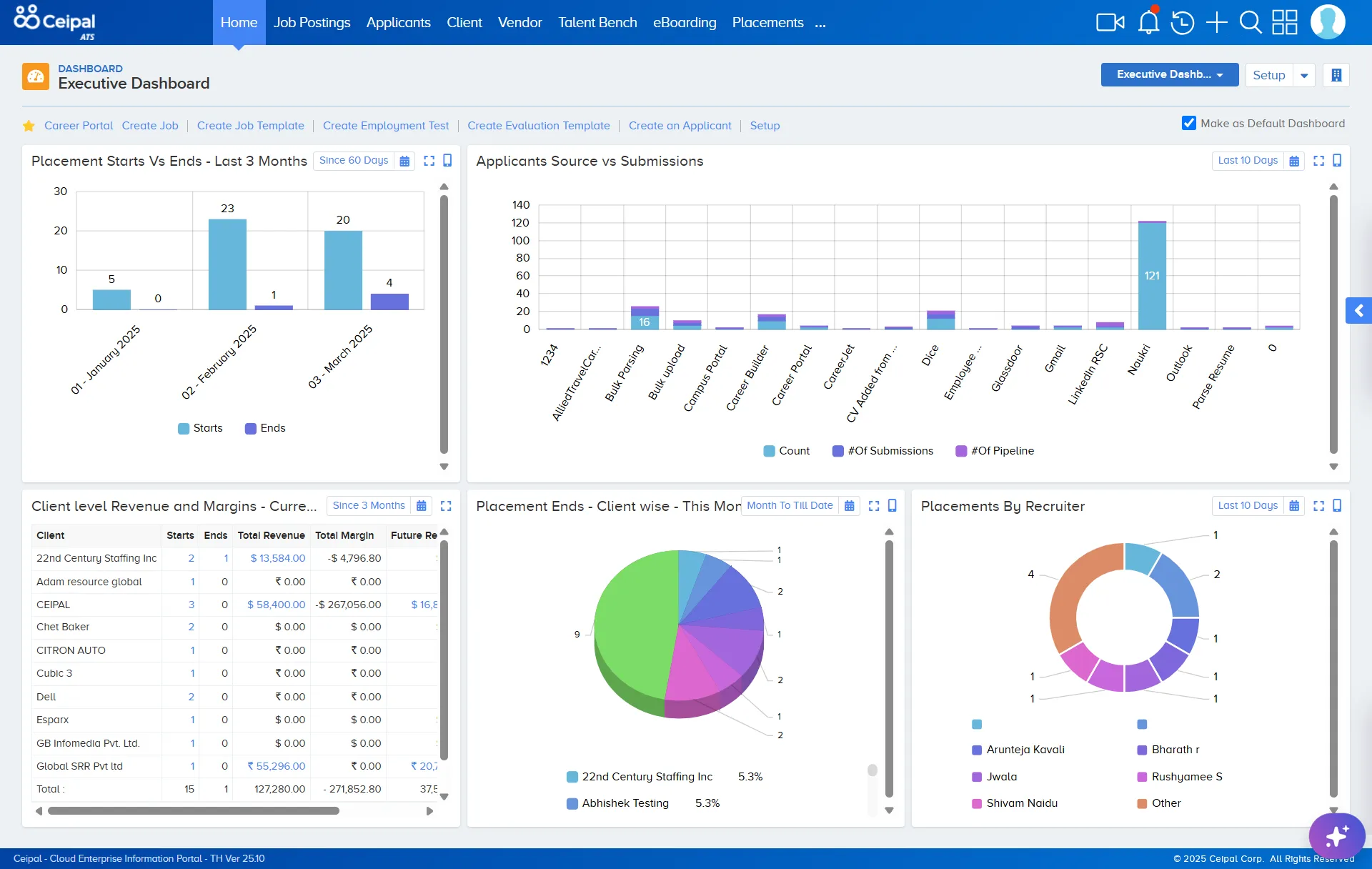
Bullhorn and JobDiva are familiar alternatives in the staffing ATS conversation. Ceipal’s positioning emphasizes connected recruiting and operations, rather than making buyers assemble every handoff themselves. That is a purchasing argument, not proof that competing products lack those capabilities. The useful comparison is the workflow your team can actually complete, with the integrations and contract you actually buy.
The connections also explain why partnerships matter. A 2021 Monster agreement put job-ad buying and publishing inside Ceipal, alongside existing candidate-search integration. LinkedIn publishes a guide for activating its Ceipal connection. These are the practical joints in the system: a recruiter needs access to outside networks without rebuilding the candidate record at every stop.
“What took an hour with our previous provider took minutes with Ceipal.”
Ken Richards · Quality Staffing of America
The people behind the plumbing
Sameer Penakalapati founded Ceipal in 2015. His experience includes a staffing business, making the company’s focus on operational aggravations less mysterious. Ceipal describes software built by industry insiders. Its headquarters is in Rochester, New York, with research and development in Hyderabad. Even its name is intended to rhyme with “people,” a small pronunciation lesson embedded in the corporate identity.

The financing followed. In 2019, Ceipal announced $7.5 million in growth equity from Resolve Growth Partners and returning investor Mistral Venture Partners. In June 2022, it announced $16.5 million in Series B equity led by Camden Partners, plus $4.5 million in debt. The stated plans included expansion in the United States, United Kingdom, and India, alongside further product development.
The company’s published values spell CEIPAL, with collaboration, accountability, and learning among the entries. Those are employer statements. The more tangible expression of its people-first pitch is the support relationship described in customer accounts: configuration, migration, and help with the daily work.
A clinician is more than a match score
Healthcare makes the handoff problem especially visible. Ceipal Healthcare combines recruiting with credentialing, scheduling, onboarding, and workforce management. Finding a suitable person is one stage; getting the required documents and arranging the work are others. A clinician portal lets workers manage applications, credentials, and timesheets, while an agency-branded mobile app keeps those interactions together.
In its June 2026 award announcement, Ceipal reported that Windsor Healthcare Recruitment Group’s six-person recruiting team increased placement volume 45% without adding headcount. It also reported faster credentialing and less administrative overhead. These are vendor-published customer outcomes. That month, TrackFive’s inaugural TalentTrack Awards named Ceipal Industry Supplier of the Year, recognizing its work in healthcare staffing.
The new AI lives in the small print
Recruiter Assistant brings the AI proposition down to named jobs: improve a job description, tag and rank candidates, assess relevance, and automate routine voice outreach. It is embedded in recruiting workflows. The product bet is that automation becomes more useful when it already knows where the candidate, job, and submission belong.
The September 2026 release is revealing. Its VMS gained Ask Anything, a conversational assistant for querying records within existing permissions. Timesheet anomaly detection asks workers to explain unusual patterns before submission. Candidates can decline a Voice AI interview and give a reason. These details address the awkward exceptions that glossy demonstrations tend to skip.
The previous month’s update described a candidate journey conducted through SMS: confirm interest, review a proposed pay package in healthcare, upload credentials, and choose an interview slot. Its Workforce changes also connected approved Procurewise timesheets to invoice generation. That makes the product direction unusually easy to picture. The recruiter spends less time carrying information from one queue to another; the candidate can respond from a phone. Whether that improves a particular team’s results depends on its configuration, records, and adoption.
Take your mess to the demo
The business model is subscription software. Historical customer accounts describe flexible seats and monthly terms, but those examples are not a current price card. Buyers should ask for a complete quote covering their modules, integrations, and implementation. August 2026 documentation, for example, marks automatic ATS-to-Workforce placement synchronization as subject to applicable charges.
Here is the method worth copying: bring one real job, a duplicate candidate, a missing document, and an approved timesheet. Ask the vendor to carry them through the system. Count repeated entries and unresolved steps. If your problem is occasional hiring with little vendor or workforce administration, much of Ceipal’s breadth may go unused. If those handoffs consume the day, make them the test. Start with the five minutes everybody has learned to tolerate.