A company can know its customers by postcode, its inventory by barcode and its quarterly earnings to the cent, yet struggle with a surprisingly domestic question: who, exactly, is working here? The consultant belongs to one supplier. The temporary worker arrives through another. A department has hired a freelancer. Everyone has a badge, an assignment and somewhere to send an invoice. An employee directory tells only part of the story.
Andy Schultz built his working life around that gap. In 1991, he co-founded PRO Unlimited, the workforce management business later renamed Magnit. He remained its chief executive until 2020. Across that span, the apparently modest task of keeping track of people outside the permanent payroll became a business involving software, services, international operations and several successive investment partners.
The appeal of this story lies in its choice of subject. Contingent workforce management is unlikely to win a naming competition against space travel. It sounds like something discovered halfway through an unusually long meeting. Yet it concerns an elementary business problem: an organization wants flexibility without losing its grip on what it is buying, whom it is engaging and what those arrangements require.
Schultz's career followed that problem as it grew. His product was partly a way of seeing. Once a company could examine its extended workforce together, instead of department by department, the scattered transactions could become something it actually managed. The contractors were already doing the work. The management system had some catching up to do.
1999: a warning was also a market
By August 1999, Schultz was already arguing publicly about the future of temporary work in technology. Litigation involving Microsoft and Time Warner had raised questions about how companies used contingent workers. Schultz, then president of PRO Unlimited, rejected the suggestion that those disputes would stop the workforce from growing. He expected continued expansion.
“Nothing could be farther from the truth,” he said of predictions of a retreat. The remark is revealing because the difficulty under discussion was also the territory his business served. More complicated employment arrangements created a need for more deliberate oversight. A manager could welcome flexible staffing and still need help understanding the obligations attached to it.
Sixteen years later, his own commentary returned to the organizational mess beneath the trend. He described companies discovering contingent labor programs scattered across departmental silos. Local decisions had accumulated into a companywide workforce, without necessarily producing a companywide view. The individual hiring decisions could make sense while the combined picture remained obscure.
That is a useful way to understand the founder's position. He was attending to the consequences of a change already taking place. The recurring question was practical: after people have found new ways to work together, who makes the resulting arrangements legible? Much of enterprise software lives in that interval between a useful improvisation and a process someone must eventually explain.
The business of having no favorite supplier
PRO Unlimited's distinctive proposition was vendor neutrality. It offered a way to manage contingent labor across suppliers, combining a managed service with its own vendor management software, WAND. The names can sound forbidding. The underlying division is straightforward: software records and organizes the work; a service operation helps a client administer the program.
Neutrality mattered enough for Schultz to mention it when a new owner entered the picture. In November 2010, PRO announced an agreement for an ABRY Partners affiliate to acquire the business as part of ABRY's proposed acquisition of COMFORCE. Schultz described the transaction as a way to preserve the model while financing WAND and further international expansion.
His phrase was “pure vendor neutrality.” In a business built around buying services from other businesses, that is a statement about incentives. A client choosing among suppliers needs confidence in the mechanism doing the choosing and overseeing. The position of the intermediary becomes part of the product. An elegant dashboard would have limited charm if the customer distrusted what sat behind it.
The offering also extended into procurement, contractor consulting, audit support and third-party payroll. These are the details that make an administrative business substantial. Buying labor involves a sequence of decisions and records. Each additional handoff offers another opportunity for confusion. PRO's approach joined software and operating services around those handoffs, giving Schultz a business whose usefulness depended on repeated, ordinary execution.
One coordinated view of contingent work
52 countries, and a larger table
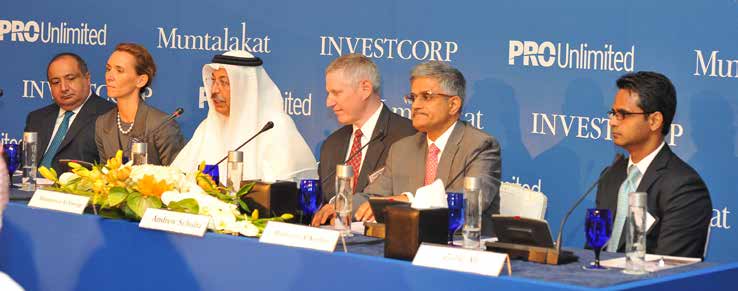
In October 2014, Investcorp and Bahrain's Mumtalakat announced their acquisition of PRO Unlimited. The company then operated in 52 countries and employed approximately 600 people. Its headquarters was in Boca Raton, Florida. Those figures place the business far beyond the scale of a local staffing office, while keeping its roots in a very specific place.
Schultz's stated ambitions centered on international expansion and broader opportunities for employees and the business. The financial partners brought capital and strategic support; he brought an operating company that had been developing since 1991. There is a particular kind of founder continuity in that arrangement: the ownership changes, while the central business question remains familiar.
The photograph of the investment announcement has the full ceremonial equipment of a corporate deal: microphones, name cards, flowers and a backdrop bearing three organizations' names. It is a crowded visual vocabulary for a business based on coordination. Even the announcement requires several parties to share a table.
The company's international footprint also puts the word “management” into perspective. A workforce spread across countries requires more than counting names. Procurement practices, suppliers and local requirements add layers to the assignment. Schultz's expansion ambition followed the same underlying problem across borders. A larger map meant more places where a client needed an organized view of its contingent labor.
Growth that arrived through the front door
By April 2017, Investcorp was preparing to sell a controlling interest to Harvest Partners and reinvest alongside it. Its account of the holding period reported net revenue growth above 40 percent and EBITDA that had almost doubled over two and a half years. It attributed part of the progress to investment in software, sales and marketing.
Another detail deserves attention: at that point, the company's growth since its founding had been organic. The distinction gives the numbers texture. This phase of PRO's expansion had come through building the existing business, rather than assembling a larger company through acquisitions. Winning clients and extending the offering had done the work.
The financing was substantial too. In May 2017, Citizens announced a $450 million asset-based revolving facility supporting the recapitalization. That number describes financing, rather than a purchase price or a personal fortune. Schultz used the occasion to acknowledge a banking relationship that had persisted through several ownership groups.
This is where his career takes on the character of a long operating assignment. Founding a business is one event. Keeping its proposition coherent through changing owners, investment rounds and international development is a different sequence of responsibilities. Schultz was still there, discussing the next phase, more than a quarter-century after PRO's beginning.
PRO Unlimited during Investcorp's roughly 2½-year holding period, as reported in April 2017. Different measures, same period.
A long conversation about work
Schultz also spent time explaining the field. His author biography credits him with speaking at more than 400 seminars on contingent workforce issues, alongside writing articles. That is a considerable amount of time devoted to a subject that many people encounter only when a contract, invoice or staffing question lands on their desk.
In the opening letter to PRO's 2019 industry report, he brought together access to talent, flexibility, innovation, cost and risk. The grouping is characteristic of the problem his company addressed: an employer wants capable people, but the route to engaging them has operational consequences. The attraction and the administration travel together.
His sign-off was an invitation: “I look forward to continuing the conversation with you.” It is a small line, but an apt one for a founder whose business required clients to think carefully about a category of work. Explaining the category was part of making the service useful. A customer first had to recognize the size and shape of the problem.
There is a quiet persistence in the chronology itself. In 1999, Schultz discussed the durability of contingent work. In 2015, he described fragmented oversight. In 2019, he was still addressing the practical choices around talent and management. Across changing business language and financial partners, the subject stayed remarkably consistent.
“I look forward to continuing the conversation with you.”Andrew Schultz · 2019 industry report
The founder leaves before the name does
On July 30, 2020, PRO Unlimited announced Kevin Akeroyd as chief executive. The announcement said Schultz had stepped down after leading the company since its inception nearly three decades earlier. The handover established a clear boundary in his operating story: he had built and led PRO Unlimited through its formative decades.
The name Magnit arrived in September 2022, with Akeroyd as CEO. Schultz's connection to today's business runs through that earlier enterprise. The sequence matters. Company histories often compress years into a single brand, but founders work in particular periods, with particular products, colleagues and decisions.
His career offers an unusually administrative view of entrepreneurship. A business can emerge from noticing what an organization repeatedly fails to organize. Here, the overlooked subject was a workforce already present, contributing and being paid, but distributed across suppliers and departmental arrangements. Schultz stayed with the task of bringing those arrangements into view. For nearly three decades, he made a business of helping companies account for the people doing their work.