A restaurant manager learns that a server has called out. The shift begins soon; the dining room will not seat itself. The old response is a little theater of desperation: call the usual substitutes, ask the kitchen whom they know, hope somebody answers. Jitjatjo arrived with a cleaner proposition. Open an app, ask for a qualified person, and let the company do the work of finding one. In its pitch, a business could book staff with as little as an hour's notice.
There was one funny problem with a service designed around emergencies. Some customers wanted to use it before they had an emergency. At first, Jitjatjo let them book only one to seven days ahead. As managers grew comfortable with the service, they asked for a longer horizon. The company moved the limit to two months. A product meant to rescue tonight's dinner service had acquired a calendar.
The short version
- Jitjatjo matched vetted W-2 workers with open shifts, starting in hospitality.
- Clients paid a displayed hourly booking rate; the company handled much of the recruiting and payroll work.
- Customer demand stretched the original seven-day booking window to two months.
- Its marketplace and enterprise software later became part of Dayforce Flex Work.
The phone call inside the phone
Tim Chatfield and Ron McCulloch came to the idea from different sides of the same headache. McCulloch knew hospitality's recurring scramble for staff. Chatfield had a technology background and was working at AWS while the company took shape. They launched Jitjatjo in New York in 2016, when the city offered a dense supply of restaurants, bars, hotels and events, plus the workers who could staff them. Dominic Esposito helped build the technology and later became chief executive of the parent company.
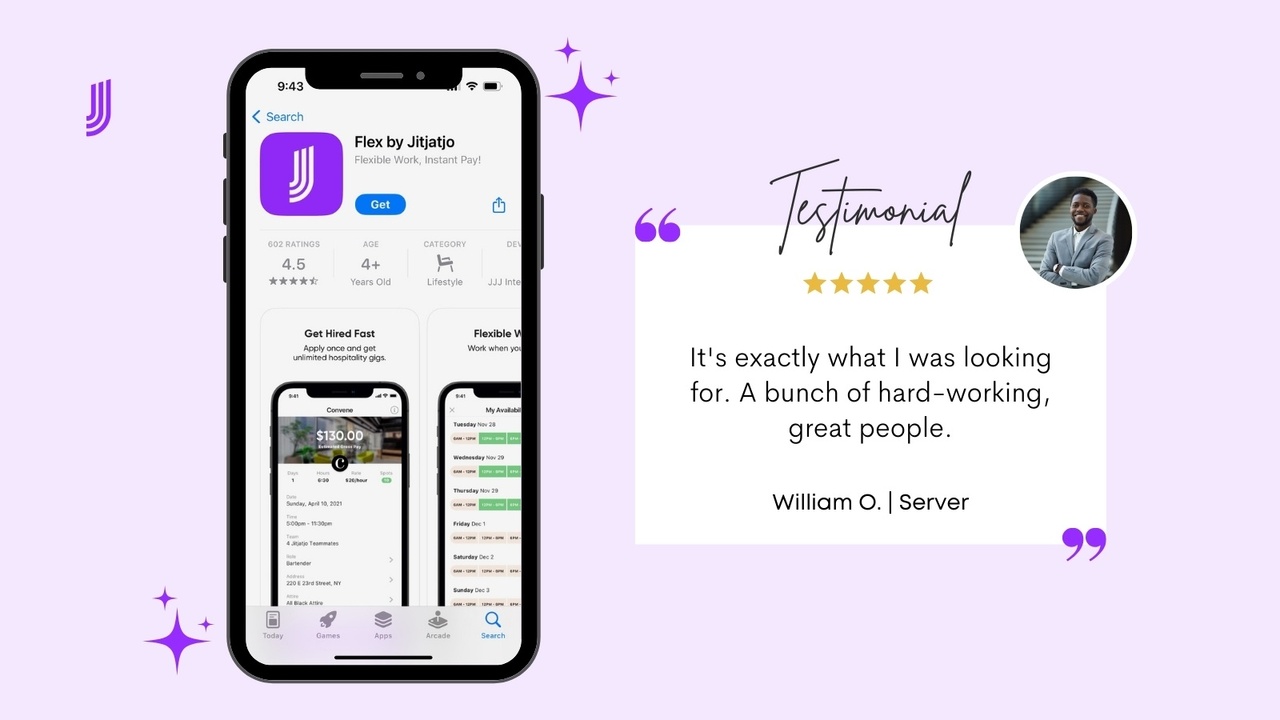
The neat app screen hid a decidedly unneat operation. Jitjatjo said it interviewed applicants, assessed skills, checked references and backgrounds, collected tax forms, recorded time, ran payroll and reviewed performance. Workers set availability and could accept shifts through Flex. Businesses placed requests through Ondemand. After a shift, each side could review the other. A venue that liked a worker could get first access to that person for another booking. The product was trying to make a familiar face out of an unfamiliar temp.
“Initially, our platform was centered around last-minute bookings and instant fulfillment.”Tim Chatfield, 2017
The distinction mattered because a staffing marketplace can solve two different problems. One is discovery: show a manager somebody who might work. The other is delivery: ensure a qualified person arrives, works legal hours, gets paid and might want to return. Jitjatjo tried to own more of the second problem. Its workers were W-2 employees rather than independent contractors, according to the founders and later Dayforce. That choice created administrative work, but it also gave the company a clearer answer to clients asking who had vetted the person walking into their kitchen.
- VetInterview and screen the worker.
- MatchPair availability and skills with the shift.
- VerifyRecord arrival, hours and performance.
- SettlePay the worker and bill the client.
Seven days was an opinion
The early booking limit embodied a theory about the customer: if you need temporary help, you need it soon. The customers supplied a better theory. Once they trusted the match, they wanted to put future coverage on the schedule too. Extending the window did not require a new slogan; it required the founders to notice that the same manager who panicked on Monday planned a banquet on Friday.
It is an unusually useful lesson for anyone building a marketplace. Watch what users do after the first crisis has passed. A customer who returns to plan ahead is giving the product a different job. In Jitjatjo's case, the two-month calendar turned a rescue tool into part of routine staffing. The company still had to keep enough available workers in each market for the promise to mean anything. A beautiful booking flow cannot conjure a bartender across town.
The bill, in plain sight
Jitjatjo's business model was transactional. Chatfield described it as retaining a percentage of each booking total. Published client terms say business registration is free and show an hourly fee when a booking is confirmed. They also spell out the less photogenic edges of staffing: overtime, cancellations and direct hiring. Overtime can raise the billed hourly rate to 1.5 times the standard rate. A client who hires a Jitjatjo worker directly before that person has completed 320 billable hours at the location may owe a conversion fee; after 320 hours, that fee is zero.
Those terms reveal what the hourly price pays for. The customer sees a worker at a particular time; behind that is recruiting, insurance and compliance work, payroll, customer support and the cost of building a local pool before every shift is filled. The public terms do not publish a universal hourly price. Rates appear at booking and vary by role and circumstance. It is more honest to call this a service with software than to pretend the software makes the service free.
A sudden change of venue
Then the pandemic attacked the very market that gave Jitjatjo its first reason to exist. Hospitality workers lost shifts as restaurants closed or narrowed service. The company trained people in hygiene, cleaning and disinfection and put its labor pool to work in places that still needed staff, including healthcare facilities. Chatfield described the move simply: “We started retraining and retooling them.” The point was practical. Someone trained to work a crowded event might also be able to learn a new frontline task, provided the company did the training and a buyer had a real need.
Jitjatjo's 2020 account said its COVID-19 awareness training reached more than 10,000 hospitality workers in its talent community. A later interview named the Javits Center and New York-Presbyterian among organizations it supported during the crisis. These were company-reported accounts, and the impressive number describes a historical talent pool, not a guaranteed supply of available workers today. Still, the episode shows the value of knowing workers as people with skills that travel beyond a job title.
The marketplace grows a second business
Jitjatjo moved into healthcare, retail, education and facilities work. It also built Network, software for enterprises and staffing agencies to manage shifts, vendors and contingent labor. This was a different sale from filling tonight's vacancy. A large operator might already have employees, alumni, agencies and local temp pools. Its problem is deciding where a request goes, enforcing rates and keeping invoices and performance visible. Network addressed that administrative maze.
The company added a worker benefits program, Better by Jitjatjo, in 2023 with Avibra. The program offered access to insurance, counseling, prescription discounts and optional paid benefits. That same year Jitjatjo announced a $30 million Series B led by Morningside Technology Ventures, following an $11 million Series A in 2019. Funding made expansion possible; it did not, by itself, prove every shift was filled or every worker was satisfied. App reviews and reporting have also recorded missed gigs, clock-out problems and delayed pay. In a labor marketplace, small software faults have immediate human consequences.
In 2024 parent JJJ International made the distinction between its businesses explicit. Jitjatjo remained the on-demand staffing marketplace. Network became the separate enterprise software brand. Esposito, a co-founder and the product architect, became CEO. The separation acknowledged that a restaurant manager buying a temporary server and an enterprise procurement team buying vendor software need different conversations, even if both products share the same view of shift work.
The hardest part of an instant shift is everything that happens before it can look instant.
The larger calendar
Dayforce acquired JJJ International in 2025 and added its capabilities to Dayforce Flex Work. Dayforce described the combined offer as on-demand staffing plus vendor management, with the ability to work across permanent staff, part-time workers, alumni and agency partners. Jitjatjo's original emergency booking now sits inside a much larger workforce map. The company that began with the empty place setting had become useful to a buyer managing the whole dining room.
There is a copyable sequence here. Start with a costly, frequent failure; for Jitjatjo it was the unfilled shift. Do the difficult backstage work so the customer can make a simple request. Then let repeat customers reveal the adjacent job. The seven-day cap was the first feature to give way because managers trusted the system enough to plan with it. The sequence relies on a dense local worker pool, credible vetting, careful labor administration and software that records hours correctly. Where those pieces are thin, the button remains a promise the operation cannot keep.
That may be the most interesting thing about the story. The founders offered to make staffing immediate. Their customers taught them that the more valuable trick was making it dependable, even when the shift was still two months away.