At 6 p.m. in a hotel, an empty shift is not an abstract human-resources problem. It is a queue at the bar, a banquet table waiting for plates, and a manager calling everyone whose number is saved under “staff.” Rota was built for that particular kind of panic. The London company began as a way for hospitality businesses to summon vetted temporary workers through an app. Its more consequential idea came later: the useful product was not merely the pool of workers. It was the system that knew who was available, who was qualified, where the work was, what happened on the shift and what should be paid afterward.
That distinction carried Rota from restaurants and stadiums into a broader workforce-management business. It also carried the company through hospitality’s Covid shutdown and, in 2022, into TTM Healthcare Solutions, which bought 100 percent of Rota. Today the app helps healthcare agency workers publish availability, find shifts and manage timesheets. A bartender and a healthcare assistant are not interchangeable, of course. The operational riddle is: match an approved person to a specific place and time, tell everyone what changed, and leave a reliable record.
The first product wore an apron
Nick Bolton, Tom Williams and Will Taylor founded Rota in 2015. The founders had unusually useful scar tissue. Williams had managed hotels. Taylor had worked a paper round, mixed drinks in a bar and taken temp shifts at a hotel. Their company initially looked like a technology-enabled staffing agency: employers posted work; Rota’s algorithms offered it to suitable members; people chose when and where they wanted to work.
The worker proposition mattered. Taylor wrote that temporary work was often a financial safety net, not a lifestyle accessory. He wanted reliable access to fairly paid work for people who showed the right attitude. Rota held parties for its members in London and Manchester to gather feedback. At the London party, Taylor offered to buy a few people drinks and ended up funding a round for roughly 100. Product research occasionally arrives with a frightening bar tab.

By 2018 the company said it had more than 5,000 active members across London, Birmingham, Manchester, Leeds, Edinburgh and Glasgow. Its client list included InterContinental Hotels, Compass Group, Manchester Arena and Hearts Football Club. A 2019 profile put the wider worker pool above 50,000 and supplied Rota’s neatest sales statistic: a company could post a shift in as little as 20 seconds, and a shift was filled in 38 minutes on average.
“We are strong believers that by combining technology with human touch service, agencies can have a winning offering for clients and candidates.”Tom Williams, co-founder
Covid found the brittle part first
Rota’s marketplace depended on hospitality shifts existing. The company had closed a £3 million funding round led by Puffin Point in March 2020, following a £1.8 million round involving Chimera Partners and Eden Ventures in 2018. The new capital was intended for expansion, marketing, technology and new staffing verticals. Then hotels, restaurants and events shut their doors. The marketplace engine had plenty of fuel and much less road.
What changed Rota’s mind was not a boardroom thought experiment. The founders had already built software to run their own agency, then watched Covid expose the cost of tying the company to one pool of jobs. Their answer was to sell the machinery to other staffing agencies. Instead of competing for every worker and client, Rota could help agencies digitise their existing relationships.
The 2021 pitch was blunt. A client posts a shift. Qualified candidates are chosen manually or by the matching algorithm. Details travel to their phones. The platform updates the schedule and timesheet. Rota said customers saw 20 percent less administrative time, four times as many roles filled and 3 to 5 percent more contracts signed. Those were company-reported averages, not independent trial results, but they explain the buying logic. The software did not promise to make staffing glamorous. It promised to make consultants stop calling down a list.
One screen, three labor markets
Rota calls its product “total workforce technology.” The phrase earns its keep when the software searches in a sensible order. An employer schedules the permanent team, sees a gap, offers the shift to an internal casual bank, and only then reaches an outside agency. That escalation ladder is the important difference from a plain scheduling calendar or a pure gig-work marketplace.
Around that core sit the less photogenic features that determine whether a staffing system survives contact with Friday night: performance ratings, shift briefings, push notifications, reminders, check-in and check-out, breaks, costs and reports. Rota described check-ins using a secure PIN or a combination of QR codes and geolocation. Managers could see who was booked, who actually arrived and what the hours would cost. A worker could see the rate, location, instructions and status on a phone.
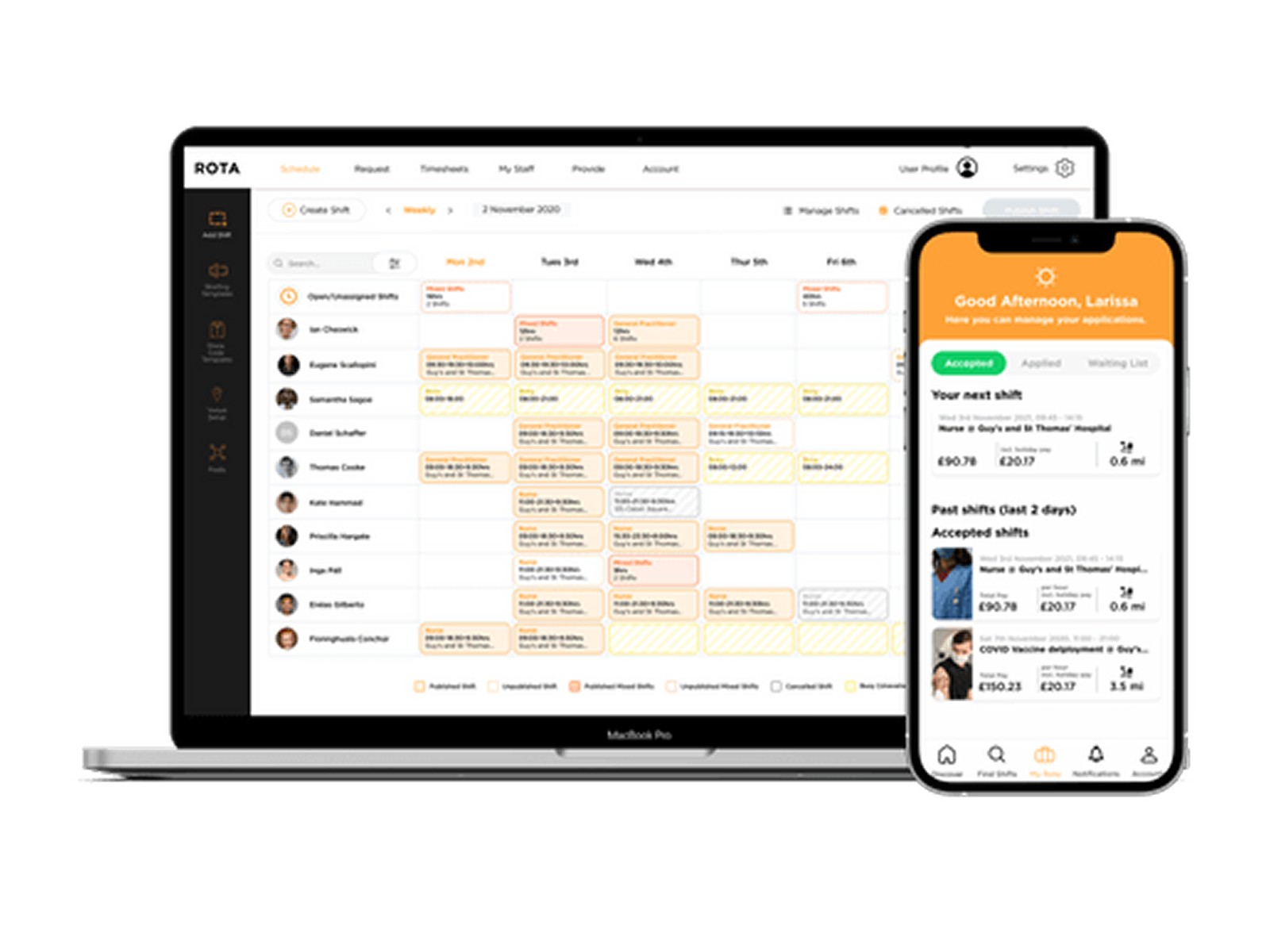
This puts Rota between several categories. Deputy, Planday, Rotageek, RotaCloud and 7shifts sell workforce scheduling. Indeed Flex and Coople match flexible workers to jobs. Traditional agencies provide screening and service. Rota’s bet was that one platform could borrow from all three: software for the employer, a marketplace-like experience for the worker, and operational controls for the agency.
The buyer pays for fewer loose ends
Rota’s commercial model moved from margin on managed staffing toward sales-led B2B software. Public pages invited employers and agencies to book a demo rather than displaying a sticker price. That makes sense for a platform whose cost depends on sites, worker populations, integrations and service. Customer-success support was part of the offer. Rota’s own writing argued that self-service SaaS can leave customers with software they never learn to exploit.
The likely economic buyer is not enthralled by a calendar. It is the operations leader paying for overtime, the agency owner measuring consultant productivity, or the finance team reconciling disputed hours. Scheduling is the visible wedge. Spend control, fulfilment and clean records are the budget.
The exit moved the app into healthcare
TTM Healthcare Solutions acquired Rota in August 2022 alongside a majority investment in international recruiter MMA Healthcare Resourcing. TTM, a large supplier to the NHS, Ireland’s HSE and Health and Social Care Northern Ireland, wanted technology that could manage multiple locations and a multidisciplinary workforce. The two acquisitions were completed in under four months from initial contact to close. The price for Rota was not announced.
The product survived the transaction. TTM’s current help material describes ROTA as its workforce-management app. Agency workers can post availability six weeks ahead, apply for or accept shifts, review past work and manage digital timesheets. Google Play lists more than 50,000 downloads and shows the Android app updated in June 2026. The brand is quieter as a standalone startup, but the software has become infrastructure inside its buyer.
What another operator can steal
Rota’s copyable move is not “add an algorithm.” It is to build around the full operational loop. An empty shift is only resolved when the right person knows about it, accepts it, arrives, records the correct hours and appears in payroll. A tool that stops at publishing the rota merely moves the chasing somewhere else.
The second lesson is proximity. Rota operated the messy service before selling the software. That gave the team live data, impatient users and a sharp view of the handoffs that fail. The third is to let former competitors become customers. Packaging its internal agency system widened the addressable market without requiring Rota to own every local worker network.
Where the model earns its place
- High volumes of repeatable shifts
- Multiple sites or worker pools
- Pre-approved, reachable candidates
- Manual timesheets and costly gaps
Where software runs out of road
- Rare, bespoke senior hires
- No trusted pool to notify
- Credentials live in disconnected systems
- Managers will not maintain availability data
Conditions matter. Fast matching works when there is a liquid pool of approved workers, clear shift information and enough demand to keep the network active. It is weaker for rare specialists, irregular executive placements, or workplaces where qualifications cannot be checked inside the workflow. Ratings also need governance: a performance score that changes someone’s access to work should not become an unexplained black box. And no mobile interface can rescue bad pay, unsafe work or a manager who changes the rota without warning.
Rota’s history is therefore less a victory lap for automation than a practical argument for connected operations. A manager still decides what good coverage looks like. An agency still vets people and handles exceptions. Workers still decide whether a shift is worth taking. The app is valuable because it gives those decisions somewhere to meet - and because, by the end, everybody is looking at the same Tuesday.
Keep exploring