A vacancy on a senior care schedule is a small blank square with an expensive social life. Someone calls a colleague. Someone offers overtime. Someone phones an agency. By the time a nurse walks through the door, several people may have spent their afternoon arranging it. KARE has built a business around shortening that sequence. But its most interesting choice comes after the shift, when the community decides it likes the person who arrived.
- Communities set shift rates; qualified clinicians choose where to apply.
- KARE charges for worked hours, with no placement fee for permanent hiring.
- NASTi adds free core scheduling, putting existing employees first.
The usual commercial instinct would be to protect the relationship. A person who moves onto the customer’s payroll stops producing marketplace fees. KARE instead encourages the hire. Think of a shift as a working interview: both parties get to see what the other is like when the work is real. A recruitment pitch acquires something rather more useful than adjectives.
The interview happens on the shift
Founded in 2019, KARE serves senior living and post-acute care: assisted living communities, nursing homes and other settings where care continues through nights, weekends and holidays. Charles Turner, its founder and CEO, comes from the senior housing industry. Public company profiles also identify Bridget Kaselak as co-founder and chief operating officer. This is a company addressing the recurring inconvenience of an industry its leadership knows.
Its clinicians are called Heroes. The name suggests capes; the application involves credentials. Nurses and licensed caregivers upload documentation, pass screening and find shifts through the app. Communities review applicants and choose whom to accept. A worker can earn extra income, explore unfamiliar employers or build a schedule around other commitments. An operator can cover an absence and meet a possible future colleague.
For permanent hiring, the placement fee is zero. There is a boundary: KARE’s terms distinguish employment from simply taking paid contracting off the platform. The arrangement gives an operator a reason to keep meeting people through KARE. My reading is that the company trades a claim on any one worker’s future for the possibility of becoming a regular place to find the next one.
The price of an empty square
A community sets the offered pay and can add an incentive when a shift is difficult to fill. KARE earns a fee on each hour worked. Signing up costs nothing. The operator buys labor when it uses labor, rather than paying an entry charge for the privilege of discovering whether anyone is available.
That still leaves the important arithmetic. An employee’s hourly wage is only one component of staffing expense. NASTi’s published savings calculation includes overtime premiums, payroll taxes, workers’ compensation, paid time off and payroll fees. Its agency comparison uses billed rates where available, or an estimate where they are absent. Operators should compare those assumptions with their own costs. A cheerful calculator can be wrong with excellent typography.
Pricing structure, not a quote for any particular shift.
In August 2021, KARE raised a $7.85 million Series A led by Golden Section Ventures for national expansion. The funding bought room to widen the marketplace. It did not repeal geography. A clinician in another city is little help to a community needing someone before breakfast.
Catch the mistake before payroll
KARE’s newer scheduling product has a name that sounds like a dare: NASTi, short for Not Another Staffing Tool for the industry. Its argument is that a report explaining last month’s overtime arrives after the money has gone. Put the policy inside the scheduling decision, and someone can act while the decision is still reversible.
“If a shift swap is going to trigger overtime, the system blocks it or flags it instantly.”Lindsay Evans, VP of Product, NASTi launch announcement
Administrators configure rules for coverage, overtime and swaps. Employees can see schedules, request shifts, exchange eligible assignments and communicate through the app. Open work can go to existing staff first, with remaining gaps routed to KARE under the operator’s settings. Nursing, dining, housekeeping and activities belong in the same scheduling conversation.
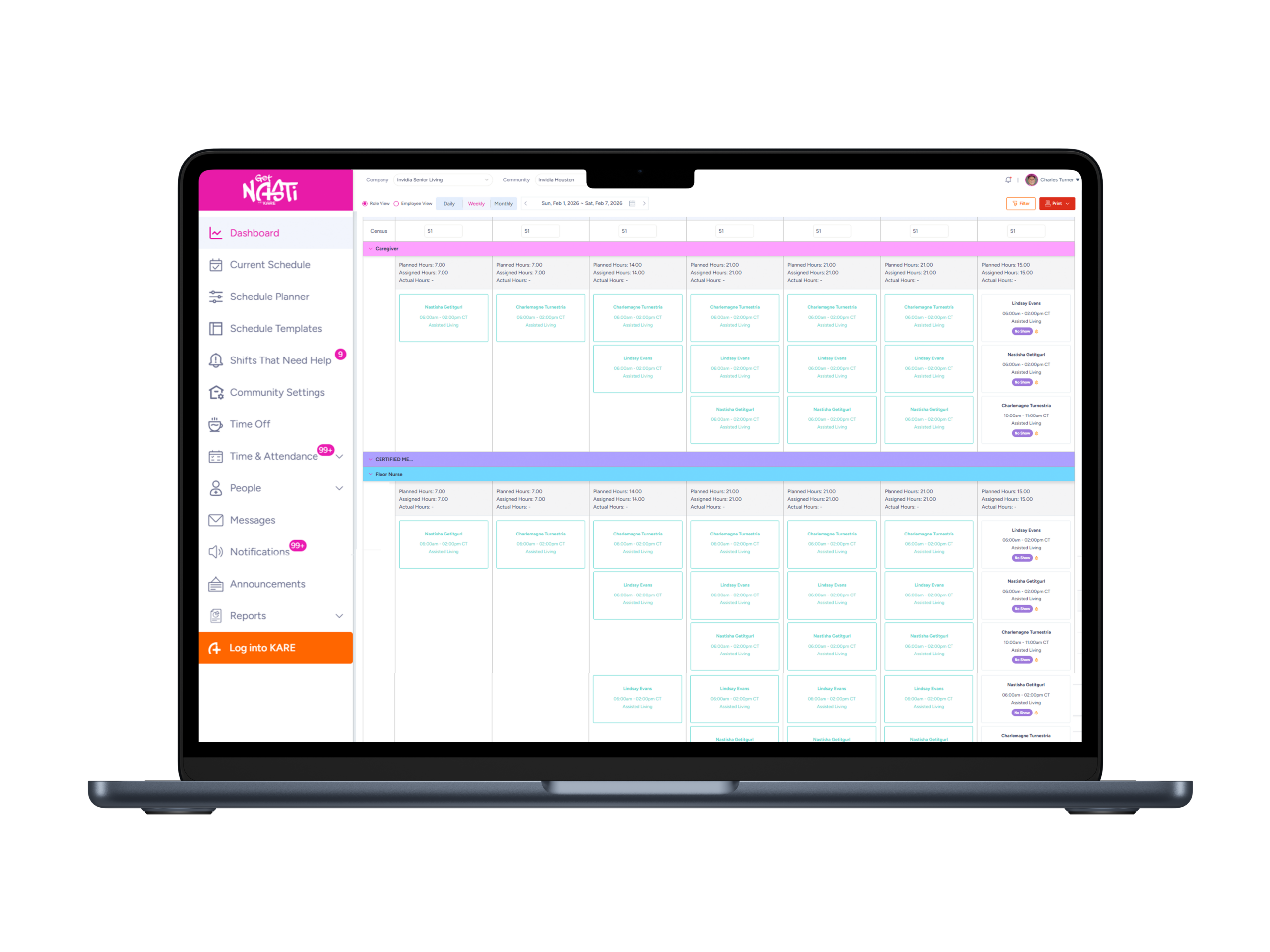
Core scheduling and time-and-attendance are free. The FAQ also lists optional paid premium insights and hands-on support, a useful qualification to the headline price. KARE says setup can take under two hours; optional payroll and HR integrations may require additional coordination. Free software beside a paid marketplace makes commercial sense: the schedule is where the need for outside help becomes visible.
- 01 / Set guardrailsCoverage, roles, overtime
- 02 / Offer internallyExisting employees first
- 03 / Send the gapKARE applicants, your selection
The app cannot manufacture a nurse
Here is the practical limit. Software can display available labor, but a qualified person must still be nearby and willing to accept the rate. Documents must be current. A new clinician needs orientation to the community. The published therapy offering, for example, lists physical, occupational and speech therapy roles in Colorado, Georgia and Texas. A national ambition does not mean every service is everywhere.
Payment has its own conditions. KARE markets fast pay, while its HERO FAQ describes verification, ratings and banking cutoffs that affect timing. Clinicians work as independent contractors, choosing shifts rather than becoming KARE employees. The flexibility therefore belongs in the same calculation as the obligations of working independently.

Digital competitors, including ShiftMed, also combine workforce tools with access to clinicians. KARE’s particular package centers on senior and post-acute care, operator-set rates, independent professionals and permanent hiring without a placement fee. Traditional agencies and an operator’s own overtime or PRN pool remain alternatives. The useful comparison is local availability, total expense and fit with the team.
There is a lesson here that does not require downloading anything. Give current employees a clear first chance at open shifts. Put spending rules where the schedule is made. Treat a good temporary colleague as someone worth hiring. KARE’s proposition becomes convincing at that ordinary moment: a stranger finishes a shift, and the community would like them to return.