The seduction of Diem Health fits inside one ordinary staffing emergency. A nurse calls out. A hospice needs coverage. Somewhere nearby, a licensed professional has an open afternoon and would like the money. Between them sits a telephone tree, an agency markup, a folder of credentials and enough voicemail to flatten everyone’s mood. Diem Health’s answer was a screen: choose a role, check a map, inspect a profile and send the visit.
Founded in 2019 and based in Pleasanton, California, the small company built a marketplace for per-diem healthcare labor. On one side were hospitals, home-health agencies, skilled nursing facilities, hospices, private offices, dental practices and veterinary practices. On the other were nurses, physicians, therapists, technicians, medical assistants, dental workers, veterinary workers and administrators. The pitch to clinicians was autonomy - work by time and proximity, search from a phone and get paid quickly. The pitch to facilities was speed - find an available, qualified person without waiting for a traditional staffing intermediary.
It was an ambitious attempt to make healthcare labor behave a little more like a live local network. Public company data records a $510,000 convertible note in August 2019. The iOS app reached version 1.1 that October. A free download and a free 90-day trial lowered the door for clinicians. Facility pricing, marketplace fees, revenue and usage were never publicly disclosed.
00 / The customer
Two people bought two different promises
For the clinician, Diem was an income and control product. A nurse or therapist did not need another employer’s fixed roster; the app promised a menu of work that could bend around an existing job, family obligations or an irregular week. Location mattered because an extra shift stops looking attractive when a long drive eats the margin. Immediate payment mattered for the same reason. Diem was not merely matching a résumé to a vacancy. It was trying to turn spare professional capacity into something a worker could see and sell.
For the facility, the problem was operational and expensive. An uncovered visit delays care, consumes a coordinator’s time and may force a manager into agency escalation. Diem’s screens offered a single place to search, verify, request, schedule and retain a record. Its likely business buyer was not the patient and not usually the clinician. It was the agency, practice or facility that already felt the cost of an empty shift. That placed Diem between workforce-management SaaS and transaction marketplace: a useful workflow could attract facilities, while successful matches could make the network more valuable.
What did it cost? Public evidence answers only part of the question. The clinician app was free to download, and a 2019 listing promoted a free 90-day trial. Diem did not publish a facility subscription, placement charge or take rate in the surviving materials. The company itself raised $510,000 through a convertible note - modest capital for mobile apps, enterprise software, compliance operations and simultaneous local market-making. That amount buys a serious experiment. It does not buy national liquidity by default.
01 / The product
A staffing desk, folded into a browser
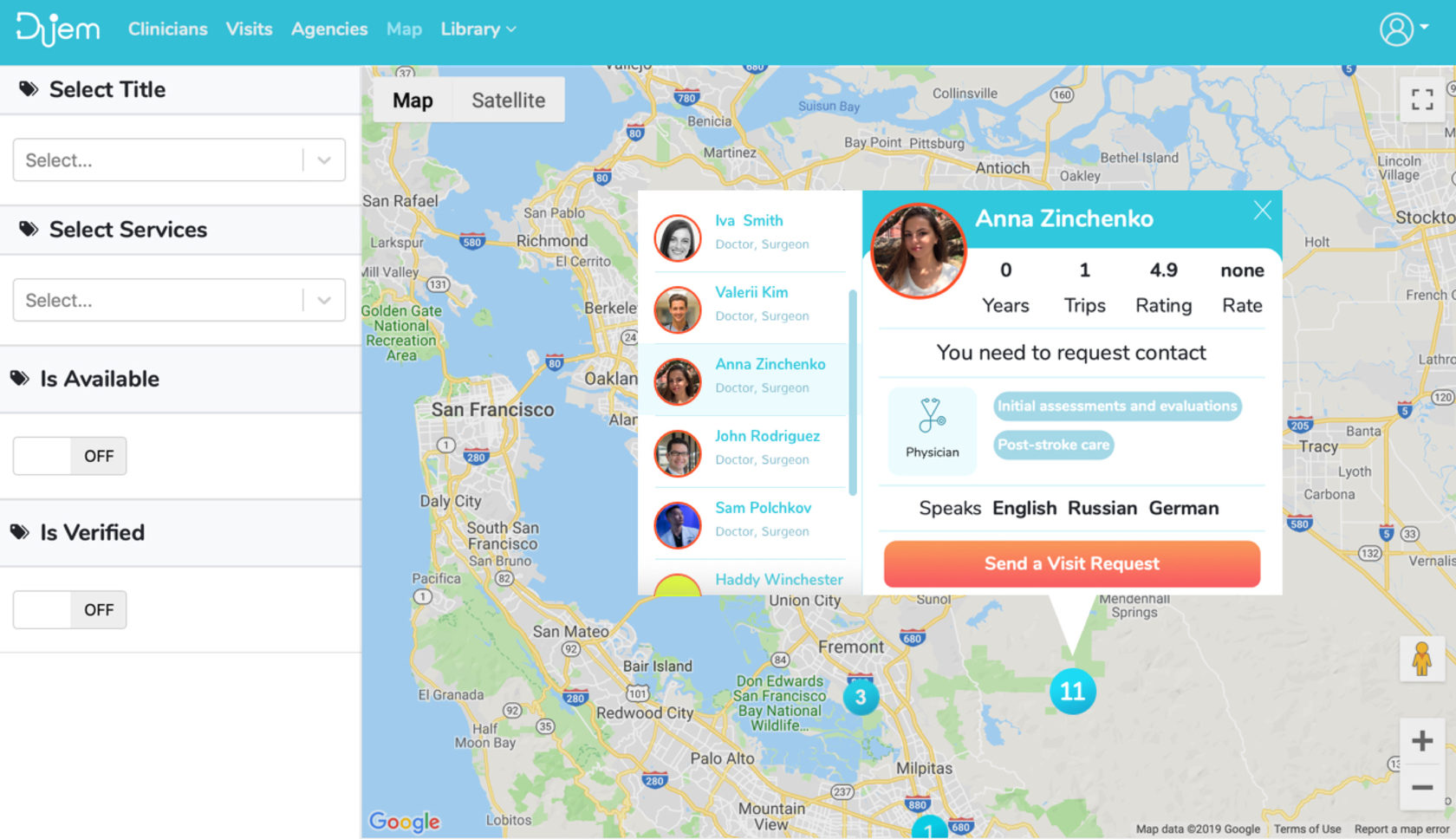
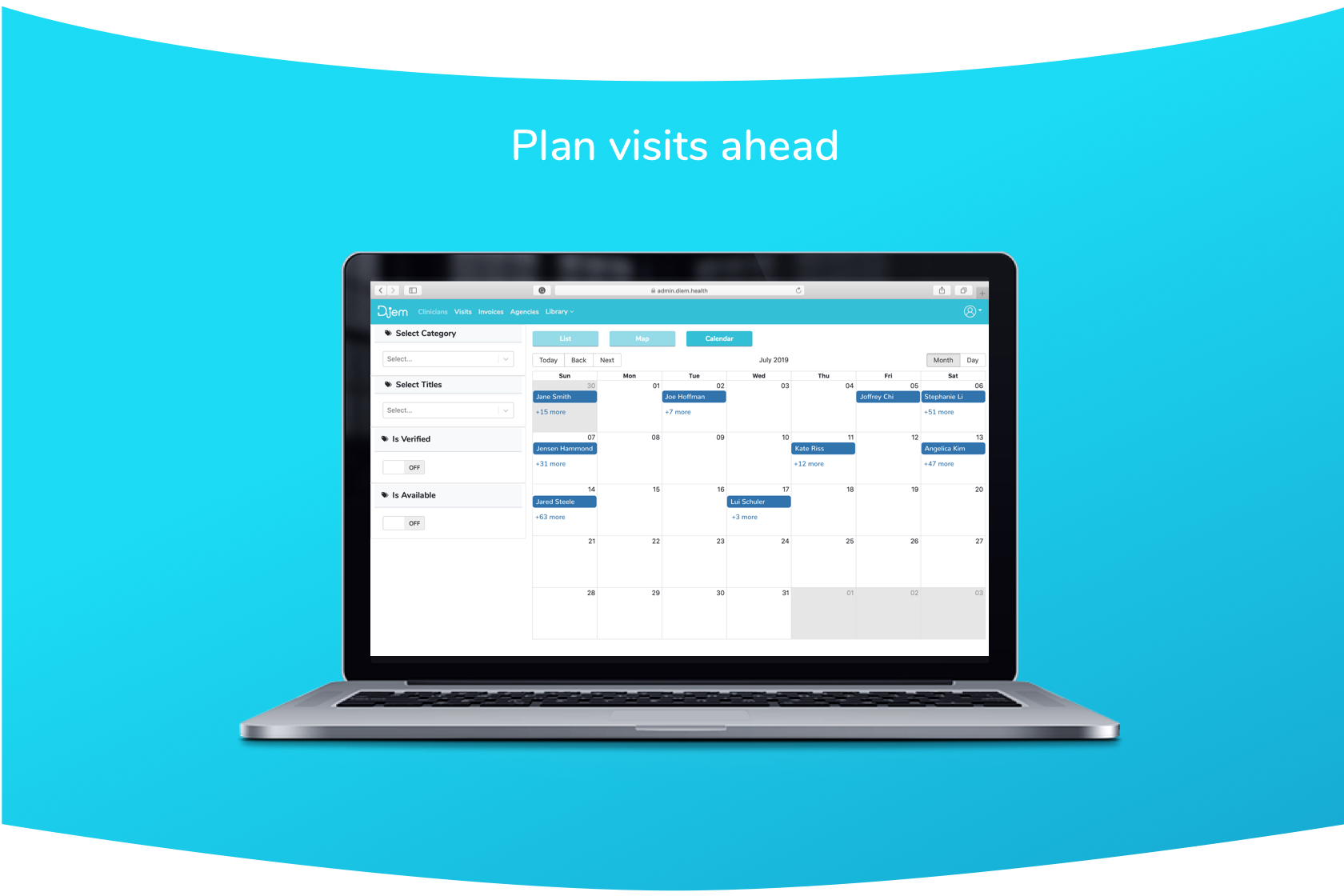
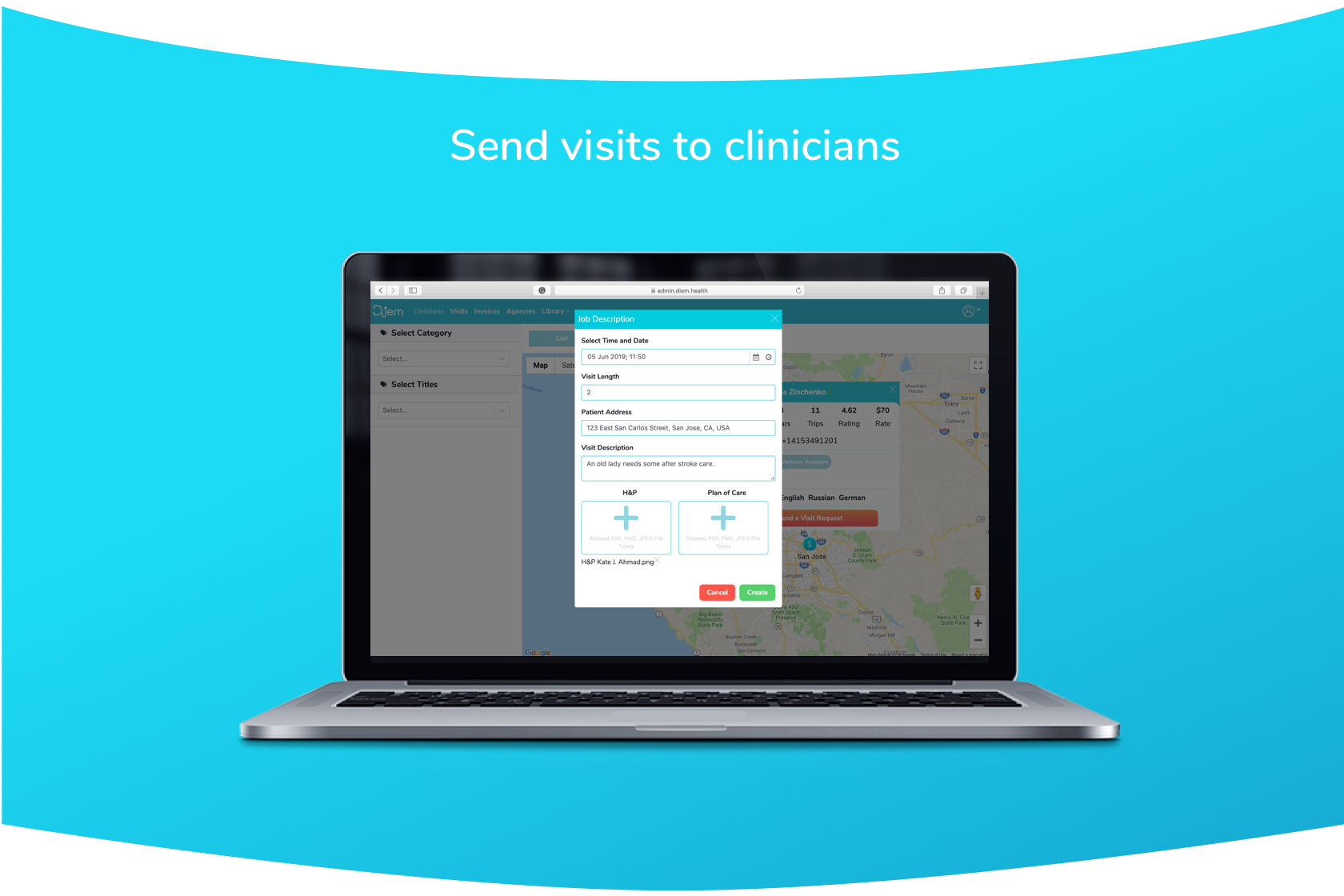
The archived product is more specific than the slogan. A facility dashboard carried tabs for clinicians, visits, invoices, agencies, maps and a library. Managers could filter workers by category, title, availability and verification status. A map view arranged nearby clinicians around the Bay Area. Open a profile and the system showed services, languages, experience and ratings; send a request and a form collected date, duration, patient address, visit details and care-plan documents.
The clinician record went deep. Demo screens included education, work experience, a calendar, professional licenses, CPR cards, identity documents and payment details. That is not incidental administration. In regulated labor, the profile is the product. A worker who must repeatedly fax the same documents has not escaped the staffing desk; the desk has merely followed them into an app.
“Focus on the work that matters most.”Diem Health’s 2019 homepage
02 / The change
First it sold the tool. Then it sold the market.
Diem’s earliest public language was enterprise software language: “Schedule. Communicate. Manage.” The site called itself a robust solution for healthcare agencies and hospitals. The machinery came first - visit management, employee notifications and advance scheduling. By May 2020, the emphasis had changed. The homepage led with connecting facilities and clinicians, “instant clinicians hiring,” mobile onboarding, flexible work and a free app.
That looks like a product pivot in positioning, though no founder has publicly explained the reason. The likely strategic fork is familiar. Selling workflow software to facilities produces a customer even before a network is liquid. Building a marketplace promises a larger outcome, but only works when each facility sees enough nearby workers and each worker sees enough worthwhile shifts. Diem moved its public story toward the second prize.
The first visible failure was not a documented product outage or a public collapse. It was the public surface itself. The marketplace proposition was still online in a November 2021 archive. By December 2022, archived visits returned “Pages are not published.” There is no reliable public postmortem, customer count or shutdown announcement. That absence matters. It limits the honest conclusion to this: Diem’s public presence stopped explaining and selling the original product.
The company never said. What the archive proves is narrower: the pitch moved from B2B workflow software in 2019 to a free-app, two-sided marketplace in 2020. A reader can observe the repositioning without inventing the meeting that caused it.
03 / The hard part
One app can contain fifty separate markets
Diem’s occupational catalog was almost comic in its range. Behavioral-health charge nurse. Flight physician. Speech-language pathologist. Dental hygienist. Veterinary technologist. Bereavement counselor. Claims specialist. Chaplain. The list demonstrated a flexible database and a generous view of healthcare work. It also exposed the marketplace trap.
A registered nurse in Oakland cannot necessarily fill a veterinary-assistant visit in Fremont. A home-health agency needing a licensed vocational nurse Tuesday morning does not care that the platform has a surgeon available Friday evening. Every geography, license class, specialty, time window and rate creates another pocket of supply and demand. Nationwide coverage on a landing page does not make those pockets liquid.
This is where Diem differed from a plain staffing agency and from ordinary scheduling SaaS. The software could reduce search and coordination costs. The marketplace aimed to remove the agency entirely. But the intermediary had been doing more than making calls: recruiting, credentialing, pricing, handling no-shows, moving payroll and carrying risk. “No middleman” is a crisp headline. Replacing every job the middleman performed is the operating plan.
04 / The steal
Copy the wedge, shrink the map
There are several good ideas here worth taking. First, make the worker profile portable. A clinician should complete credentials once, update them in one place and reuse that verified identity across opportunities. Second, place the request inside the discovery flow. Diem let a manager move from map to profile to visit form without a handoff. Third, give the fragmented side an easy entry. A free app and trial make sense when supply is the scarce ingredient.
The part not to copy is the visible breadth. A new marketplace would be better served by one metropolitan area, one facility type and one repeatable shift category. Win weekend nursing coverage for skilled nursing facilities in a tight radius, for example. Measure fill rate, time to fill, cancellations, repeat bookings, credential completion and worker earnings. Expand only when both sides return without being dragged back by sales or subsidies.
Turn credentials into a reusable worker passport, then put booking one click beyond trust.
Do not confuse a long role menu with liquidity. Every new category can be a cold start.
Subsidize clinicians if needed; monetize facilities only after faster fills are measurable.
Fill rate, time to fill, cancellation rate, repeat usage and earnings per active worker.
The model would not work everywhere. Rural markets may lack enough nearby professionals for on-demand matching. Highly specialized roles produce thin supply. Facilities with strong internal float pools may not need an outside network. Union rules, worker classification, licensing, insurance, payroll and local regulation can change the economics. Immediate pay also requires working capital or a finance partner. A map cannot wish any of that away.
Diem Health’s public record ends without the satisfying bow founders usually add to a case study. That makes it more useful. The company found a real irritation, drew a remarkably legible product around it and then aimed at the larger marketplace hiding behind the workflow. The archive preserves both the insight and the warning: software can make a staffing market visible, but visibility is not the same as density. The calendar is easy to draw. Filling it, shift after shift, is the company.