A shift has an awkward habit of beginning before anyone clocks in. Someone must find the work, find the worker, explain the assignment, and make sure the money arrives afterward. Jobble has spent its life moving along that chain. What began as an effort to organize hourly gigs now stretches from a homeowner asking for help to a manager approving the hours. The company’s changing shape makes more sense when you start with the inconvenience that came first.
- For workers: find flexible jobs, manage shifts, and track payments in one app.
- For businesses: recruit and manage workers, with self-service and supported options.
- The newer move: sell customer opportunities alongside workforce tools.
- The useful lesson: a match needs instructions, follow-through, and someone willing to return.
A check in the mail, an idea in the meantime
Zack Smith and Corey Bober knew the loose arrangement of odd jobs: an email, an assignment, a paper check weeks later. An earlier student staffing business, Collegiate Contact, supplied the starting point. Jobble’s own history dates its launch to 2016, although public reporting described a beta marketplace in 2015. The idea had a longer apprenticeship than the tidy anniversary suggests.
“It was always a very decentralized process.”
Corey Bober, speaking to Northeastern in 2021
That early coverage described seven companies lined up to test the service and a $10,000 grant from Northeastern’s IDEA accelerator. Workers could choose assignments by location, availability, and pay; businesses could inspect profiles and past ratings. The proposed improvement was wonderfully unglamorous: make short jobs easier to arrange, and handle the payment afterward.

The gigs disappeared. The need for work did not.
Then the event calendar emptied. During COVID, Jobble expanded its efforts to meet supply-chain demand while workers lost jobs tied to public gatherings. By November 2021, Bober said events accounted for less than 10% of listings. Delivery, retail, restaurants, and warehouse work had become more prominent. The platform could carry other kinds of work; its original pool of assignments could not carry the company indefinitely.
The practical lesson is to distinguish the machinery from its first use. Jobble had built ways to connect workers and businesses. An event was one application of that machinery. When that demand collapsed, the company moved toward work that still needed doing. For another marketplace operator, the question to copy is whether the existing relationships and workflow can serve a neighboring need.
Its July 2019 financing, led by Vestigo Ventures and AXA Venture Partners, was intended to expand development, sales, and marketing. The Inc. ranking followed in 2022. Neither milestone explains the business by itself. The more revealing evidence is what Jobble chose to organize next.
Who finds the customer?
The current offer has three names: Acquire, Deploy, and Operate. Acquire qualifies and routes customer opportunities. Deploy organizes workers and assignments. Operate adds account management, payment support, and help running the process. Consider a home-service business: a crew without customers is expensive; customers without a crew are a different sort of embarrassment. Jobble is selling tools for both sides of that predicament.
Jobble Pro makes the acquisition offer concrete. A business sets its service area, weekly budget, and maximum lead price, then receives homeowner requests. Workforce management lives in a separate dashboard. The distinction matters: buying a lead buys an opportunity to talk, not a finished sale. Pro’s terms explicitly decline to guarantee conversion or profit.
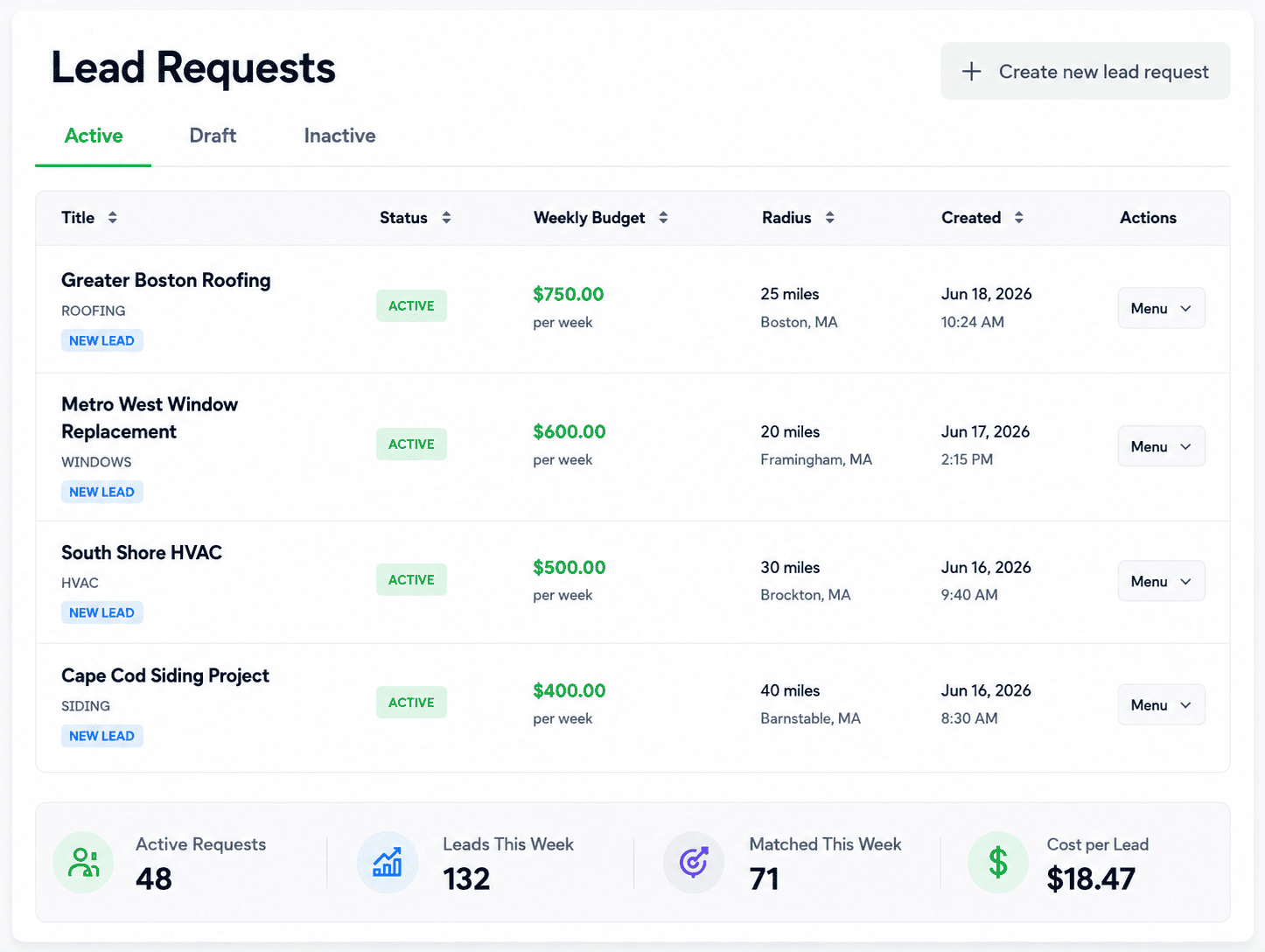
This places Jobble across two markets. Instawork and Wonolo also help businesses fill hourly roles, so scheduling and payment tools alone are familiar territory. Jobble’s broader pitch connects those tasks with demand generation. Its site also describes physical assignments triggered by digital requests, such as inspections and photo verification. The proposed bridge runs from software instructions to somebody actually arriving.
The operations layer acknowledges how much work remains after a successful match. Jobble offers a team to help launch accounts, monitor lead quality, adjust targeting, coordinate staffing, and support invoicing. That makes its expertise partly technical and partly procedural. A buyer can manage the platform directly or seek help with a more customized workforce. The commercial question is how much coordination the business wants to keep in-house.
The arithmetic behind the shift
Jobble’s public staffing price adds 39% to worker pay. On an illustrative $20 hourly rate, an eight-hour shift means $160 for the worker and $62.40 in platform fees: $222.40 combined. That is a calculation using the published rate, not a quote for every engagement. The price deserves comparison with the coordination time and alternative staffing costs it replaces.
$222.40 combined at a $20 hourly rate + 39% fee
Direct hiring has its own terms: within six months of the worker’s last day, the published fee is $2,500 for up to 500 hours worked, dropping to zero above 500. Workers use the app free. They verify their details, complete a profile, apply, accept offered shifts, and undergo a background check. The getting-started guide describes direct-deposit payment within five to seven business days.
Benefits have been another strand of the offer. A 2021 partnership with indi, supported by PNC Bank and Mastercard, introduced banking features including expense tracking and tax savings. It fits the underlying problem: independent work leaves the worker to assemble services that a conventional workplace might arrange.
The parking lot is part of the product
Jobble’s hiring guidance recommends posting a week ahead, allowing at least 72 hours for last-minute needs, and initially over-hiring by 40% to accommodate cancellations. Its advertised rapid fill rate should be read alongside that operational advice. A large network does not make every worker available in every town.
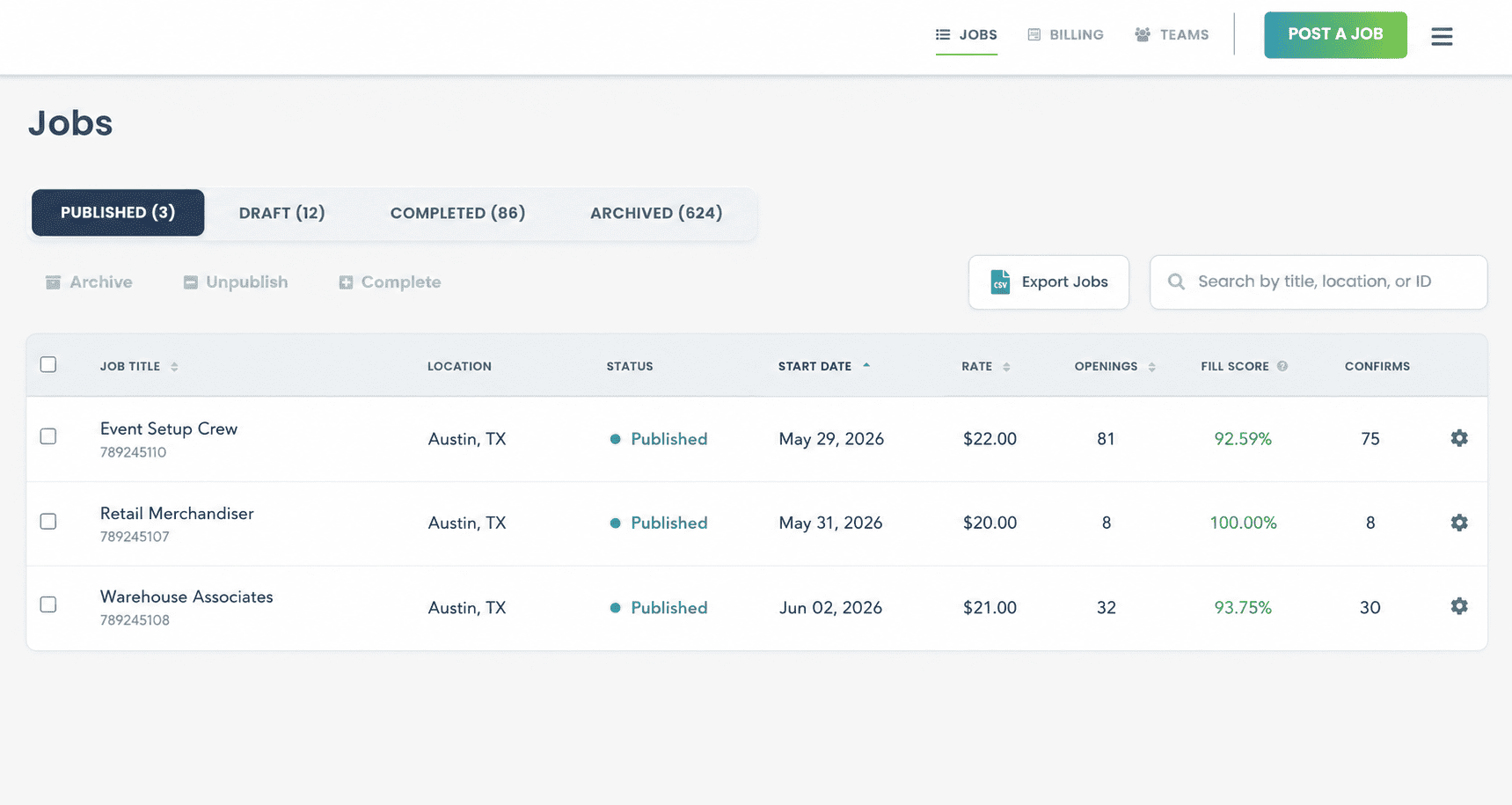
The copyable habits are straightforward: explain arrival details, offer competitive pay, pay promptly, and invite capable workers back. Highly specialized credentials and urgent local shortages still need scrutiny. For a small operator, a sensible trial is one location with clearly defined work and enough notice. The interesting test is whether the second shift becomes easier. A marketplace earns its place when yesterday’s stranger becomes tomorrow’s familiar face.