Work. Now. Locally. 1,000,000+ workers on the platform 3M+ jobs filled $200M+ raised through Series D Born inside Coca-Cola's Founders program Post a shift, fill it in minutes Paid within 1-2 business days Work. Now. Locally. 1,000,000+ workers on the platform 3M+ jobs filled $200M+ raised through Series D Born inside Coca-Cola's Founders program Post a shift, fill it in minutes Paid within 1-2 business days
Company Profile Marketplace Founded 2013

Wonolo

The on-demand staffing marketplace that fills a shift in the time it takes to read this sentence.

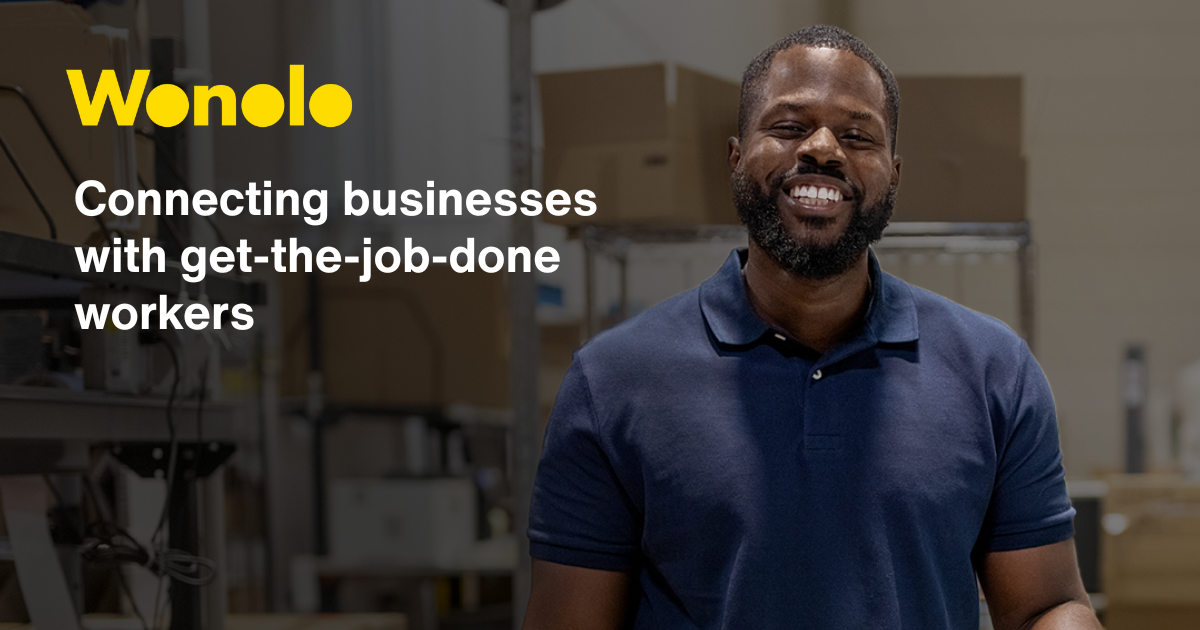
Wonolo brand banner - Connecting businesses with get-the-job-done workers

THE PITCH, IN ONE FRAME. A worker on the floor, a wordmark in Wonolo yellow, and a promise stripped to its studs - connect businesses with people ready to get the job done. No suits, no stock-photo handshake. Just the loading-dock economy, looking back at the camera.

1M+
Registered workers
3M+
Jobs filled
$200M+
Total funding
2013
Year founded
The Story

A soda company's staffing problem, solved

Here is a fact that sounds like a setup for a joke but is instead a business school case study: one of the more interesting labor-market companies of the last decade was invented inside The Coca-Cola Company. In 2013, two Coca-Cola employees, Yong Kim and AJ Brustein, were handed the kind of unglamorous problem that keeps consumer-goods executives up at night - how do you make sure the product is on the shelf, in the cooler, in the right place, at the right time? Part of the answer, it turned out, was people. Specifically, having enough of them, on short notice, in the right location, to move the boxes and stock the shelves.

The traditional way to solve that problem was to call a staffing agency and wait. You would describe your needs to a human, the human would work the phones, and eventually - hours or days later - some workers would show up, minus a healthy cut taken by the agency in the middle. This is a fine system if you have a lot of time and don't mind opacity. Kim and Brustein, working out of Coca-Cola's internal Founders program, noticed that both the businesses posting the work and the people doing it were being poorly served by the middle. So they built software to remove as much of the middle as they could. They called it Wonolo, an acronym for "Work Now Locally," which is the rare startup name that actually tells you what the company does.

"Post a job in seconds, fill it in minutes."

— The Wonolo value proposition, compressed

The pitch is speed, and speed is the whole thing. A business - a warehouse, a distribution center, an e-commerce fulfillment operation, an events company - opens the platform, describes a shift, and posts it. Nearby workers, who go by the delightfully proprietary name "Wonoloers," see it on their phones and accept. The shift, in the ideal case, is claimed in minutes. This is a genuinely different experience from the phone-tag model, and the difference is the product. When you make speed the feature, everything that slows hiring down - the resume, the interview, the callback, the two-week wait for a first paycheck - starts to look like friction to be engineered away.

The market Silicon Valley skipped

For years, "the gig economy" mostly meant getting a stranger to drive you somewhere or bring you a burrito. Those are large businesses, but they are a slice of the actual on-demand labor market. The bigger, quieter slice is the warehouse floor, the loading dock, the merchandising route, the event tent, the food-production line. When Wonolo raised a $32 million round in 2018, TechCrunch described its users as blue-collar and labor contractors "left behind by Silicon Valley." That framing is a little dramatic, but it captures the strategy: point the same marketplace tools that had been aimed at knowledge workers and rideshare drivers at the frontline jobs that keep physical commerce running.

The economics of that choice are straightforward. Wonolo is a two-sided marketplace. Businesses pay per shift or per hour to reach the pool of workers; workers use the app for free; and Wonolo lives on the margin in between, plus the platform and service fees that come with being the party that handles vetting, background checks, and payment. Workers have historically earned somewhere in the range of $12 to $21 an hour depending on the gig and the geography, and they get paid within a day or two of finishing - not on the two-week cycle a traditional employer runs. Shortening the loop between doing the work and getting paid is not a small thing. It changes who shows up.

Showing up, in fact, is the load-bearing behavior of the entire model, and this is where Wonolo did something clever. A marketplace for last-minute labor has an obvious failure mode: the worker who accepts a shift and then doesn't appear, leaving a business short-staffed and furious. Wonolo's answer is a reliability system with teeth. Broadly, three no-shows or late arrivals and you're removed from the platform. Consistency, by contrast, is rewarded - reliable workers earn badges that unlock access to better and better-paying shifts.

This is trust, designed into the product rather than assumed. It is also, if you squint, a small piece of economic policy: the platform is using its rules to price reliability, making it a currency workers can accumulate and spend. That is more sophisticated than it looks, and it is a big part of why businesses come back. The value of an on-demand staffing app is not really the app. It is the confidence that when you post a shift at 6 a.m., someone competent will actually be standing at the dock by 8.

The money

Investors noticed. Sequoia Capital led a Series B in early 2018; a $32 million Series C followed later that year, with Bain Capital Ventures joining, pushing total funding to roughly $60 million. Then, in October 2021 - a moment when the labor market was tight, e-commerce was booming, and "flexible frontline work" was very much in vogue - Wonolo raised a $138 million Series D led by Leeds Illuminate, with 137 Ventures, G2 Venture Partners, and Franklin Templeton participating. That round pushed total venture funding past $200 million.
Series B Apr 2018
$13M
Series C Nov 2018
$32M
Series D Oct 2021
$138M

The person steering the company is worth a sentence of his own. CEO Yong Kim immigrated to the United States alone from South Korea at fifteen - a biographical detail that a company mission statement will inevitably describe as formative, and that in this case genuinely maps onto the business. Wonolo's stated mission is about access: helping people find work and businesses find workers, with an emphasis on transparency, flexibility, and making job opportunities reachable for people who don't fit neatly into a resume-and-interview funnel. Whether a company lives up to a mission is always an open question, but at minimum the mission and the product are pointed in the same direction.

How It Works

Three taps, roughly

STEP 01 — BUSINESS

Post a shift

A company describes the work - warehouse, delivery, merchandising, event, food production, general labor - sets pay and location, and posts it in seconds.

STEP 02 — WORKER

Claim it nearby

Vetted, background-checked "Wonoloers" browse open shifts by location and industry on the app and accept the ones that fit. Popular shifts fill in minutes.

STEP 03 — BOTH

Work, rate, get paid

The worker completes the shift; both sides rate the experience; payment lands within 1-2 business days. Reliability earns badges and better shifts.

What You Can Do With It

For two very different people

If you run an operation that spikes - the pre-holiday warehouse crush, a product launch that needs merchandisers across a region, an event that needs forty people on Saturday and zero on Sunday - Wonolo is a valve. You get on-demand capacity without carrying the headcount year-round, and without the multi-day lead time of a traditional agency. The platform handles vetting, background checks, and payment, so what you're buying is essentially reliable labor on tap.

If you're looking for work and want flexibility more than a fixed schedule, Wonolo is a way to turn your calendar into income. Download the app, set up direct deposit, get approved, and pick up shifts near you that match what you can do. There's no interview, the pay is visible before you accept, and the money arrives fast. Build a track record of showing up and the better shifts open to you. It won't replace a benefits-laden W-2 job for everyone - but for filling gaps, it's fast and it's honest about the terms.

Timeline

From side project to a million workers

2013

Founded inside Coca-Cola

Yong Kim, AJ Brustein, and Jeremy Burton launch Wonolo out of Coca-Cola's Founders program to solve staffing gaps.

2014

The app launches

The mobile marketplace goes live - businesses post shifts, workers accept nearby gigs.

2018

Series B and C

Sequoia leads a $13M Series B; a $32M Series C follows, pushing total funding to roughly $60M.

2021

$138M Series D

Leeds Illuminate leads a $138M growth round, bringing total funding past $200M.

2024

One million workers

The platform surpasses 1M registered workers and more than 3M jobs filled.

The file on Wonolo

Legal name
Wonolo Inc.
Founded
2013
Headquarters
San Francisco, California
Founders
Yong Kim (CEO), AJ Brustein, Jeremy Burton
Model
Two-sided on-demand staffing marketplace
Team size
~800 employees
Latest round
Series D · $138M · 2021
Competitors
Instawork, Bluecrew, Adia, Indeed Flex, GigSmart
Questions People Ask

The FAQ

What does Wonolo stand for?
"Work Now Locally" - a nod to its focus on connecting people to nearby, on-demand jobs.
How does Wonolo work?
Businesses post shifts, and nearby workers ("Wonoloers") browse and accept them through the app. Shifts can be filled in minutes, and workers are paid within 1-2 business days of completing them.
What kinds of jobs are on Wonolo?
Warehousing, delivery, merchandising, event staffing, food service and production, administration, cleaning, and general labor.
How many people use it?
More than 1 million workers have registered on the platform, filling over 3 million jobs for thousands of businesses across the United States.
How much has Wonolo raised?
Over $200 million in venture funding, including a $138 million Series D in October 2021 led by Leeds Illuminate.
Watch

Interviews & product demos

The Links

Go deeper

Figures and milestones drawn from public reporting and company statements; some numbers (revenue, exact headcount) are approximate and vary by source. Compiled July 2026.