A driver is not ready because a manager says so. The driver is ready when the identity check clears, the agreement is signed, the insurance is active, the tax record matches, the right license is current and every step can be proved later. Multiply that little obstacle course by a thousand people, several states and a weekly settlement cycle, and the gig economy starts to look less like an app and more like a filing cabinet with a bank attached.
Openforce has spent 25 years making that cabinet searchable. The Scottsdale company sits between businesses that use independent contractors and the small businesses doing the work. It recruits and screens candidates, builds customized onboarding flows, stores agreements, monitors expiring documents, facilitates insurance, processes settlements, prepares 1099s and gives contractors a portal for their records and benefits. The product is aimed most sharply at final-mile delivery, courier, trucking, home care and field services - industries where a missing document can keep a person off a route, and where sloppy worker classification can become a legal event.
The product is a trail of proof
The category label “contractor management” sounds like lighter-weight HR software. Openforce is closer to a middle office. Its business customer wants a contractor ready fast without behaving like that contractor's employer. The contractor wants clear requirements, affordable coverage and accurate money. The compliance team wants a time-stamped history that will survive an audit. Openforce tries to make one workflow satisfy all three.
One contractor, one continuous record
That continuity is the differentiator. A generic payment processor can move money. A screening vendor can run a background check. A transportation management system can dispatch a truck. Openforce's argument is that none of those tools, alone, can show the entire commercial relationship. In February 2026 it integrated with Key Software Systems and Dispatch Science, two transportation platforms, using a crisp division of labor: the TMS manages routes and execution; Openforce remains the system of record for onboarding, compliance, insurance and settlements. Approved status can pass into dispatch without another employee retyping it.
What failed first was paper
Dart Transit offers the cleanest origin story for the purchase. In 2015, its legal chief was watching worker-misclassification cases produce expensive headlines elsewhere while Dart managed 1,400 owner-operator agreements on paper. Hard copies were not merely slow. Hand-filled forms created errors, storage made retrieval awkward, and the company could not inspect the whole contractor program at a glance. The fear was not that a printer would jam. It was that the business could not prove its process when somebody important asked.
Openforce replaced the paper path with online contracts, a shared database and automated qualification steps. That move captures what the company actually sells: less chasing, fewer handoffs and a stronger answer to “show me.” Its current marketing says manual onboarding commonly consumes four to six administrative hours per contractor and says its customers have achieved onboarding up to 94 percent faster. Those are vendor-reported figures, not a universal promise, but the direction is easy to understand.
“We're all looking at the same data - one version of truth consolidated in a single repository.”Tekisha Roberts, compliance director, UST Logistical Systems
A smaller home-care case shows what changed minds after implementation. No Place Like HomeCare expected up to 20 percent of its contractors to resist the switch. Nobody left. Staff stopped scanning piles of documents, reminders went out automatically at 90, 60 and 30 days before credentials expired, and payment-day work shrank from roughly a full day to a few hours. Owner Joel Chaffins estimated the office recovered at least two hours every day. The surprise was not a futuristic feature. It was that mature office staff and contractors could use the system without revolt.
The migration fear that did not happen
Insurance is not an add-on here
Many workforce products stop after a contract is signed. Openforce keeps going because insurance is where the neat org chart meets a collision, an injury or damaged property. Through affiliated ICM Insurance Services, coverage can be offered inside enrollment and premiums deducted from settlements. The company advertises occupational accident, contingent liability and other commercial options, including usage-based structures.
Xcel Delivery Services explains why that matters. Its contractors once complained about flat occupational-accident premiums: a driver doing a few jobs paid the same fee as a busy one. A Crum & Forster option calculated premiums as a percentage of settlements instead. Part-time drivers paid less when they worked less. The change helped Xcel appeal to contractors who wanted genuine flexibility rather than an economic nudge toward full-time volume. Here, insurance design doubled as retention design.
The same idea appears throughout Openforce's model. An invoice is generated from settlement data so the contractor can submit it. Coverage deductions are visible in the settlement. Documents and 1099s remain available in the portal. Benefits and discounts sit in a small-business marketplace. These details support Openforce's preferred frame: the worker is an independent business, not a shadow employee receiving a thinner version of payroll.
Then came the contractor between contractors
Openforce's most revealing new product is Master Toolkit, launched in July 2025 after a customer pilot. A “master” might be a regional service provider, delivery service provider, freight agent or owner-operator who manages subcontractors beneath a larger contracting company. That middle layer had two stubborn problems: it could not see which subcontractor document was missing, and payments lived in a separate process.
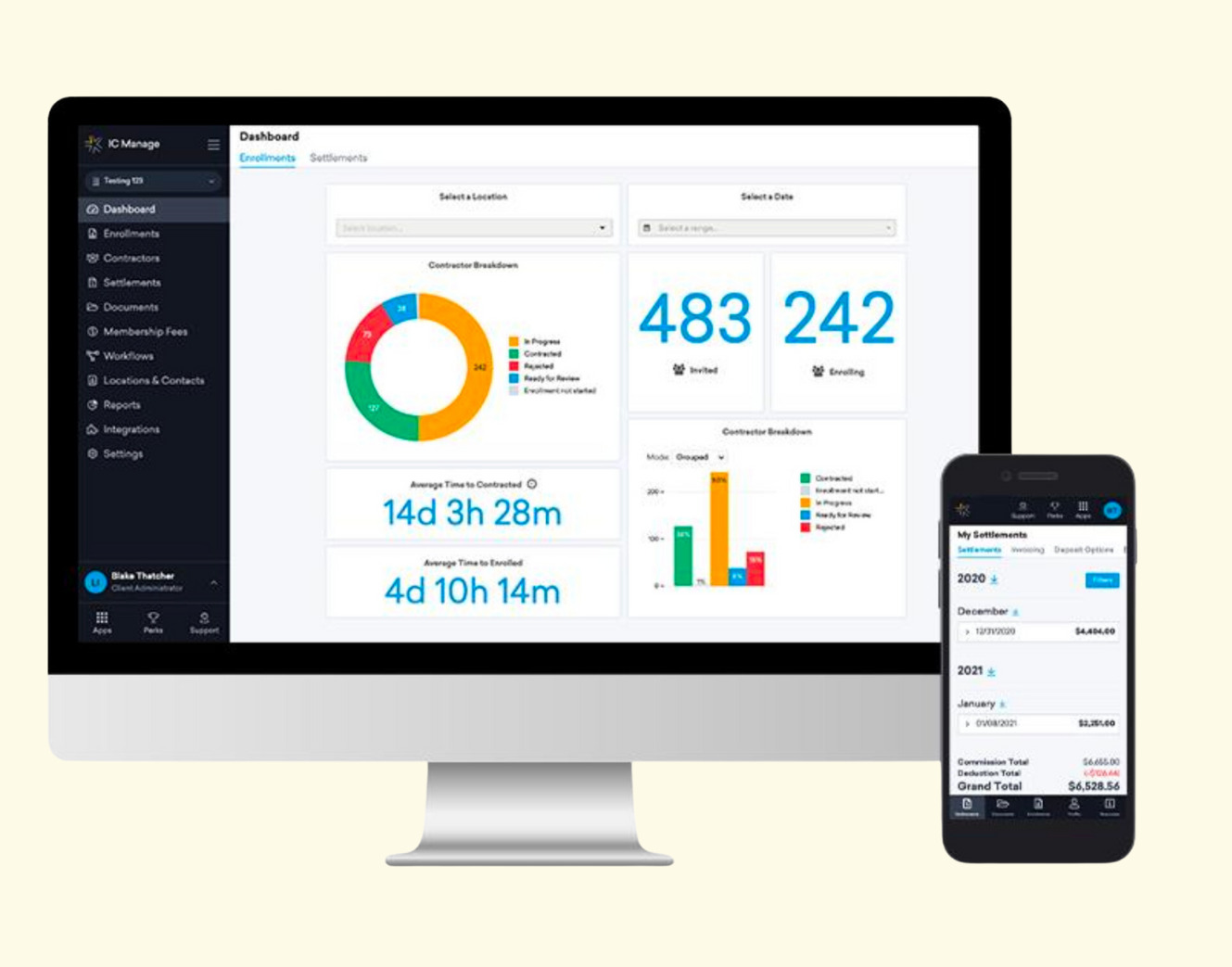
Master Toolkit put document-level onboarding status and settlement submission into one dashboard. A master can see whether an item is approved, absent or rejected, then submit weekly payments without hopping into email. Openforce says pilot feedback refined the product. The lesson is wonderfully copyable: do not add another executive dashboard when the actual user needs to know which exact document is blocking Tuesday's work.
Three months later, the company launched a rebuilt Vendor Portal after another pilot. It gave contractors real-time enrollment and document status, settlement history, profile controls and mobile access. Openforce called the portal AI-based and said AI helped its onshore engineering team accelerate development. The practical test is not whether the interface can claim intelligence. It is whether a contractor knows what to do next without calling support.
The reliability tax
Centralization creates leverage and a single point of pain. Public complaints mention locked accounts, slow multi-factor resets, onboarding trouble and delayed payment access. When software sits between labor and money, support speed is part of the payment product.
The cost is custom; the stakes are not
Openforce does not publish a standard price. Buyers select modules and request a quote, with implementation shaped around their industry, screening rules, agreements, insurance and integrations. That makes quick cost comparison difficult. It also signals the intended customer: a company whose contractor program is complicated enough to justify configuration and services.
The business model combines enterprise SaaS, managed administration, settlement processing, insurance facilitation and professional expertise. Riverside Partners owns the company; the amount and date of its investment have not been publicly detailed. Openforce acquired courier specialist Flexible WorkForce in 2019 for undisclosed terms, broadening its last-mile footprint. In 2026, at age 25, it landed at No. 4,415 on the Inc. 5000 after reporting 44 percent revenue growth from 2022 through 2025.
Scale raises the bar. Openforce says it pays more than 90,000 contractors weekly and processes about $5 billion in settlements annually. Its app, meanwhile, showed a 2.0 rating from 41 U.S. App Store ratings when this profile was prepared, while Capterra showed a 4.7 rating from 27 software reviews. Different populations can have radically different experiences: the administrator values one database; the contractor judges the login, the deduction and the arrival of money. Both are the product.
Copy this playbook
- Design around the evidence trail, not just task completion.
- Put status at document level so users can clear a precise blocker.
- Connect specialist systems through APIs instead of rebuilding dispatch.
- Pilot with the awkward middle user before announcing the product.
When it will not work
- Your workforce is mostly W-2 employees or spread across many countries.
- You have only a few contractors and little compliance variation.
- You need transparent self-serve pricing and same-day setup.
- Your team cannot commit to migration, data cleanup and workflow ownership.
The boring moat
Openforce began in 2001 as Contractor Management Services, a name so literal it practically wore a name badge. The 2017 rebrand announced a more software-driven ambition, but the old name still reveals the company's advantage. Contractor operations are full of exceptions: state rules, vehicle classes, expired licenses, insurance selections, background screens, custom agreements, deductions and master-subcontractor relationships. Twenty-five years of encoding those exceptions is harder to copy than a pleasant dashboard.
Its competition comes from several directions. WorkMarket and MBO Partners manage contingent labor. Deel and Remote make global contractor administration easy to buy. Rippling bundles contractor tools into a larger HR system. GigSafe competes closer to Openforce's compliance territory. And the cheapest alternative is still the improvised stack - spreadsheets, folders, e-signature, a payment service, an insurance broker and outside counsel.
Openforce wins when that stack starts contradicting itself. It loses when its own portal becomes the new source of friction. The company's next chapter is therefore less about sprinkling AI on forms than making a complicated commercial relationship feel boring, fast and trustworthy. That is not a cinematic vision of the future of work. It may be the useful one.
Keep exploring