A company finds the right person. The interview goes well. The offer is accepted. Then a less photogenic set of questions arrives: Who puts this person on payroll? Who explains the health plan? Who knows whether the background check is finished? HireArt has built its business in that interval between a successful hire and a functioning employment relationship.
- One platform for sourcing, contract employment, staffing vendors, and freelancers.
- Customers can bring their own recruits and keep existing staffing partners.
- The useful test: can managers see and act on what happens after the offer?
The offer letter was the easy part
Founded in 2012 by Dain Lewis, Eleonora Sharef, and Nicholas Sedlet, HireArt joined Y Combinator’s winter batch. Its early proposition was appealingly concrete: show employers what candidates can do. Work samples and video assessments supplied evidence that a résumé could miss. An early company profile described clients including Airbnb and Autodesk. The product addressed the uncertainty before a hiring decision.
By 2017, HireArt had changed direction toward an employment platform for contract workers. The shift expanded the job it was taking on. Recruiting solves the problem of finding someone; employment introduces a continuing sequence of obligations. HireArt began building around that sequence. The original recruiting idea had reached the edge of its remit: a good match still needed a workable arrangement after the interview.
Bring your recruiter. Keep one record.
Today, HireArt combines employer-of-record services, sourcing, vendor management, and freelancer administration. For W-2 contract employees, it handles employment functions such as payroll, benefits, onboarding, and HR support. Managers get software for administering the relationship. A client can source someone itself, ask HireArt to recruit, or use a staffing partner. The route into the business can vary while the employment system stays consistent.
That makes its relationship with staffing agencies interesting. HireArt competes with the fragmented agency experience while inviting agencies into its vendor network. Customers can retain vendors they like. A specialist recruiter can keep doing specialist recruiting; HireArt provides the shared employment infrastructure. Its sourcing page says the talent pool exceeds one million job seekers and includes partners across dozens of countries.
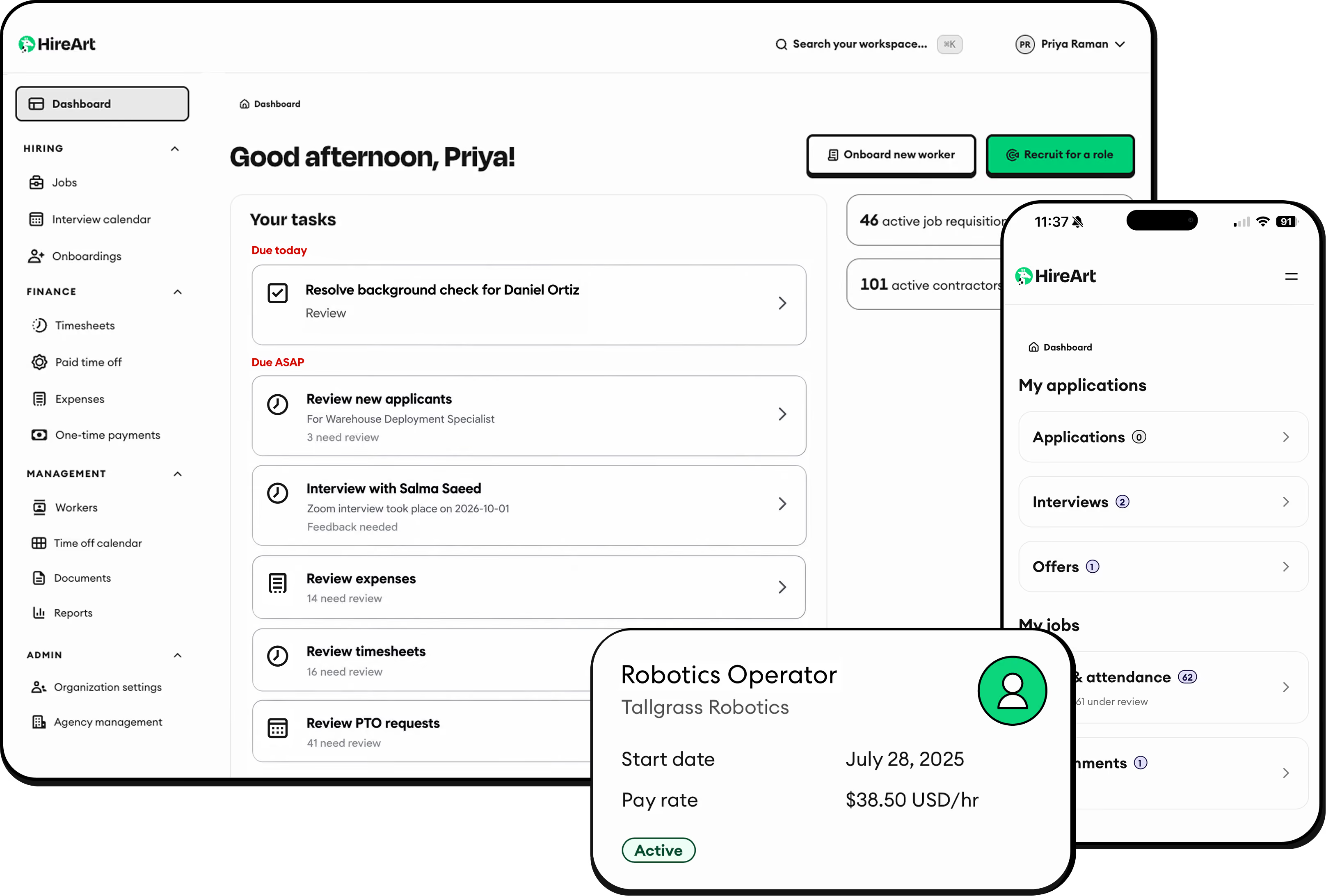
The distinction between employees and freelancers remains essential. HireArt also offers worker classification and freelancer management, including agent-of-record services. These are different arrangements from W-2 employment. Putting both in a shared interface helps companies see their workforce, but the interface does not make the relationships interchangeable. The company advertises ongoing classification checks and indemnification alongside its administrative tools.
A city launch is also a hiring problem
Via makes the operational problem tangible. Opening a transportation service in another city requires people on the ground: drivers, fleet operations, maintenance, support, and sometimes brand ambassadors. In HireArt’s account, Via needed repeatable local talent pipelines and employment administration that could keep pace with expansion. Recruiting became part of the city launch process, rather than a fresh scramble every time.
HireArt’s Via case study reports 1,193 hires across 85 cities as of August 16, 2022, alongside a 91% retention figure. Its Zoox case study describes consolidating 88 contract workers under one employer of record and reports 90% retention by 2023. These are company-published examples with different measurement periods, so they illustrate deployments rather than provide a controlled comparison of performance.
The lesson extends beyond transportation. If every location or staffing supplier introduces another process for documents, pay, and approvals, expansion multiplies the handoffs. Consolidation offers a way to make those handoffs visible. For an organization running several hiring channels, that can be more useful than adding another source of candidates.
The bill has several moving parts
HireArt sells businesses a combination of software and services through tailored sales engagements. Candidates use the service free. For a buyer, the sensible comparison separates recruiting, employment administration, benefits, and ongoing support. Bringing a pre-identified worker can remove a sourcing step; it still leaves the cost of employing and supporting that worker. A percentage without its service scope tells very little.
HireArt reports average savings of 16.6% for clients moving contractors to its platform. That is a company claim, rather than a promise for every buyer. Its employment offering includes medical, dental, vision, and configurable 401(k) options. The proposition combines lower administrative friction with an employment experience workers have reasons to value. Reducing the bill and reducing support are separate decisions.
Building that arrangement required capital. HireArt announced a $26.25 million Series B led by Three Fish Capital in 2022. Its accompanying vision emphasized supporting contract workers throughout their working relationship. That commitment gives the product a broader brief than filling vacancies: the employer remains involved when the initial excitement has worn off and ordinary problems arrive.

The question hiding in the dashboard
In June 2026, HireArt introduced a rebuilt manager dashboard. The announcement identified a familiar complaint: managers could not tell where new hires stood in onboarding. The redesign surfaces background checks, screenings, and readiness to work, with filters and downloadable reports. Global search finds workers, candidates, and jobs. The improvement is concrete: fewer status requests for information the system already holds.
“We are all HireArt employees”HireArt’s published company values
HireArt says it runs its own employees on the platform and uses contractor feedback to improve it. One useful detail predates the current AI rush: AI trainers were among its first 50 contract hires in 2017. Behind the emerging technology were familiar needs for dependable employment administration. The tools change; the questions about pay and support keep returning.
The market comparison follows from those choices. A staffing agency may supply the candidate and employ them. A vendor management system tracks suppliers and spending. An employer of record takes on employment administration. HireArt combines these functions for teams that want to manage the program themselves, with human support available. The buyer therefore has to evaluate the whole operating arrangement: who recruits, who employs, who approves changes, and who helps when something goes wrong. A polished dashboard is useful only if those responsibilities are clear to the people using it.
What can another business copy? Map the handoffs after acceptance. Give each status an owner. Let managers handle routine changes within approvals. Compare sourcing separately from employment. The fit is weaker when a company only needs a permanent recruitment search, or when its required country, benefits, or controls fall outside a proposed arrangement. HireArt’s central idea is practical: hiring succeeds when the next Tuesday works, too.
HireArt website ↗ Company blog ↗ Dashboard update ↗ LinkedIn ↗ X ↗ Facebook ↗ GitHub ↗