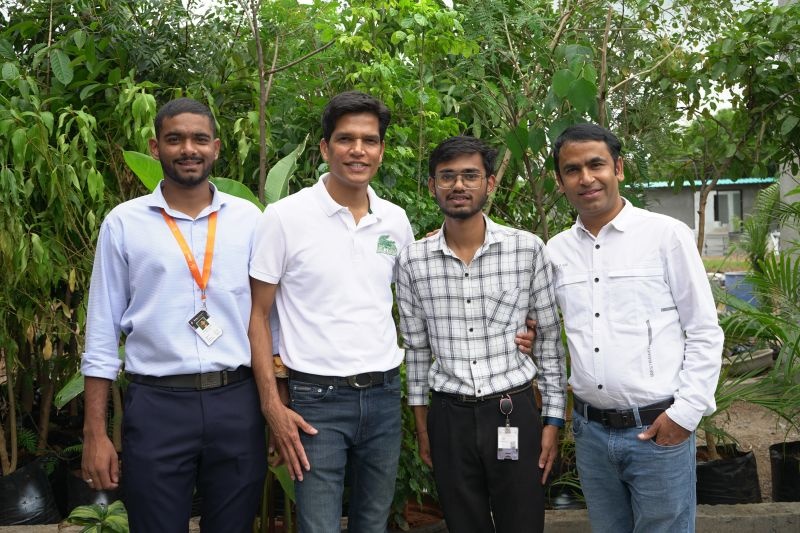
In Paregaon, a village in Maharashtra, Manoj Agarwal posed for a photograph with members of a software team. Trees filled the background. There was no conference stage, no skyline, no enormous company name looming over the group. The occasion was a visit to THE BAAP COMPANY, whose team was working on SimplifyVMS. For a business concerned with connecting people and work across borders, it was a pleasantly literal picture.
Pratik Jamdar, who shared the visit in July 2025, described a conversation with Agarwal and a development team with farming roots. He credited BAAP founder Raosaheb G. with creating the opportunity. The detail gives Agarwal’s professional story a useful setting: software for a US workforce business, being developed with people in a rural Indian village. The map of work can be more interesting than the map of office rents.
Agarwal is the founder and CEO of SimplifyVMS, the workforce technology business. He also founded US Tech Solutions in 2000. His career connects two sides of a transaction most people encounter only occasionally: finding someone to do a job, and arranging everything that allows that person to begin, continue and get paid. The second side offers fewer dramatic announcements. It offers plenty of work.
2000: before the platform, the placements
US Tech Solutions began in 2000, with Agarwal as its founder. Its business put him in the staffing and technology services trade, where a successful introduction has to survive the realities of an assignment. A candidate needs the right skills. A client needs someone available. The engagement needs commercial arrangements that both sides can actually use. Even a promising match arrives with paperwork attached.
By March 2009, Agarwal was speaking publicly about the practical uncertainty facing staffing businesses during the recession. Financial services clients were concerned about restrictions connected with hiring foreign workers. His comments were measured: the immediate availability of talent reduced the problem, while changing conditions could make recruitment harder later. The distinction between a problem today and a problem when demand returns was already part of his working vocabulary.
There is something revealing about that early appearance. The subject was neither a product launch nor an entrepreneurial victory lap. It was ambiguity, clients trying to interpret it, and the consequences for hiring. These are ordinary concerns for a staffing operator. They are also the sort of concerns that a workforce technology company eventually has to accommodate. A contract can be signed on one day; the conditions around it keep moving.
An established founder goes back to class
In May 2016, Agarwal joined the inaugural US QuantumShift program at the University of Michigan. The program, developed by KPMG and Michigan’s Ross School of Business, brought together founders and business leaders for an intensive week. The participant list identified him as CEO of US Tech Solutions. He was sixteen years into the company’s history, attending a program designed around the challenges of growing an enterprise.
His educational background also includes MBAs listed at Columbia Business School and London Business School. Those institutions sit alongside a career spent running businesses, giving the outline a rhythm more substantial than the familiar sequence of graduation, incorporation and triumph. Here was an operating executive continuing to spend time in business education.
A classroom offers a different kind of meeting from a sales appointment. The immediate transaction recedes; the shape of the business becomes the subject. QuantumShift’s format placed Agarwal among other people responsible for companies of their own. The documented fact is straightforward, and appealing enough without embellishment: well after founding his business, he made room for another week as a participant.
- 2000Founds US Tech Solutions
- 2016Joins Michigan’s inaugural US QuantumShift class
- 2018Leads Simplify Workforce as CEO
- 2025Visits the BAAP development team in Paregaon
The hiring business acquires a software business
By November 2018, Agarwal was publicly identified as CEO of Simplify Workforce. Its flagship product was SimplifyVMS, built for managing contingent workers and services procurement. The initials describe a vendor management system. Behind that compact label sits a sprawling cast: hiring managers, staffing suppliers, contractors, procurement teams and the people who have to reconcile the bill.
Simplify was expanding its leadership team. Neha Goel joined as senior vice president of marketing and strategy, with experience at DCR Workforce. Raul Lopez Pomares and Patrick Chartrand joined in brand and demand generation roles. Agarwal connected the appointments with investment in research and development, internal processes and customer experience. He spoke of reaching “critical mass, quickly.”
The appointments matter because software needs more than a working product. Someone must explain its purpose, understand the customer’s requirements and connect what is sold with what is implemented. In this case, the advertised brief explicitly connected sales, implementation and product teams. A platform built to coordinate other businesses was also assembling its own coordination machinery.
In 2019, US Tech Solutions celebrated Agarwal’s inclusion in the Staffing Industry Analysts Staffing 100. The company described having passed $200 million in revenue through organic growth and named Workspend and Simplify Workforce as additional businesses addressing the managed service provider and vendor management markets. This was an expansion from a staffing foundation into adjacent parts of the same working world.
The company was also reconsidering how it presented itself. During a 2019 brand refresh, its marketing partner interviewed management, employees, customers and other stakeholders. The resulting campaign used the phrase Creating Work-Life Adventures. The interviews emphasized finding appropriate assignments for contracted people and using technology in the recruiting process. It is an unusually useful piece of corporate branding history: the presentation changed, while the underlying subjects remained people, their work and the tools used to bring them together. Even the language around the business had to account for both halves.
US Tech Solutions revenue milestone reported in its 2019 Staffing 100 announcement.
HISTORICAL MILESTONE / US TECH SOLUTIONSA better introduction is only the beginning
SimplifyVMS deals with the external workforce: people engaged through arrangements such as temporary assignments, contracting and services projects. Its product range includes vendor management, direct sourcing and talent pools, and services procurement. Those categories describe different ways an organization can get work done, with different relationships between the buyer, the supplier and the person doing it.
Direct sourcing allows an organization to develop its own branded talent pools. Services procurement covers work purchased through a statement of work. Vendor management brings the suppliers and the engagements into a system where the organization can follow them. It is a practical subject, occasionally disguised by language that seems to have been approved by several committees before lunch.
The appeal of this part of Agarwal’s career lies in its continuity. His first business dealt with supplying talent. Simplify deals with the systems around a wider workforce. The distance between the two is short enough for experience to travel. The responsibilities, however, broaden: visibility, onboarding, supplier relationships and the movement of information all enter the picture.
A hiring announcement is a moment. An assignment is a sequence. The software has to remain useful after everyone has stopped congratulating one another. That is where this business lives, among the repeatable steps that determine whether an engagement feels organized or becomes a collection of unanswered messages.
- 01Source talent
- 02Onboard
- 03Manage work
- 04Track & pay
A conceptual sequence, not a performance measure or product screenshot.
“What they want are solution outcomes”
In a March 2021 discussion of digital change in talent systems, Agarwal described the movement from mechanical automation toward cloud services and outsourced delivery. The earlier focus, he explained, had been on administrative sequences such as moving a requirement through to payment or a hire through onboarding. He was interested in what happened when technology became part of the service itself.
His phrase “what they want are solution outcomes” is a concise expression of that view. The customer’s concern is the result that the technology makes possible. For a founder whose career spans staffing services and workforce software, it provides a connection between the two businesses without requiring either to disappear.
A platform demonstration can end at a carefully chosen moment. A service has to keep going. Agarwal’s argument puts attention on delivery: how the tools, processes and people combine once a buyer has decided to use them. The point has a certain commercial plainness. Customers have their own business to run; admiring someone else’s software is unlikely to be the main event on the calendar.
“What they want are solution outcomes.”
Manoj Agarwal / on talent technology, 2021
Recognition, then a place for customers to argue
Agarwal’s public LinkedIn profile lists Staffing 100 recognition in 2019, 2020 and 2022. A 2023 congratulatory post by Simplify executive Sameer Srivastava records another appearance that year. The repeated recognition marks his place in the staffing industry, spanning the period in which his work had extended into workforce technology.
The more recent company activity introduces another kind of recognition: a formal place for customers to help shape the product. SimplifyVMS’s Customer Advisory Board brings enterprise workforce stakeholders into discussions about priorities, requirements and the roadmap. Its stated remit includes governance, reporting and the demands of operating across regions. These are specific operating questions, the kind that become more consequential as a system spreads.
In 2025, SimplifyVMS announced a collaboration with Direct Collective, giving advisory board members access to a wider community of contingent workforce leaders. The collaboration included member discussions, live talks and events. Direct Collective described a community of more than 200 members representing more than 175 organizations. The mechanism was conversation among people who run workforce programs.
Read beside the photograph from Paregaon, the advisory board supplies a fitting second scene. One brings the executive closer to people helping build the software. The other brings the company closer to people using it. Between them sits the business Agarwal has been developing: services, systems, suppliers and workers, with a great many handoffs to get right. The company name makes simplicity sound like a starting condition. His career makes it look like an ongoing assignment.