Before Shashank Saxena sold software to large companies, he worked inside them. He knew the buyer’s side of the table: the established systems, the internal negotiations, the challenge of getting a new idea into daily use. At Citi and Kroger, digital transformation was a job with colleagues and consequences. Years later, that experience would become useful preparation for a company of his own.
VNDLY, the workforce software business he co-founded in Cincinnati in 2017, reached an approximately $510 million acquisition agreement with Workday in 2021. It is the number that tends to arrive before his name has finished being introduced. Numbers are efficient conversationalists. They can also crowd out the interesting parts.
There is a longer story here: a graduate student arriving from India, an executive learning how enterprises operate, a founder trying to improve an overlooked category, and an investor who returned to running a company. Today Saxena is CEO and chairman of Pantomath and a venture partner at Sierra Ventures. The customer’s chair remains a useful place to begin.
An education on the buying side
Saxena grew up in Mumbai. His recollection of childhood includes a family established in the same house across three generations, with cousins close by. In 2006, he moved to the United States for graduate school at the University of Cincinnati, which had offered him a scholarship. An MBA followed in 2008. His education also includes a master’s in information systems and a computer science bachelor’s degree from Troy University.
His working life began at Citi in 2008. He later joined Kroger, taking on responsibilities across digital and e-commerce, partnerships, new business development and corporate strategy. These were large organizations with existing customers, distribution and ways of doing things. Getting something new built required understanding the machinery already in motion.
By 2017, his activities extended beyond his employer. He had taught digital and emerging channels marketing at Cincinnati’s business school, mentored at The Brandery, and served as Kroger’s liaison to Cintrifuse. The résumé suggests several overlapping classrooms: a university, a retailer and a local startup community. Each offered a different view of how ideas become businesses.
Corporate innovation had given him room to experiment within an established institution. Starting VNDLY increased the number of variables he would have to manage himself. The attraction, as he later explained it, included a personal test: could he make the transition? A corporate platform supplies many things a founder must assemble from scratch. Distribution is rather easier to appreciate once someone stops providing it.
Career at Citi
co-founded
acquisition
operating role
A company hiding between two words
The initial approach came from Narayan Surabhi, who asked Saxena about becoming an angel investor. Saxena’s involvement grew into a co-founder’s commitment. They examined vendor management software, the systems companies use to organize their external workforces, and saw room for a new entrant.
Their thesis combined changing workforce arrangements with an opportunity to replace older enterprise applications. Companies relied on people beyond their permanent payrolls. Those workers still needed to be recruited, brought into projects, managed and paid. A workforce could become more flexible while its administrative software remained stubbornly attached to the past.
Saxena and his collaborators put their assumptions on paper and tested the proposition with investors. Their intended $1.5 million seed round became $3 million. It was an encouraging response to a business that still had plenty to build. Raising the money established that others would back the hypothesis; customers would supply the more demanding examination.
The name carried a little editorial opinion of its own. VNDLY combined “vendor” and “friendly.” In explaining it, Saxena emphasized collaboration with suppliers and sharing information in real time. A supplier that could fill a role faster or move a process along more efficiently could help the client as well. The relationship deserved better software than its reputation might suggest.
That thinking gave the product a practical center. Vendor management can sound like a department that exists to issue a form. Underneath it are people trying to get work done across company boundaries. Improving the information available to one participant can make the whole arrangement work better. The founding argument was understandable without a tour of the software.
“Am I earning revenue? Or am I buying revenue?”
Shashank Saxena, on the questions founders should ask
He also urged founders to understand the relationship between growth and profitability. Revenue alone does not explain what it costs to acquire it, or how much control a business has over that cost. The question has the appeal of an awkwardly useful colleague: it can interrupt a celebration, but it is worth having in the room.
The organization behind the software
VNDLY’s surroundings mattered. The team spent nearly 18 months incubating at Union Hall, Cintrifuse’s Cincinnati coworking space. The city connected corporate experience, startup advice and venture relationships in a fairly compact geography. Saxena had already participated in parts of that network before becoming a founder himself.
Inside the business, hiring required a different kind of attention to networks. In 2021, he described a workforce that was 40 percent women, while also pointing out that Black employees accounted for only 3 percent. A favorable aggregate could conceal a problem within it. He was willing to discuss both figures together.
VNDLY developed a two-year leadership rotational program with three eight-month assignments. Participants could work across functions including customer support, implementations and technical documentation. Saxena also described outreach to historically Black colleges and professional groups. These were ways to connect the intention to the actual routes by which people entered the company.
His reasoning about early hiring was practical. The first people in an engineering organization help determine who will want to join it next. Employees recommend friends; a narrow starting network can keep reproducing itself. By his account, women were included in VNDLY’s early engineering team, and veterans held some of its first roles. Company culture begins recruiting well before anybody writes it down.
The deal, and the work after it
On November 18, 2021, Workday announced its agreement to acquire VNDLY for approximately $510 million, principally in cash and subject to adjustments. The acquisition closed that December. For Workday, the combination offered a way to connect information about permanent employees with information about contingent and outsourced workers.
Approximate consideration for VNDLY, principally cash.
The logic extended across familiar corporate boundaries. Human resources, finance, procurement and operating teams all had reasons to understand who was working, what that work cost and what the organization would need next. Joining those views could make workforce planning more coherent. A contractor’s existence should not become an administrative surprise merely because another department holds the paperwork.
Saxena stayed on to help lead the business within Workday. By 2023, he and Mariana Santiago were co-general managers of Workday VNDLY. There had already been a relationship before the acquisition: VNDLY had a certified Workday integration, and more than two dozen customers were using its connection to Workday Human Capital Management when the companies joined.
The subsequent change to the Workday VNDLY name accompanied work to align the user experience and connect the product to Workday’s data foundation. This is the less cinematic part of an acquisition story, and often the part customers experience most directly. The announcement takes a day. Making products work together becomes somebody’s continuing responsibility.
Back across the table
Investing was another extension of Saxena’s operating experience. He joined Bowery Capital as a venture partner in 2021 and Sierra Ventures in April 2024. Sierra described his mix of technical and commercial knowledge as part of the attraction. He had worked through enterprise problems from several directions: inside the customer, inside the startup and inside the acquirer.
His public advice to founders is correspondingly concrete. Know the product. Keep contact with customer problems. When evaluating a founder, he looks for someone who creates clarity, demonstrates persistence and can defer immediate rewards. He also considers whether wider market changes will help the business. A capable operator still benefits from choosing a useful direction.
“Good leaders never disconnect from the front lines”
Shashank Saxena, advice to founders
Pantomath brought him back into a day-to-day executive role. His brother Somesh, who had worked in data operations at GE, founded the company after encountering the difficulties of managing complex data systems. In an earlier account of building Pantomath, Somesh identified Shashank as a mentor who had supported him throughout the process. That relationship preceded the current division of titles.
Today, Pantomath lists Shashank as CEO and chairman and Somesh as founder and president. The company’s August 2025 announcement of a $30 million Series B, led by General Catalyst, described an ambition to go beyond observing data problems toward automating their resolution. Quentin Clark joined the board as part of that financing.
Pantomath’s focus: follow data across systems, identify failures and automate responses.
Snowflake Ventures announced an investment in January 2026, alongside plans for deeper integration. The work included metadata collection, data quality monitoring and lineage, the record of how data moves between systems. These are details that matter when a failure travels farther than the team that first encounters it. An organization needs to know what depends on what before it can confidently repair the chain.
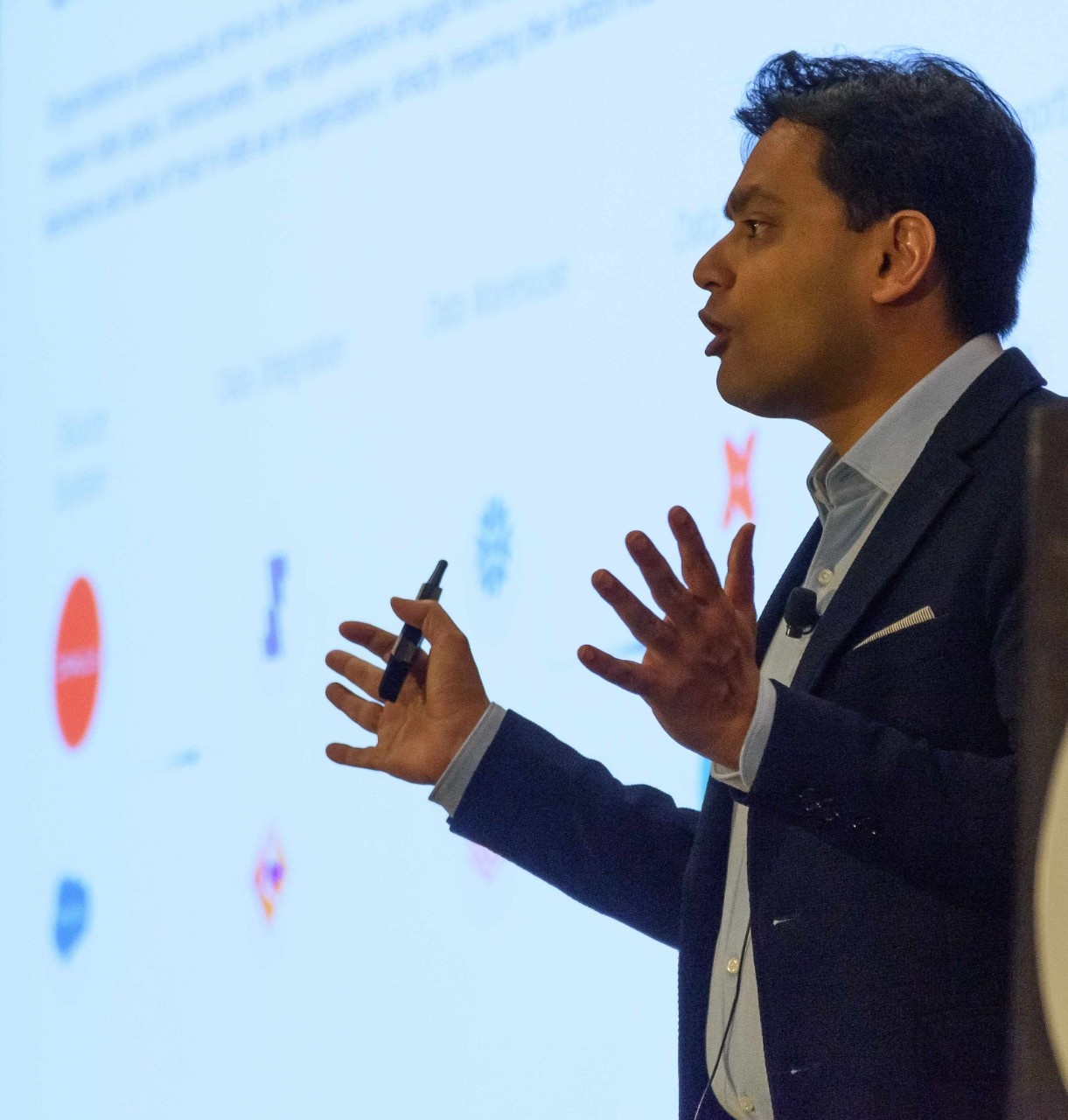
Back at Cincinnati’s Analytics Summit in 2025, Saxena spoke about another wave of digital transformation, this time shaped by AI. His career gives that subject a particular continuity. He has already helped established businesses adapt to digital change, then built a company for a workforce whose arrangements were changing around them.
Now the problem is the reliability of the information on which organizations depend. The product category has changed; the attraction of an operational difficulty remains. Somewhere inside a large business, people are still trying to make a process work. Saxena has spent enough time on their side of the table to find that an interesting place to start again.