Dev Ittycheria once ran his one-to-one meetings with a list. His subjects came first; the other person’s concerns arrived near the end, if there was time. Later, a problem would surprise him. Why hadn’t anyone mentioned it? Eventually he noticed the obstacle sitting at the head of the conversation: himself. He changed the meetings. Less agenda, more room for the other person to speak. A chief executive had discovered that being thoroughly prepared could leave him poorly informed.
It is a small story for someone whose résumé contains two software IPOs as CEO. It is also a useful introduction to Ittycheria, who has spent much of his working life learning how to give other people enough room to do difficult things. His subject is enterprise software. His recurring problem is human: what happens to the truth on its journey towards the boss?
In September 2026, that problem became his daily responsibility at MongoDB again. After eleven years leading the database company, he had stepped away from full-time operations in November 2025. His successor, Chirantan “CJ” Desai, departed for a senior role at Meta less than a year later. On September 28, the board brought Ittycheria back as interim president and CEO. The familiar name returned to a familiar office, with an unfamiliar next chapter.
Interim president and CEO. Board member. A permanent successor search underway.
The safe career had a curious example
His father, an engineer, recommended an engineering degree and a reputable employer. It was sensible advice, though the family history supplied a livelier alternative. His parents had left India in the early 1970s, lived and worked in Britain, Canada and Nigeria, and eventually settled in the United States. His father returned to graduate school and began a new career. Safety, in this family, had required quite a bit of adventure.
Ittycheria earned his electrical engineering degree at Rutgers and went to AT&T. He advanced, but the prospect of another title lost its appeal. He wanted to build a business and bear the consequences of his decisions. Through venture investors financing broadband companies, he saw people creating businesses to sell to customers like him. The distance between executive and entrepreneur began to look crossable.
Applica followed in 1998, BladeLogic in 2001. The latter made software for automating data-center operations. Ittycheria took it public in 2007; BMC acquired it the following year for approximately $900 million. At BMC he ran the enterprise service management business, with about $1.4 billion in annual revenue and more than 4,000 employees. Founding a company and managing a large division gave him rather different views of the same machinery.
Venture investing offered another seat. He worked at Greylock, then OpenView. A founder must persuade someone that a company deserves to exist; an investor must decide which of those persuasive people to believe. By the time MongoDB called, he had practised both sides of the conversation. His career was becoming an unusually long education in how software reaches paying customers.
A database with an audience, and a business to build
He arrived at MongoDB in September 2014, succeeding Max Schireson. He had already investigated competing database investments and come away impressed by MongoDB’s developer adoption. The opportunity had a practical attraction: people wanted the product. Converting that interest into an effective organization would take work.
That distinction matters in a field where technical arguments can become tribal. Developers choose tools because those tools help them build. Companies buying critical infrastructure also want dependable operations, support and a relationship that survives the first installation. Ittycheria’s experience put him at the meeting point of those demands. A database could win an engineer’s affection long before it won a procurement department’s signature.
MongoDB’s early distribution model let developers download software and run it themselves. That helped adoption spread without waiting for every purchase to begin in an executive office. It also left customers responsible for the everyday chores of operating a database. A popular download and a durable commercial relationship were separate achievements. The gap between them became one of Ittycheria’s central assignments.
The small business inside the bigger one
On June 28, 2016, MongoDB launched Atlas, a managed cloud database service. Customers could hand over provisioning, configuration, patching and backups to the company that built the database. The proposition had an appealing lack of glamour. Let developers spend less time tending infrastructure and more time making the application they actually cared about.
For MongoDB, however, the change was substantial. Shipping software and continuously operating someone else’s database require different habits. Service reliability becomes part of the product every hour of the day. Atlas initially launched on Amazon Web Services; Azure and Google Cloud support were planned to follow. MongoDB was asking customers to trust it with a continuing operational responsibility.
Ittycheria treated Atlas as a startup within the company. It had a directly responsible individual and its own visible measures of progress. That last detail is revealing. A new business begins with numbers too small to impress the people running the established one. If every conversation uses the parent company’s scale, an experiment can disappear while technically remaining on the agenda.
Giving Atlas separate attention made its early progress legible. It also made responsibility harder to lose between departments. There is a management lesson here with very little theatrical appeal: sometimes a strategic decision needs its own set of numbers and someone whose name is attached to them. The future has a better chance when somebody has to report on it.
- 2007BladeLogic goes public
- 2014Joins MongoDB as CEO
- 2016Atlas launches
- 2017MongoDB goes public
- 2026Returns as interim CEO
A boss who wants the awkward version
The same concern with visibility appears in his account of leadership. Early on, he believed a CEO should project certainty. Admitting confusion seemed likely to cost him the team’s respect. Experience changed his mind. An executive who acknowledges an unanswered question gives colleagues permission to stop performing certainty too.
“Informality breeds candor,” he has said. The meeting without a tightly controlled agenda was a way of making that principle concrete. The boss already has plenty of opportunities to broadcast what matters to the boss. Hearing what matters to everyone else takes a different arrangement.
“Bad news travels very slowly up the organization, but very quickly down the organization.”
Dev Ittycheria
When a problem finally reaches him, he assumes other people knew earlier and the situation may be worse than the first account suggests. That is an uncomfortable operating assumption, especially for the executive paying for all those reporting systems. It recognizes something a dashboard cannot fix by itself: people edit information when they fear the recipient’s reaction.
He argues for inspecting work regularly and avoiding punishment of the messenger. Otherwise, the organization teaches itself to delay the very information management needs. A forecast can look reassuring for an impressively long time if everyone has learned which answer earns a pleasant meeting. His preferred corrective is to make the difficult conversation ordinary.
Steve Walske, a former BladeLogic chairman and one of his mentors, gave him another way to think about the job. People tend to rate themselves more generously than reality warrants. Good leaders keep the distance between those two assessments small. Ittycheria has described looking back at some of his earlier decisions with embarrassment, and treating that discomfort as evidence that he has learned something. A polished résumé can be a surprisingly poor guide to how its owner remembers the work.
That willingness to revise his opinion of himself helps explain why uncertainty recurs in his public conversations. A CEO can ask colleagues to improve while quietly exempting himself from the exercise. Ittycheria’s account puts the executive back among the people who still have things to learn. The title does not confer graduation.
The price of protecting the product
Openness inside a company does not make its outside decisions painless. In October 2018, MongoDB changed the license for Community Server to the Server Side Public License, or SSPL. The company wanted to address cloud providers offering its database as a service without a corresponding commercial relationship or contribution on the terms MongoDB sought.
The SSPL introduced conditions around offering the software as a public service, including disclosure of the software used to deliver that service. It has not been approved by the Open Source Initiative. That distinction matters when describing MongoDB today: the company’s origins in open source do not turn every subsequent licensing choice into an OSI-approved open-source license.
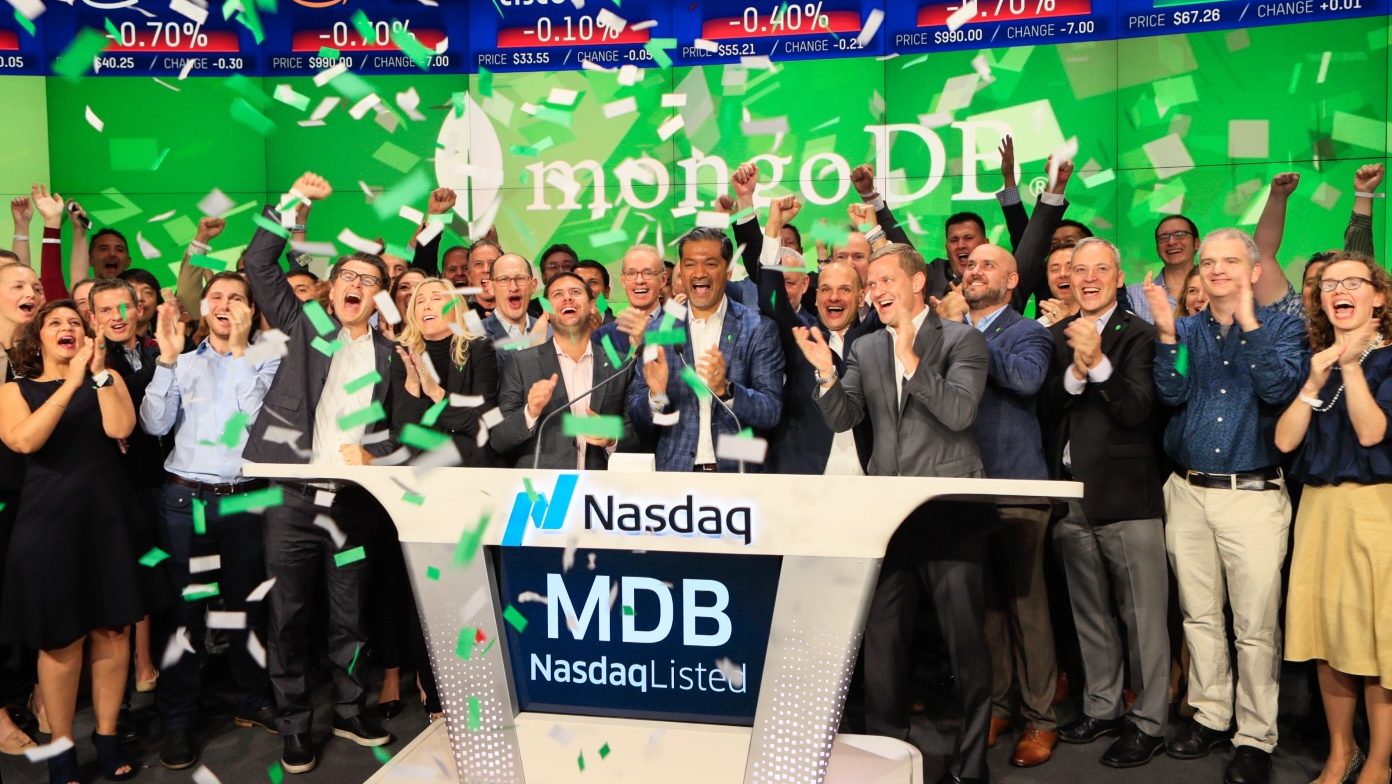
For Ittycheria, this was a commercial judgment with a community attached. A developer audience had helped create the opportunity. Protecting the economics of serving that audience could alter how people understood the company. The decision belongs in his story alongside the IPO photograph. Running an infrastructure business involves choices that confetti is poorly equipped to explain.
Back at the desk, with another question
By the end of his first tenure, the business had grown from roughly $35 million to more than $2.3 billion in annual revenue. Those endpoints describe a company transformed over eleven years, rather than a single clever product launch. The November 2025 handover left him on the board and advising his successor. September 2026 brought him back to daily operations while the board searched for a permanent CEO.
His interests now extend beyond MongoDB. He is a partner and senior advisor at Sequoia and lead independent director at Datadog. He has described wanting to work with technical founders who understand the rest of the business as carefully as they understand their technology. Customers must arrive, stay and make economic sense. Elegant software still needs someone to buy it.
In a 2024 conversation, he worried about whether the next generation of applications would see MongoDB as the right architecture. That is a useful concern for a returning executive. Success supplies an extensive collection of reasons to keep doing things the old way. New developers arrive with their own requirements, and little obligation to admire the previous decade.
The earlier lesson from his one-to-ones still applies. Experience gives Ittycheria plenty to say. His own account of getting better at the job begins with leaving enough space to hear something he did not expect.