At a diner in Truckee, California, in 2005, Aneel Bhusri proposed starting over. His prospective partner, Dave Duffield, had already built PeopleSoft. Oracle had acquired it after a hostile takeover battle. The two knew the customers, the software and the peculiar experience of losing control of something they had helped build. Bhusri arrived with a proposal for another company. Breakfast acquired a rather expensive sequel.
The idea became Workday. Twenty-one years later, Bhusri is back in its chief executive’s chair, having handed over the job in January 2024 and returned in February 2026. The software business has acquired another technological upheaval in the meantime. The founder who once argued that the cloud would change enterprise computing now says artificial intelligence will change it again.
There is a tempting way to tell this story: a founder returns, a new technology arrives, the orchestra gets louder. But Bhusri’s career becomes more interesting at conversational volume. Its recurring characters are a mentor, a business partner, prospective employees and customers who need their payroll to work. Its recurring question is how much of a company you can change while keeping the reasons people joined it.
A job offer with the job still missing
Bhusri’s education combined electrical engineering and economics at Brown, followed by an MBA at Stanford. Between college and business school he worked at Morgan Stanley. He has described engineering as useful preparation for business because it teaches problem solving and the mathematics needed to understand financial statements. A balance sheet is less romantic than a circuit board, but both punish loose connections.
He had wanted to work at Apple. Instead, he met Duffield while finishing business school and joined PeopleSoft in 1993. That choice gave him an apprenticeship in how a software company could feel from the inside. He remembers colleagues greeting him, opening doors and teaching him the ropes. Those details survived in his account long after the formal job description had ceased to matter.
Duffield took him out for a beer during their early acquaintance and hired him before settling on precisely what he would do. Bhusri was encouraged to travel first; the assignment could wait. Eventually he took on new initiatives and rose into product strategy, business development and marketing. The relationship had begun with someone deciding he wanted Bhusri around, then finding work worthy of that decision.
That is a surprisingly personal beginning for a career spent selling software to institutions. It also helps explain the durability of the partnership. Before Bhusri and Duffield negotiated an organizational chart, they had learned how to work together.
The diner had room for a second company
The early Workday proposition was specific. Business applications could be delivered through the cloud, with customers using a common version of the software. Updating an application could become the vendor’s responsibility, rather than an ordeal each customer had to organize. Familiar frustrations at PeopleSoft supplied both practical knowledge and a reason to try a different design.
Bhusri’s pitch at the diner included five PowerPoint slides. There is something cheering about that restraint. Enterprise software would eventually require sales teams, implementation projects and innumerable meetings. Its founding argument could still fit into a presentation a person might survive before lunch.
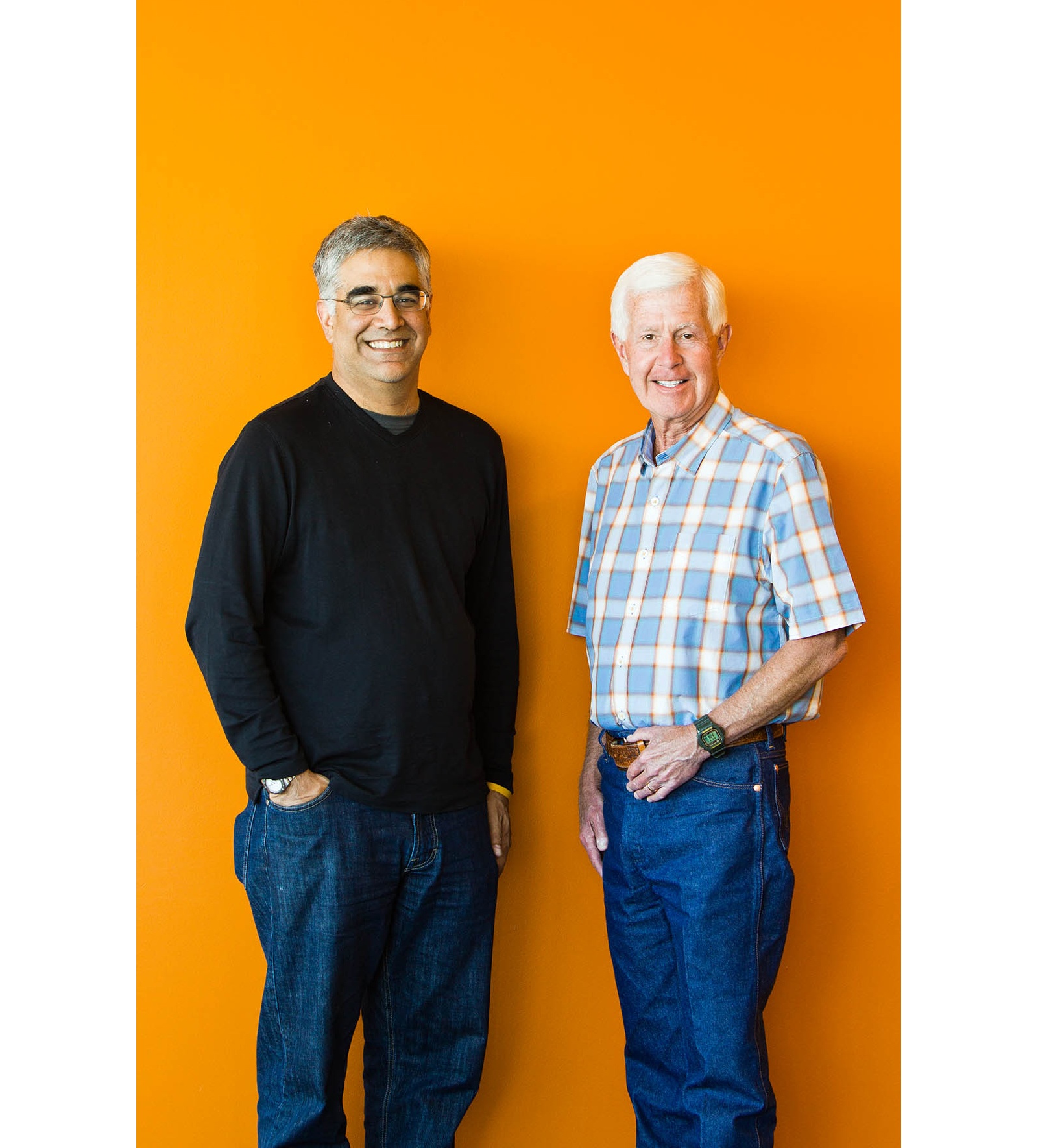
Workday’s attraction depended on doing difficult, unglamorous things more gracefully. In 2007, Bhusri described customers configuring processes to suit their businesses while Workday handled upgrades. He was already being drawn into larger accounts sooner than expected. The ambition extended well beyond a convenient tool for a small department.
The division of labor was equally practical. Duffield concentrated on sales and customer relationships; Bhusri concentrated on product vision and daily operations. Major decisions were made together. A partnership can look mysterious when reduced to a pair of titles. It looks rather more comprehensible when each person knows whose conversation to start.
Five hundred chances to get the company right
Bhusri and Duffield set out to interview Workday’s first 500 employees themselves. Hiring managers had already examined the candidates’ professional abilities. The founders’ conversations concerned how those people would behave inside the company. Teamwork and shared values had to survive the arrival of each new colleague.
Early employees the founders set out to interview personally for cultural fit, after the skills assessment.
This is where a soft-sounding management idea acquires a hard cost: the founders’ time. A value printed on a wall takes up very little of the calendar. Sitting down with candidates takes considerably more. The choice tells us something about what Bhusri regarded as a founder’s job, even when there were plenty of other demands competing for it.
He summarized the starting point plainly: “Employees are the core of who we are.” In his account, employees who are treated well can take care of customers. The ordering matters. For a business selling tools that organize other people’s working lives, the treatment of its own employees is an unusually visible test.
Eventually the company grew beyond the founders’ capacity to conduct every such conversation. Bhusri has described continuing the practice through employees who carry the culture into hiring interviews. The method had to be transferable. A company that depends forever on two people’s personal availability has given itself a fairly inconvenient growth strategy.
The investor in the operating room
Bhusri also built a career at Greylock, which he joined in 1999 and where he is now an advisory partner. The overlap with operating Workday was deliberate. In an early interview he explained that remaining close to venture investing exposed him to ideas that could influence products. Consumer internet services, for example, were changing expectations about how software should feel.
That combination placed him on both sides of a familiar discussion. As an investor he could examine emerging companies; as an operator he had to make choices inside one. Interesting technology still had to become a product someone would buy, adopt and keep using.
By 2013, after Workday’s 2012 public offering, he was describing a race between the new vendors’ product innovation and the incumbents’ distribution. Oracle and SAP had customer reach; Workday needed to build its own. His plans included expanding in Europe and developing financial applications alongside human resources software. He was discussing the machinery of becoming a larger company while continuing to sell the advantages of a younger one.
There is a useful lack of mysticism here. The cloud did not remove the need to sell, distribute and deliver. A technological transition created an opening. Bhusri still had to build an organization capable of walking through it.
- 1993Joins Duffield at PeopleSoft
- 1999Begins his Greylock chapter
- 2005Co-founds Workday
- 2012Workday goes public
- 2026Returns as CEO
A corner office with more than one chair
Workday’s leadership history includes several arrangements: Bhusri and Duffield as co-CEOs, Bhusri as sole CEO, and later periods of shared leadership. In January 2024, Carl Eschenbach became sole CEO and Bhusri became executive chair. He remained connected to the business rather than disappearing from it.
Then the board appointed him CEO again, effective February 6, 2026. The announcement followed on February 9. He retained the chairmanship; Eschenbach became a strategic adviser. The distinction between the appointment date and the announcement is small, though useful in a story about a return that can otherwise sound instantaneous.
Bhusri gave the new assignment a technological rationale: “AI is a bigger transformation than SaaS”. That is his assessment, and it sets a demanding standard for his own tenure. He helped build a company around one shift in software delivery. He now has to guide that established company through another.
“AI is a bigger transformation than SaaS”
Aneel Bhusri, February 2026
The starting conditions have changed. In fiscal 2026, Workday reported $9.552 billion in revenue and more than 11,500 customers. Scale supplies resources and obligations in the same envelope. Customers cannot suspend payroll while their vendor experiments with the future. A founder’s enthusiasm has to coexist with an accountant’s insistence on getting the number right.
The future still has to run payroll
In March 2026, Workday introduced Sana from Workday, bringing conversational AI and agents into its enterprise software. The proposed uses include finding information and taking actions across connected systems. Bhusri’s stated approach couples AI with the trusted business processes, permissions and controls customers already rely on.
That emphasis suits the territory he has occupied for decades. A useful suggestion and a completed financial transaction carry different responsibilities. The interesting test is whether an employee can do something more easily while the organization still knows who was allowed to do it and what actually happened. The conversational interface is the inviting front door; the locks still matter.
His life outside the executive title includes institutional commitments, too. He joined Stanford’s trustees in 2019. He and his wife, Allison, were announced as Giving Pledge signatories in 2018, committing the majority of their wealth to philanthropy. He also serves on the boards of the Workday Foundation and Eat. Learn. Play. These are public commitments with a horizon extending beyond a product release.
The smaller details make the picture less ceremonial. A longtime enthusiast of Boston sports teams, Bhusri has spent his working life in California. His professional story also keeps returning to informal tables: a beer with a future mentor, a diner with a future co-founder, regular dinners to work through disagreements. There is room in enterprise software for the oldest collaboration tool of all: sitting down together.
His return puts that habit under a fresh test. Workday now has an installed customer base to protect, AI products to develop and employees to bring along. The diner decision was to begin again. The harder decision, two decades later, is what beginning again should mean for everyone already inside.
Continue the conversation
Read Bhusri’s Workday biography and essays, or follow him on LinkedIn and X.