The car accident was minor. The inconvenience that followed was ambitious. While studying at MIT, Snejina Zacharia saw her insurance premium jump and went looking for another policy. There were websites, phone calls, repeated questions. There was spam. What she wanted was familiar to anyone who had booked a flight online: a place to compare the alternatives and make a decision. Insurance seemed to have misplaced that particular invention.
- Compare personalized insurance quotes, then buy online or with a licensed agent.
- Shopping is free; insurer commissions and advertising fund the business.
- Weekly payments tackle the cash needed to start coverage.
Insurify grew out of that irritation in 2013, with Zacharia, her husband Giorgos Zacharia, and product co-founder Tod Kiryazov. Its comparison engine launched in 2016. But the interesting part of this story happened before anyone could admire the interface.
01 A fender bender meets a locked door
In a 2025 MIT Sloan interview, Zacharia described the first obstacle: insurers liked the idea of a comparison marketplace, provided somebody else joined first. She spent almost a year talking to industry executives. One agency distribution agreement finally brought access to 13 carriers; an integration partner supplied another essential piece.
“Nobody wanted to be in the top three.”
Snejina Zacharia / MIT Sloan, 2025
The initial miscalculation was time. In a separate interview, she recalled another six to eight months obtaining approvals to display rates online. A website could be built. Permission moved at an insurer’s pace. For a marketplace founder, the lesson is wonderfully inconvenient: customer acquisition comes after having something customers can buy.

02 The agency behind the screen
Today, Insurify serves American insurance shoppers, particularly drivers. Its auto marketplace advertises more than 120 insurer partners. Homeowners, renters, life, and pet insurance widen the offering. Customers enter their information, compare available options, and proceed toward purchase online or with help from a licensed agent.
The agency matters. A page of attractive prices is useful only if the customer can turn one into coverage. Insurify built an in-house agency, adding people who could help complete purchases and service policies. The insurer still underwrites the risk and handles claims.
Behind that combination sits a company split between insurance operations and software. Its careers page describes hybrid work and emphasizes accountability, learning, and customer focus. Those are stated values; the more concrete clue is the mix of people it hires, from machine-learning engineers in Sofia to licensed digital agents in the United States.
That puts Insurify among digital intermediaries such as The Zebra and Jerry, alongside independent agents and direct insurer websites. Its case rests on the combination of comparison, carrier connections, and help finishing the transaction. In 2023, it acquired Compare.com while keeping the brand; former majority owner Admiral retained a minority stake in Insurify.

03 The money behind the menu
Consumers pay nothing to compare. Insurify earns commissions when shoppers buy policies and can earn advertising or click-through revenue. Its disclosure says compensation may affect which products appear and their placement. The company says it does not sell shoppers’ personal information.
For a shopper, the practical move is to keep the coverage limits constant while comparing prices, then examine the payment schedule. Otherwise, two numbers that look comparable may describe different protection or different amounts due at the start. The smallest number on the screen deserves a second question.
So the menu has incentives behind it. Comparing available offers is useful; assuming they represent every insurer would go further than the product promises. A quote also depends on accurate information and the carrier’s final checks.
Building this machinery required outside capital. Insurify announced a $23 million Series A in January 2020 and a $100 million Series B led by Motive Partners in September 2021. Those are financing amounts, not a bill for building the website. Its engineering expansion included a Sofia team recruited from travel-search company Skyscanner: comparison expertise moving into another difficult purchase.
Cumulative auto insurance quotes served, reported July 2026. Quotes are not customers, sold policies, or revenue.
04 The form gets out of the way
Insurify’s more revealing AI work may be its least theatrical. In 2025, it publicized policy upload: give the system your declarations page, and it extracts information to prefill the application. Users check the results. Existing coverage limits carry into the comparison unless the shopper changes them.
That detail is consequential. A cheaper policy with different protection is a different purchase. The company says upload cuts average quoting time by two minutes. The useful principle travels well beyond insurance: start with information the customer already possesses, then let the customer verify it.
05 The seven-day discovery
Then came another bottleneck. As Insurify explained in September 2026, finding a better price did not necessarily solve the down-payment problem. A driver might afford insurance over time and still lack the cash required today.
Insurify Car addresses that gap with partner-underwritten, state-minimum liability coverage paid in seven-day increments. By September, the company reported more than 100,000 distinct policies sold since launch. That is a sales count, not a count of policies currently active.
Smaller payment intervals address cash timing. They do not establish a lower total premium.
The distinction matters for the customer, too. Liability-only coverage does not include collision and comprehensive protection for the driver’s own vehicle. Availability is limited by state. The product suits a particular coverage need and budget rhythm; it cannot make every insurance problem fit into seven days.
06 A different front door
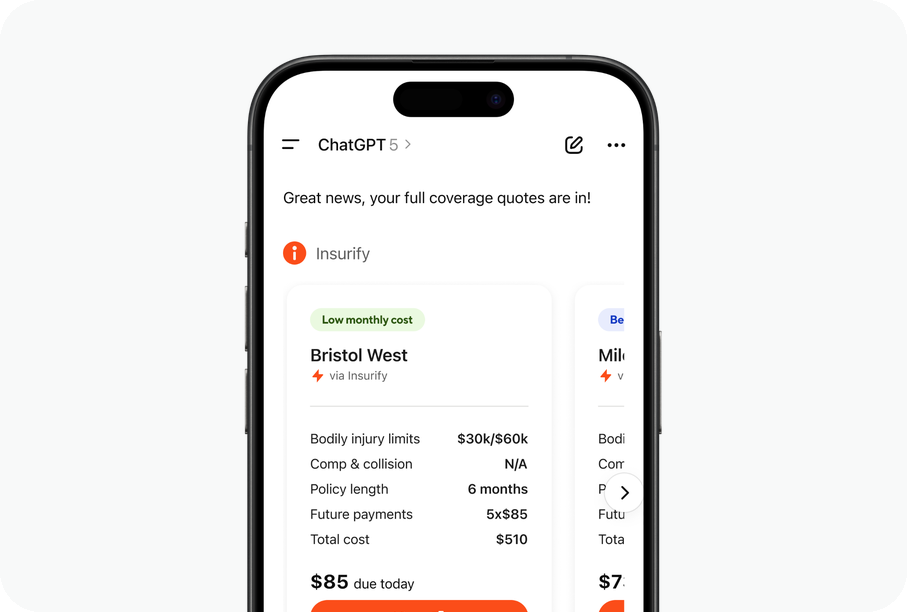
Insurify also moved into ChatGPT in 2026, expanding to personalized real-time quotes for eligible shoppers in selected states. Drivers can discuss coverage and payment schedules, then continue toward purchase through the agency or insurer. The conversation changes the shopping experience; the carrier connections remain essential.
In October, it joined design discussions for Poppy, a proposed personal-agent protocol concerned with consent and company boundaries. Even a conversational purchase needs rules about who can use a shopper’s information.
Insurify’s story keeps returning to the same small distance: between wanting insurance and getting covered. First the missing carriers. Then the repetitive form. Then the money due before payday. Each improvement begins by noticing where a perfectly reasonable customer gets stuck.