The collision claim was worth $2,304.86. It happened in Ohio, in January 2021, and Clearcover says it resolved the claim in seven minutes. A driver uploaded photographs. Software assessed the information, checked for fraud risk, applied the deductible and issued an electronic payment. The memorable detail is the stopwatch. The revealing detail is how many decisions had to happen before anyone could press pay.
- Clearcover sells car insurance with mobile policy tools and digital claims.
- Its seven-minute payout is a record for an eligible claim, not a universal turnaround.
- Agents, embedded distribution and an AI services business now extend the original consumer proposition.
Insurance is bought in anticipation of an unpleasant interruption. Then, when the interruption arrives, the customer encounters another one: waiting. Clearcover’s wager was that software could shorten that second experience. Understanding the company means following the waiting time through the business, including the places where removing it still leaves an expensive problem.
01 / The claim before the clock
Kyle Nakatsuji and Derek Brigham founded Clearcover in 2016 after working at American Family Insurance. They were insurance insiders approaching a familiar product through a different operating model. By early 2018, the business was selling policies. The proposition combined digital purchasing, a mobile app and technology intended to keep operating costs down.

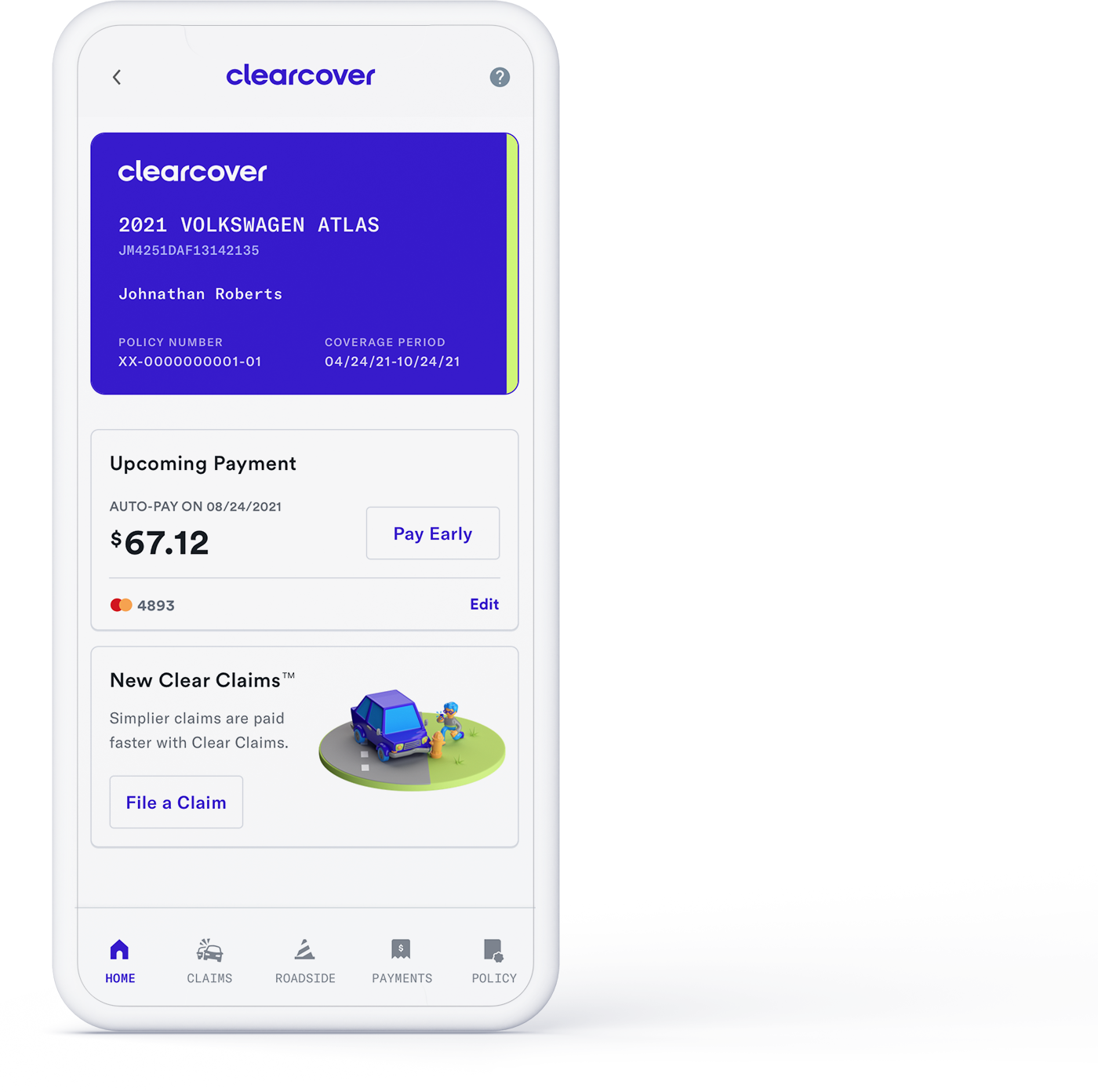
For drivers, the product remains recognizably car insurance: liability protection, collision and comprehensive coverage, plus other options depending on the policy and state. The app puts ID cards, payments and claim tracking in one place. That makes it useful to someone who would rather photograph damage than arrange another call during the working day.
ClearAI assesses fraud risk and claim complexity; Clear Claims determines whether a claim qualifies for expedited payment. This distinction matters. The company’s record illustrates a particular route through the process. Injury disputes, missing documents or uncertainty about responsibility can require a different route. A quick initial payment also cannot make a body shop finish repairs immediately.
“Not all of our claims are paid in seven minutes”Aaron Wheaton · Clearcover · September 2022
02 / A dashboard was too slow
One instructive obstacle appeared behind the scenes. An Arize case study describes Clearcover’s early plan to monitor machine-learning models using business-intelligence dashboards. Existing tools seemed a reasonable place to start. In practice, setting up monitoring for each model could take around two weeks, and detecting performance degradation could lag by roughly a day.
Consider the mismatch. A model helps make a decision during a live quote, while the mechanism watching that model reports trouble tomorrow. Clearcover selected Arize after a proof of concept in early 2021, adding alerts and checks for changing inputs. Comparison-site questions and visitor populations could shift. The model needed supervision that noticed those shifts.
- 01Upload
the evidence - 02Assess risk
and complexity - 03Route to
payment
There is something other builders can copy here: design the feedback mechanism alongside the automation. A system that makes decisions quickly needs a practical way to detect bad inputs, investigate exceptions and change course. Buying monitoring infrastructure was an operating choice, with consequences for how much time the team could spend developing models.
03 / The expensive part of being quick
The financing was substantial. Clearcover announced $43 million in Series B funding in January 2019, $50 million in Series C a year later and $200 million in Series D in April 2021. Eldridge led the last round. At that point, Clearcover said its total funding had reached $329 million and outlined plans to expand its teams.
The subsequent record complicates the picture. Coverager reported a 15% workforce reduction in April 2023. The Insurer reported another 28% cut that September. Those reductions show the limits of the earlier expansion. A service can get faster while the organization supplying it has to become smaller.

More recent carrier figures make the distinction measurable. Coverager’s account of Clearcover Insurance Company’s first quarter of 2026 put written premiums at $29 million, down 10% year over year, and the underwriting loss at $740,000. Its combined ratio improved to 106%. Above 100%, claims and underwriting expenses still exceed earned premiums; faster processing does not settle that arithmetic.
Six percentage points better year over year. Still above break-even. Carrier subsidiary figures, not consolidated group results.
04 / Meet the customer somewhere else
Clearcover also sells through agents and partner experiences. Its embedded offering includes co-branded pages, quoting APIs and white-label insurance. An automotive or financial-services business can introduce coverage within an existing customer relationship. The practical attraction is distribution: insurance appears where a customer is already doing something relevant, rather than depending entirely on a separate shopping trip.
For a driver, Progressive, GEICO, State Farm and technology-led insurers such as Root remain alternatives. Clearcover’s differentiation sits in its operating and distribution choices. It still has to compete on an individual quote, coverage terms and service. An API cannot establish that one policy will be cheaper for every household.
The customer definition has widened, too. Clearcover introduced a Texas general agency and a reciprocal exchange in 2025 as it expanded into non-standard auto insurance. In April 2026, it announced a Florida product with payment schedules aligned to weekly, biweekly or monthly paychecks. For a cash-constrained driver, the billing calendar can matter as much as the app.
05 / Selling what the insurer learned
In March 2026, Clearcover’s holding company launched Dearborn Labs, a separate business embedding teams inside insurers and managing general agents to build production AI systems. The proposed customer now includes another insurance operator. Years of internal implementation become experience that can be sold outside the group.
The test remains concrete. Clearcover’s claims technology works most persuasively when evidence is available, eligibility is clear and exceptions have somewhere useful to go. Its broader business needs sound risk selection and adequate capital. The seven-minute claim earns its place in the story because it demonstrates something specific. The next achievement must survive a longer clock.