Consider the peculiar career of a calorie. In a fitness app, it is usually a number you are pleased to lose. In Burn to Give, the venture Eduardo and Cristóbal della Maggiora started in Chile in 2018, it became a reason somebody else might eat. Users tracked exercise; the platform connected that activity to sponsored food donations. The calorie had acquired a second job.
That small rearrangement became Betterfly. The company eventually attached healthy habits to insurance, employee benefits and rewards. Its proposition was easy to enjoy: take care of yourself, and something useful happens elsewhere. Building a business around that proposition proved considerably less tidy.
- Employers buy the platform; employees use the benefits.
- Healthy habits can unlock rewards, donations and extra protection.
- A five-country retreat preceded the 2026 acquisition of Mexico’s minu.
Give a policy a reason to be opened
Insurance presents an awkward design problem. The moment it becomes indispensable is often the moment something has gone wrong. Betterfly tried to introduce a more ordinary occasion for contact: a walk, a meditation session, a night’s sleep. Under eligible offerings, activity could grow life insurance coverage or earn currency redeemable for benefits and donations.
The underlying insight is about attention. A policy promises help later. A reward supplies a reason to return now. Charitable giving adds another motive: somebody outside the workplace can benefit from an employee’s effort. The app puts those consequences beside the activity that earns them.
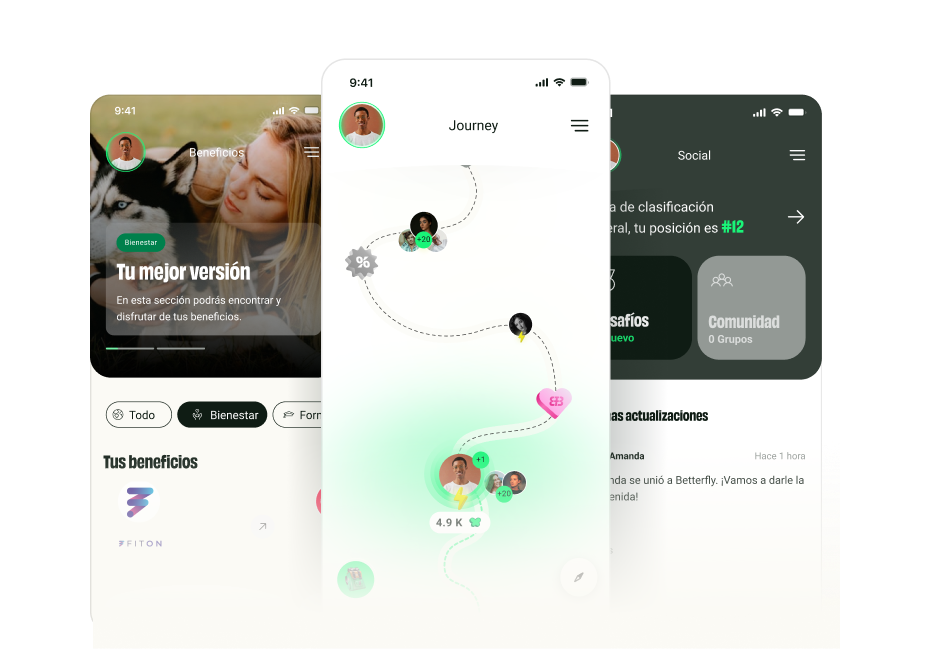
Employers purchase a subscription for their teams. Employees get an app; HR gets administration and reporting. Depending on the country and contract, the menu includes insurance, telemedicine, mental-health support, fitness resources and discounts. Carrier relationships supply the insurance component. Chubb’s December 2021 alliance named five Latin American markets, giving the software company a route into protection without building every part itself.
The first price was small. The expansion wasn’t.
A June 2021 company announcement advertised membership starting at $4 per employee per month. That historical offer included life insurance and wellbeing tools. The arithmetic was approachable: an employer with 100 covered workers would start at $400 monthly under that advertised rate. Today’s contracts and services require their own pricing.
Historical advertised starting price. Not a current quote.
Investors funded a much larger experiment. Betterfly raised $60 million in June 2021, then $125 million in February 2022 at a reported $1 billion valuation. The latter round was led by Glade Brook Capital Partners. Expansion plans stretched across Latin America and into the United States and Europe.
The brothers had complementary jobs. Eduardo was the CEO; Cristóbal is identified as president on the company’s careers site. That site also records a U.S. public-benefit corporation established in 2020. B Lab dates Betterfly’s certification to October that year. Social impact was part of the company’s stated purpose as it pursued commercial growth.


Then the map got smaller
The strain soon became organizational. After 30 reported layoffs in August 2022, Betterfly cut about 30% of its workforce in January 2023. In an internal letter reported by Diario Financiero, Eduardo explained that costs had grown alongside revenue as the company prepared for another period of rapid expansion. A tougher economic environment changed that calculation.
There was a product problem, too. That month, chief product officer Ronny González acknowledged to the same publication that Betterfly had struggled to explain its product simply. The observation matters. The original calorie story took a sentence. Insurance, software, donations, rewards and benefits required a much longer conversation.
The calorie story took a sentence. The benefits business required a much longer conversation.
On the cost of a growing proposition
In March 2025, Betterfly’s retreat became geographical: Colombia, Ecuador, Peru, Argentina and Brazil closed. Another 30 departures were reported. The company said Chile, Mexico and Spain generated 94% of revenue. Those figures suggested the map had become much larger than the core business.
three markets
Chile · Mexico · Spain Company statement, March 2025
Health meets payday
June 2026 brought a different kind of expansion. Betterfly acquired minu, the Mexican financial-wellness company. The combined Mexican business reported reach exceeding one million employees across 4,000 companies. Its customer roster included Grupo Modelo, Liverpool and Televisa Univisión. These were figures for the combination, rather than proof that Betterfly had acquired every customer organically.
Minu contributed earned wage access and other financial benefits. The logic is practical: an employee’s wellbeing also depends on whether money lasts until payday. Expansión reported a $100 million transaction value; announcement coverage described the price as undisclosed. That reported valuation should not be mistaken for a confirmed cash payment.
Meanwhile, Betterfly’s current U.S. website pitches benefits navigation, preventive lab panels, telehealth and Buddy, an AI health guide. It targets employers and brokers, promising a useful relationship after enrollment. The product has moved well beyond counting steps.
The U.S. pitch also changes what the app sits beside. Betterfly says it can explain coverage employees already have, rather than requiring them to enroll again. It advertises two annual lab panels spanning more than 150 biomarkers, with Buddy connecting benefits, wearable information and lab results. Those are the company’s product claims. They describe a navigation and prevention layer around care, with the value depending on the services included in a particular arrangement.
Copy the connection. Check the conditions.
Betterfly occupies the overlap between insurance distribution, benefits software and workplace wellness. YuLife also combines insurance and game mechanics; Vitality rewards healthy behavior; Wellhub offers employer-sponsored wellbeing access. Betterfly’s particular combination adds a charitable thread and, through minu, financial tools. Buyers still have to compare actual coverage and local availability.
The useful lesson is the connection between action and consequence. Make a small action legible. Attach something people value. Give them a reason to repeat it. For an HR buyer, that means checking who can enroll, what care is accessible and whether employees keep using the service.
Usage and outcomes also deserve separate questions. A challenge completed or a benefit opened shows participation. Whether that participation improves health or reduces an employer’s costs requires a different kind of evidence. A buyer should ask what each dashboard number measures before treating engagement as a return on investment.
The mechanism depends on credible rewards, understandable policies and services people can actually reach. An unused app cannot improve access; a leaderboard cannot repair inadequate coverage. Betterfly’s history makes the question concrete: after the first reward, what brings someone back?