On a Tuesday in New Jersey, a worker at Jersey Precast Construction finished a shift. The wages were real; the payday was somewhere else on the calendar. In September 2013, according to Payactiv, one of those workers made the company’s first earned wage access transaction. The event was unremarkable in the way useful inventions often are. Nothing about the shift changed. The worker simply got to use some of its pay before the usual pay date.
- Payactiv connects to an employer’s payroll data and shows eligible workers a portion of wages already earned.
- The company fronts a requested amount, then settles it through an authorized payroll deduction.
- Standard ACH and several direct uses are free; some instant delivery routes have a published fee.
- The employer is the gateway. A worker generally needs a participating employer to use its wage access product.
The company was founded in 2012 by Safwan Shah, Sohail Aslam and Ijaz Anwar. Shah had studied aerospace engineering and built a payments company, Infonox, before turning to a more terrestrial puzzle. In an interview, he described wondering why so many Americans lived from paycheck to paycheck in a wealthy country. He eventually focused on the interval between earning wages and receiving them. An employer’s two-week cycle may be tidy accounting. A flat tire is an event with its own schedule.

The clock was the product
Shah’s first audience was not the worker with an app store search. It was the employer willing to make payroll information available. That is the hinge of Payactiv’s model. The service uses employer data to estimate eligible earned wages, lets the employee request a portion, funds that request itself, and recovers the amount when normal payroll runs. The regular pay date need not move. The worker sees the early payment offset on the paystub.
That mechanism explains both the appeal and the constraint. It is designed for wages that exist, with an employer participating in the system. It cannot conjure pay for an unworked shift or erase a household shortfall bigger than the accessible balance. Still, for a bill due before payday, timing alone can be expensive. Payday loans, overdrafts and late fees make a calendar mismatch into a charge.
The idea had to clear a second obstacle: persuading employers that it was neither a new payroll run nor a conventional loan. In a conversation with OnShift, a senior care software partner, Shah called it “a payment solution, not a credit solution.” OnShift’s Mark Woodka said his first reaction had been to mistake the service for a cheaper payday loan. The difference became clearer when he understood that the money was tied to work already done. The change of mind matters because employers, not app downloads, open the door for workers.
“Why do we pay people on a two-week cycle? Because we always have.”Mark Woodka, former OnShift CEO, in conversation with Payactiv
A fee schedule with a plot twist
Payactiv’s early model charged for access. In 2016, a Goodwill example reported a $5 transaction fee, with Goodwill covering half. Then the pandemic produced a test: Payactiv waived fees for 75 days. In 2022 it said it would eliminate general access fees for several delivery methods, including standard bank transfer. The company also asked to end a special 2020 Consumer Financial Protection Bureau approval order so it could change the fee model. The CFPB agreed to terminate the order; it also said it had been concerned by company language that suggested official endorsement. The episode is a reminder that product pricing and regulatory claims travel together in financial services.
Instant Payactiv Card loads are listed as free after a qualifying $200 direct deposit per pay period. Delivery options may vary by location and program.
This is where the economics become interesting. The free route may take days, while the bill may be due tonight. Payactiv makes money when a user chooses certain faster routes; its public materials say the standard EWA program is free for employers. Other enterprise and API arrangements can differ. The price of speed is therefore visible, and sometimes unavoidable for someone facing a deadline. A worker considering the product can compare that fee with the likely cost of waiting, and can choose the free option when time allows.
The company outgrew the button
Walmart made the product conspicuous. In December 2017, the retailer began offering earned wage access to 1.4 million U.S. associates. The partnership soon revealed that a bank transfer was not a complete answer. In 2018, Payactiv announced cash pickup at Walmart stores for its users, including people without a bank account. That is an unusually concrete form of financial inclusion: a person can leave with cash, rather than wait for a bank rail to approve its journey.
The app grew outward from the wage button. Payactiv’s Visa prepaid card accepts direct deposit and gives users a destination for wages. Bill Pay schedules payments. SmartSave suggests amounts to set aside, and goal-based savings can move money into a separate purse. SmartSpend analyzes spending. Payactiv Connect, introduced in 2021, added messages and optional shift scheduling for deskless employees. The company was trying to become useful on ordinary days, not only on the afternoon an emergency appears.
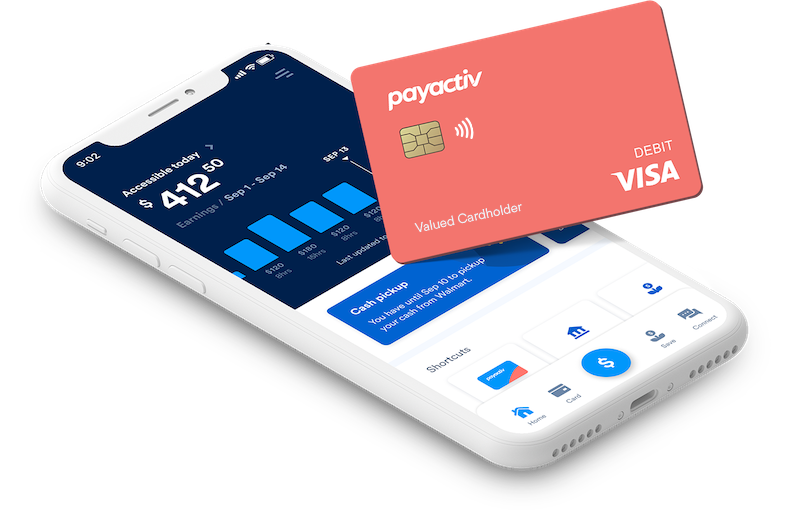
That expansion also changed who Payactiv competes with. DailyPay, EarnIn, Branch and One@Work offer routes to earlier pay, while payroll platforms, card programs and benefit providers occupy adjacent territory. Payactiv’s particular claim is payroll integration: verified earnings, visible deductions and multiple destinations. The company describes its product as non-recourse, with no interest or collections for non-settlement except fraud. Competitors’ methods and fees vary, so the useful comparison is a specific employer program against another specific program, not a slogan against a slogan.
Distribution is the quiet advantage
In 2020 Payactiv announced $100 million in Series C financing and a related funding facility, led by Eldridge with existing investors participating. It said then that it served more than four million employees at over 1,000 businesses. Later company materials use larger figures: its 2025 Visa+ announcement cited more than 20,000 businesses, while its current Access-as-a-Service page says more than 40,000 businesses and five million workers served. These are company-reported totals and use different timeframes. They show the direction of travel, not a clean active-user trend line.
Recent moves put Payactiv closer to the software that already holds workforce data. In 2025 it announced Visa+ transfers to Venmo and PayPal, joined the Workday partner program, and listed its solution on SAP Store for SuccessFactors customers. Access-as-a-Service packages wage access and related financial services for other platforms to embed under their own brands. For an employer, this can turn a new benefit into an integration project instead of a new payroll philosophy. For Payactiv, it widens distribution without needing every worker to discover a standalone app.
The employer gets an answer to recruitment and retention pressure; the worker gets a way to use some earned wages before the scheduled check. Payactiv cites improved retention, but the size of that effect will depend on workplace conditions, adoption and what other benefits are available. The service solves a timing problem. It cannot solve an insufficient wage, a missing shift or rent that exceeds income. That distinction is worth keeping, because it makes the actual invention more legible.
There is a modest lesson here for anyone designing a benefit. Find the calendar that everyone treats as natural, then ask who pays for obeying it. Payactiv did this with payday, tested it with a construction company, made the service easier for large employers to adopt, and changed its fee structure when experience and scrutiny pushed it there. The result is not a new wage. It is a claim that a worker’s Tuesday ought to count before Friday arrives.