At first, the pitch went nowhere. In a later account of DailyPay’s beginnings, cofounder Jason Lee described approaching Uber drivers at JFK Airport with an offer: access the money they had earned before their usual payday. He spoke to about a hundred drivers without a signup. Then one driver joined, shared the service in a Facebook group, and others followed. The financial proposition had barely changed. The person recommending it had.
That is a useful place to begin with DailyPay. Moving money requires machinery. Getting someone to trust the machinery requires something else. Today the company reaches workers through their employers, placing a new financial habit inside a familiar relationship: the job.
- Access earned wages through a participating employer.
- Choose paid instant access, free slower access, or a qualifying card route.
- Earlier transfers leave less to receive on payday.
Your shift is over. Your money is waiting.
Founded in 2015 by Lee and engineer Robert Law, DailyPay sells employers a benefit called earned wage access. Employees see an available earnings balance, then request a transfer before scheduled payday. A grocery run, a utility bill, or the petrol needed to reach tomorrow’s shift need not wait for the payroll calendar.
The important word is earned. Available balances depend on work and employer data, with allowances for deductions. This is access to part of an existing paycheck. Money taken early reduces what remains on payday. The application changes the timing of income; it cannot increase its amount.
Employers are the distribution channel, while employees are the everyday users. DailyPay’s September 2026 announcement reported more than 2,000 employer clients, over six million eligible employees, and more than 180 prebuilt integrations. Eligible does not mean active. Its public customer roster includes Dollar Tree, Adecco, and HCA Healthcare - workplaces where managing a large frontline workforce is a daily operating problem.

THE PAYCHECK TEST“Money taken early reduces what remains on payday.”Profile excerpt
The clever part happens behind the button
A consumer sees a balance and a transfer button. Behind them sit timekeeping records, payroll connections, payment rails, and capital. DailyPay funds early access and recovers the money when payroll runs. Employers can offer earlier access without switching to a daily payroll schedule.
In its full-funding model, an employee’s net wages flow through a DailyPay account; the company reconciles early transfers and sends the remainder onward. That routing matters. “No change to payday” can still involve a substantial change in how a paycheck travels.
In September 2026, DailyPay added a deductions method, allowing early transfers to be recovered through standard payroll deductions. The announcement does not establish that the original method failed. It does show a broader accommodation of employers’ payroll preferences. The practical lesson is copyable: fit a useful new service into the systems customers already operate.
Workday is an especially valuable doorway. The companies announced a strategic partnership in March 2025; DailyPay now describes a native, co-built Workday feature with one-click employer setup and employee access inside Workday. ADP is another integration partner. Connections like these make distribution and implementation part of the product.
- 01Work gets
reported - 02Available pay
is calculated - 03Early transfer
is funded - 04Payroll
reconciles
Same earnings. Earlier arrival.
What does “now” cost?
DailyPay’s revenue model includes flat fees for instant transfers. Its published program terms list free next-business-day ACH and instant transfers at $1.99 to $3.99, varying by employer. Its employee fee page shows $3.49 as an example. The account’s displayed terms matter more than any single advertised number.
The DailyPay Visa Prepaid Card offers another route: fee-free instant transfers of available earnings to the card when it is set up for direct deposit, subject to eligibility. Other card fees and limits apply. Slow transfers and qualifying card transfers make it possible to use the service without paying an instant-access fee.
The arithmetic deserves daylight. Four instant transfers at the illustrated $3.49 price cost $13.96. Twelve cost $41.88. These are examples, not measured customer averages. For someone preventing a larger late charge, paying for speed may be sensible. Repeating that purchase every few days makes speed a recurring household expense.
Here the company meets its sharpest criticism. In April 2025, New York’s attorney general sued DailyPay, alleging unlawful lending, deceptive practices, and violations of wage-assignment rules. DailyPay disputes that characterization. In an April 2026 court filing reported by Payments Dive, it emphasized its employer relationships and argued that workers have no repayment obligation if their employer fails to pay DailyPay. The allegations should not be read as a court’s findings.
Illustration at $3.49 per transfer. Employer pricing varies. Free options can cost $0.
A short wait needs a large balance sheet
Eliminating a few days of waiting takes serious financing. In January 2024, DailyPay announced more than $75 million in equity at a $1.75 billion pre-money valuation, plus $100 million of additional credit capacity. Those are different instruments: equity finances ownership and growth; credit helps fund wage transfers.
In June 2025, it completed a $200 million asset-backed securitization of on-demand-pay receivables. In February 2026, it expanded a secured facility by $200 million to $960 million, with Barclays, Citi, TPG Credit, TD Bank Group, and Royal Bank of Canada participating. Borrowing capacity is neither revenue nor money paid for company shares.
The product range has widened too. Cycle handles off-cycle payments such as corrections and termination pay. Reward distributes digital bonuses. Tips moves gratuities electronically. Credit monitoring, savings tools, Perks discounts, and Bill Manager extend the relationship beyond an urgent withdrawal. Nelson Chai, formerly Uber’s finance chief, became DailyPay’s CEO in October 2025.
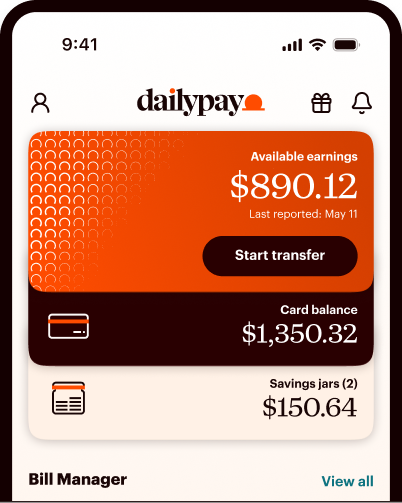
A choice.
A transfer.The payroll connections stay backstage.
A better calendar still needs enough money
DailyPay competes with employer-connected services such as Payactiv and Rain. An app, early access, and a prepaid card are not unique by themselves. DailyPay’s case rests on the combination of payroll connections, financing capacity, distribution partnerships, and increasingly flexible repayment workflows. Buyers should compare those operational details alongside the fees workers will actually encounter.
The service depends on employer participation, accurate reporting, and available earnings for participating workers. Delayed work data can delay access. A worker whose expenses persistently exceed income will still face that shortfall after the calendar changes. For employers, adoption figures alone cannot establish better retention; that requires measuring outcomes against a credible comparison.
The lesson from the airport survives the scale. A useful offer needs a trusted route to its audience. DailyPay has built that route through work, then supplied the connections and capital behind it. Its promise is easiest to judge one paycheck at a time: how much arrives early, what that access costs, and how much is left when payday comes.