Jessica had $20,000 in credit card debt, some of it charging nearly 30% interest, and a job moving containers at an Illinois distribution center. She wanted a house for herself and her son. First, she needed a way out of the arithmetic. An advertisement at work pointed her toward Brightside. The interesting part of what happened next was how ordinary it looked: a conversation, a review of her bills, a plan.
- Employers pay. Eligible employees get confidential financial help at no cost.
- A dedicated human helps with bills, debt, credit, savings, and benefits.
- Brightside keeps no product kickbacks. Partner loans still have their own terms.
In the account published by investor Obvious Ventures in 2022, Jessica’s Financial Assistant helped consolidate her credit card debt and refinance her car. The projected saving exceeded $15,000 in future interest. Her credit score rose 30 points; she began saving weekly. This is one reported case, not an average result. But it explains the company better than a screenshot could. Someone helped turn an intimidating pile of decisions into a sequence she could act on.
A benefits department builds its own answer
Brightside began with a customer’s problem. Comcast’s benefits team and Comcast Ventures helped create the company after Shawn Leavitt, then a senior benefits executive, saw an opening for a service that would guide employees through financial decisions. Healthcare already had a useful precedent: Accolade helped people navigate a complicated system. Why couldn’t money have a navigator, too?
Callum King left Comcast Ventures to build the venture. Tom Spann, Accolade’s founding CEO, came aboard; Jacky Chiu brought technology experience from LifeLock. The founding team also included Christine Tozzi from Willis Towers Watson and Petrina Thompson from American Express. Founded in 2017, Brightside publicly launched in May 2018 with $4 million in seed funding and Comcast as its charter customer.
The gap they saw was practical. A worker facing an urgent bill might already have access to financial education, retirement tools, and assorted financial products. Knowing those things existed did not settle the bill. Brightside’s proposition was to provide someone who could work through the options and help execute the next step. That made the service as much about navigation as knowledge.
Unum offers a useful example of that mismatch. In Brightside’s account, the employer already offered financial education, webinars, and a 401(k), yet money stress remained a leading employee concern. It sought a partner that could provide empathetic human support and work across its benefits. The revealing change was in the question: which service would help people deal with their circumstances, rather than simply add another resource to the shelf?
Follow the fee
To understand Brightside, follow who pays whom. Employers purchase the benefit. Eligible workers use the support without paying for access. Brightside says it receives no kickbacks from loans or other financial solutions. When a referral bonus exists, it passes the money to the employee. The company calls that a KickForward, a cheerful little name for a consequential decision about incentives.
Its pitch occupies a particular place in the benefits market: personal help with the financial problem happening now. A planning service can help someone prepare for retirement; early access to wages can move money forward. Brightside offers a navigator across needs and options, including free assistance. Employers are buying the prospect of a more stable workforce alongside that service. The employee, meanwhile, needs confidence that the conversation will not become a sales funnel.
“Trust is the currency of the business.”
Tom Spann, CEO · September 2026
The price distinction deserves care. Free access to a Financial Assistant does not make a partner loan free. Interest, approval, and repayment terms still matter. Brightside is not the lender and does not determine approval.
The app remembers. The person decides.
Brightside’s technology supports the relationship. Its platform describes case records that keep people from having to retell their story, automated tools that help assistants review options, and follow-up tasks tied to what was agreed. Payroll connections and employer eligibility feeds make the workplace part of the service’s plumbing. The company’s current description also names Navi, its AI supporting Financial Assistants.
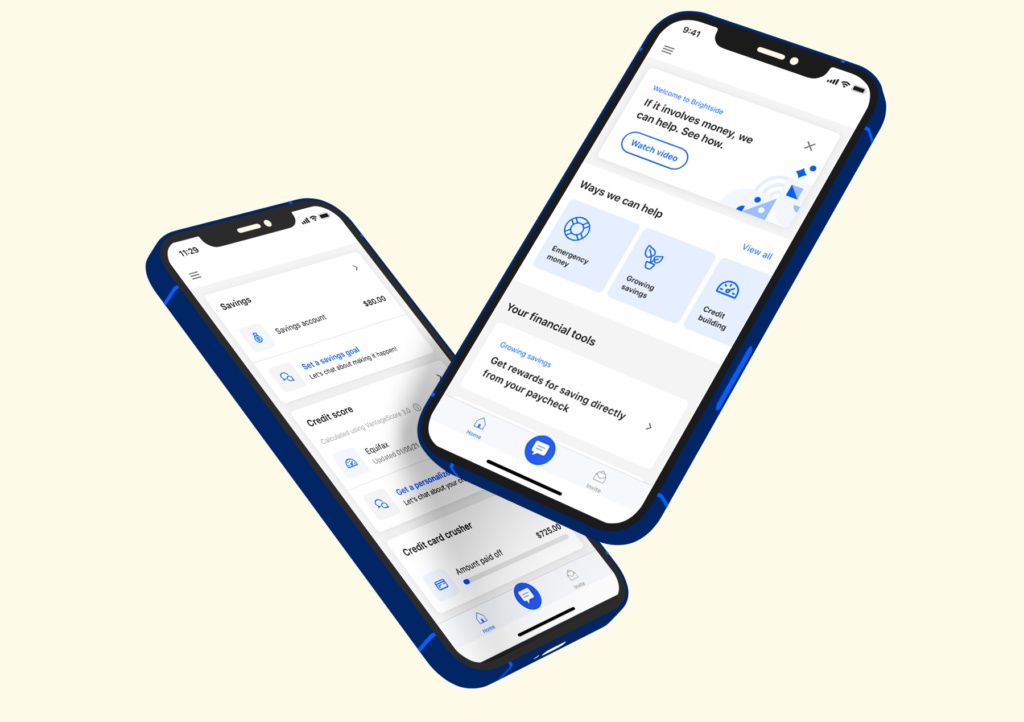
The available help ranges from locating community assistance and negotiating bills to handling debt and building savings. Products include savings and spending accounts and access to paycheck-linked partner loans. Availability varies by employer. The useful expertise lies in connecting those tools to someone’s circumstances: an emergency grant and a new repayment obligation have very different consequences for the next paycheck.
- 01ListenStart with the immediate need.
- 02Find optionsLook for free help first.
- 03Do the legworkHelp put a choice into action.
- 04Build a bufferWork toward savings and stability.
What 150,000 workers can tell you
There is evidence of demand beyond the original Comcast relationship. In September 2026, Amazon said more than 150,000 hourly employees had used Brightside since 2022. That is cumulative use, not a count of people currently active. Unum is another named customer. Brightside also joined UnitedHealthcare’s UHC Hub vendor network in 2023, giving it another route into employer benefits conversations.
hourly employees had used Brightside since 2022
Financing helped build that reach. Andreessen Horowitz led a $35.1 million Series A in 2020; Obvious Ventures led a $33 million Series B in November 2022. By 2025, Brightside ranked No. 137 on the Inc. 5000. The company reported 2,772% revenue growth across the ranking’s 2021-2024 measurement window.
Outcomes require a different reading. Brightside reports roughly $1,200 a year back in engaged families’ pockets on average, and lower turnover among engaged workers compared with similar nonusers. Those comparisons are useful signals; they should not become a promise that every deployment produces the same result. Employers need to examine who engaged, what changed, and how the comparison was constructed.
The copyable lesson is the sequence: begin with the problem a person wants solved, keep sales incentives out of the recommendation, and make follow-through somebody’s job. At a September 2026 conference session, Amazon’s financial wellness program manager described studying its workforce, piloting, and measuring before expanding. Access still depends on employer participation; workable options depend on eligibility and circumstances. A navigator cannot guarantee a loan or manufacture a grant. Brightside’s bet is that having someone help with the search can change what happens next.