The peculiar thing about a mental health benefit is that having one and using one are separate achievements. An employee can possess an insurance card, a list of names and every intention of getting help, yet still have no appointment. Each unanswered call becomes another task. The person who needs care becomes the person responsible for assembling it. Lyra Health has spent its life working on that uncomfortable interval.
- Employers buy the benefit. Employees and families use the care.
- Matching, treatment and outcomes tracking sit in one system.
- Family care and benefits integration expand the original idea.
- Its AI guide supplements human care between sessions.
The work before the work
David Ebersman had been chief financial officer at Facebook and Genentech before helping start Lyra in 2015. His résumé supplied an intriguing combination: technology’s appetite for scale and medicine’s insistence on evidence. The initial proposition was practical. Use information about patients, providers and clinical guidelines to make finding appropriate mental health treatment less of a guessing game.
That October, the company announced $35 million in Series A funding. Ebersman recalled the starting point plainly: “We had no product, no employees, no customers.” The money supported screening, matching and tracking outcomes. Those three activities remain a useful description of the original insight. A directory tells you who exists. A care system must help determine who can help, then find out whether the help worked.
“We had no product, no employees, no customers.”
David Ebersman, on starting Lyra in 2015
A match was only the beginning
The early years were not a frictionless ascent. In May 2016, Fast Company reported that co-founder and chief medical officer Dena Bravata was leaving, along with at least two others from the clinical team. That is an observable early disruption. It does not, by itself, explain the company’s later decisions or establish that the product had failed.
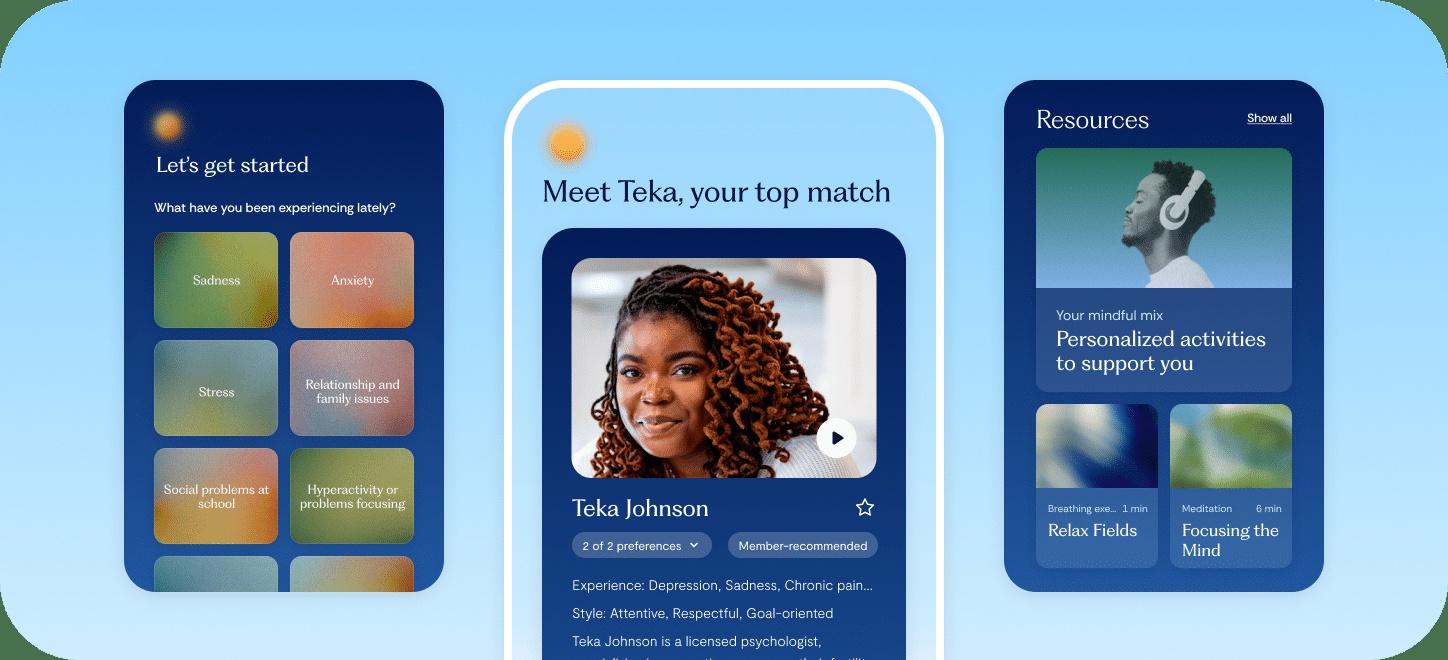
A more revealing account arrived from Lyra itself in 2018. The company described moving from helping people navigate the first steps of care to supporting the care experience from start to finish. The change widened its responsibility. Successfully introducing two people was insufficient; treatment had to be accessible, engaging and measurable. A referral could no longer serve as the finish line.
Today, the offering spans coaching, therapy, psychiatry, digital exercises and specialized support. Clinical care comes from licensed professionals through affiliated and contracted practices; Lyra Health supplies technology and administrative services. Its expertise lives in the combination of clinical research, provider selection, care delivery tools and measurement. Calling it an app misses much of the work.
The employer at the other end
Lyra has two audiences. One wants help with an intimate problem. The other wants a benefit that employees use and a cost it can defend. Customers include Starbucks, Morgan Stanley, Salesforce and Genentech. Starbucks’s FY2022 report made its offer particularly legible: 20 free therapy or coaching sessions annually for U.S. employees and qualified family members. The allowance makes access tangible.
Lyra’s July 2025 pricing explanation also deserves a careful reading. Employers pay for care delivered. After a year, meeting agreed performance targets earns Lyra a bonus; missing them produces a credit on care fees. “Pay for results” therefore still involves paying for treatment. Access, satisfaction, symptom improvement and return on investment become commercial measures, rather than decorative dashboard numbers.
The financial argument is larger than the therapy bill. A company-reported analysis of roughly 30,000 members across four years found an average 26 percent reduction in annual health plan spending for participants. That is a defined study result, not a forecast for every workforce. A buyer still needs to examine the comparison, the care fees and the contract before turning claims savings into expected net savings.
Participant average in Lyra’s four-year analysis. Study result; individual employer returns vary.
In the employer market, alternatives include Spring Health, Modern Health, Headspace and conventional employee assistance programs. Lyra’s pitch emphasizes coordinated, evidence-based care and measured outcomes. That positioning is more specific than selling a library of wellbeing content. It also creates a demanding obligation: the quality of the care network must support the promise made by the software.
When the family enters the picture
Expansion has followed the places where the original problem reappears. In January 2022, Lyra announced a $235 million financing and the acquisition of ICAS World, whose employee assistance operations reached more than 155 countries. International care requires local infrastructure. The purchase gave the global ambition something sturdier than a translated interface.
In July 2025, Lyra acquired Bend Health, adding pediatric expertise, neuropsychological evaluations and virtual intensive outpatient capabilities. The logic is easy to recognize: an employee’s working day is affected by a child’s difficulties, but the child needs age-appropriate care. An adult therapist directory cannot automatically solve that problem. Families require another layer of expertise.
Lyra Link tackles a related obstacle. An employer may offer separate benefits for diabetes, physical pain, caregiving and mental health. The employee gets the coordination job. Announced partners including Virta, Hinge Health and Carrum Health connect these services through Link. The practical ambition is fewer repeated explanations and better handoffs when needs cross a vendor’s boundary.
the need
and book
care
progress
The hour between appointments
Jennifer Schulz became CEO in January 2025, succeeding Ebersman. Under her leadership, Lyra introduced Empower, its platform for members, providers, benefits leaders and integration partners. In October it announced a conversational AI guide, initially available through a coaching pilot. The proposed use was support between human-led sessions, a period when difficulties do not politely wait for the calendar.
In May 2026, Lyra announced plans to broaden availability during the year, with conversational search, enhanced triage and voice features. Its published safeguards include clinical review, human oversight and privacy protections; members can opt out. The useful question is whether these tools help people reach appropriate care. Availability around the clock is a feature. Safe, effective support remains the test.
Make the next step possible
There is something readers can copy here without building a health company. Find the point where a person must do extra work to receive the thing you promised. Reduce that work. Check what happens afterward. Lyra’s evolution suggests that the next obstacle often appears just beyond the one you removed.
The approach depends on actual access: benefit eligibility, suitable providers, sufficient covered care and appropriate escalation. A tidy intake screen cannot compensate for missing clinical capacity. Lyra’s story is compelling because it keeps returning to that ordinary, consequential moment: a person asks for help, and somebody has to make the next step possible.