Consider the employee whose parent has just come home from hospital. There is a job to return to, a household to run and now a collection of questions nobody put in the discharge instructions. Who can help at home? What will insurance cover? Which decision matters today, and which can wait? The family has acquired a care coordinator. Unfortunately, the care coordinator has acquired no training.
Grayce built a company around that predicament. Its idea was to put an experienced person beside the family and give both a practical way to organize the work. The service combined a digital platform with master’s-level Care Partners, helping people handle the logistical and emotional demands of caring for someone else. Employers bought access because a family’s unfinished business can become an employee’s interrupted working day.
- The work: personalized care plans, resource navigation and hands-on help.
- The buyer: employers supporting working caregivers and their families.
- The bet: human expertise made more accessible through software.
- The turn: in November 2025, Grayce formally referred all clients to Cariloop.
Where the story stands: Grayce’s original service has ceased, according to its benefits-directory listing. The company’s announced referral agreement points employers seeking continued support toward Cariloop. This profile follows the service Grayce built and the lessons in its design.
Two founders who knew the other shift
Julia Cohen Sebastien and Kassidee Kipp founded Grayce in San Francisco in 2019. The pair had met through a mentoring program more than two decades before their 2024 funding announcement. Both brought personal experience of caring for others. Kipp had cared for her mother, who had Parkinson’s disease. The business began with a problem its founders had already encountered away from a pitch deck.

The initial assumption was eldercare: employees supporting aging parents. Customers widened it. Kipp later described discovering substantial needs involving children, spouses and other loved ones. Geography widened too. An employee’s office location tells you remarkably little about where that employee’s family needs help. Grayce expanded its ambitions to reflect those relationships.
That is a useful correction for anyone designing a benefit. An eligibility map is tidy. A family is less obliging. The relevant unit is the person needing help and the person responsible for arranging it, even when they live in different places. A service built only around the office postcode risks answering the wrong question with admirable efficiency.
The product was a person with a plan
Grayce’s Care Partners helped identify needs, set priorities, find resources and coordinate next steps. The scope could include healthcare navigation, housing, financial assistance, legal resources and everyday practical support. Around that relationship sat educational material, digital planning tools and a peer community. The work connected medical circumstances with the arrangements that made daily life possible.
For a family weighing eldercare options, that could mean organizing the search for housing or in-home support and helping understand how to pay for care. For another member, the immediate task might be sorting out an insurance claim. These are concrete jobs with dependencies. A resource list can be useful, but somebody must still decide which entry applies and what to do with it.
- 01IdentifyUnderstand the family’s needs
- 02PlanPrioritize decisions and tasks
- 03ActResearch, coordinate, connect
- 04RevisitAdjust as circumstances change
Grayce occupied the space between the family and a fragmented collection of providers, benefits and public resources. Its historical alternatives included Wellthy, Cariloop and ianacare. Human guidance was part of a broader market, so the useful comparison is practical: which tasks will the service take on, which relatives qualify, and what happens after the first conversation?
Navigation also has a natural limit. Helping someone search for care cannot manufacture a local worker or make an unaffordable service affordable. The model is most useful when confusion, coordination or overlooked resources are the obstacle. It still depends on available services, workable eligibility rules and a family willing to share enough information to make the plan specific.
A Google Doc meets a worried family
A designer’s account supplies an unusually revealing detail: Grayce’s care plan started as a shared Google Doc. An early outsourced web version made the plan digital but left members uncertain about what was happening. They could struggle to distinguish completed work, forthcoming work and tasks that belonged to them. The interface had moved forward; the explanation had fallen behind.
Ellen Hughes’s portfolio describes redesigning the experience so care plans communicated status and next steps more clearly. Navigator actions and the member-facing view were brought into alignment. Her account reports extensive user research and iteration. These are the designer’s historical observations about the product, rather than an independent audit of its outcomes.
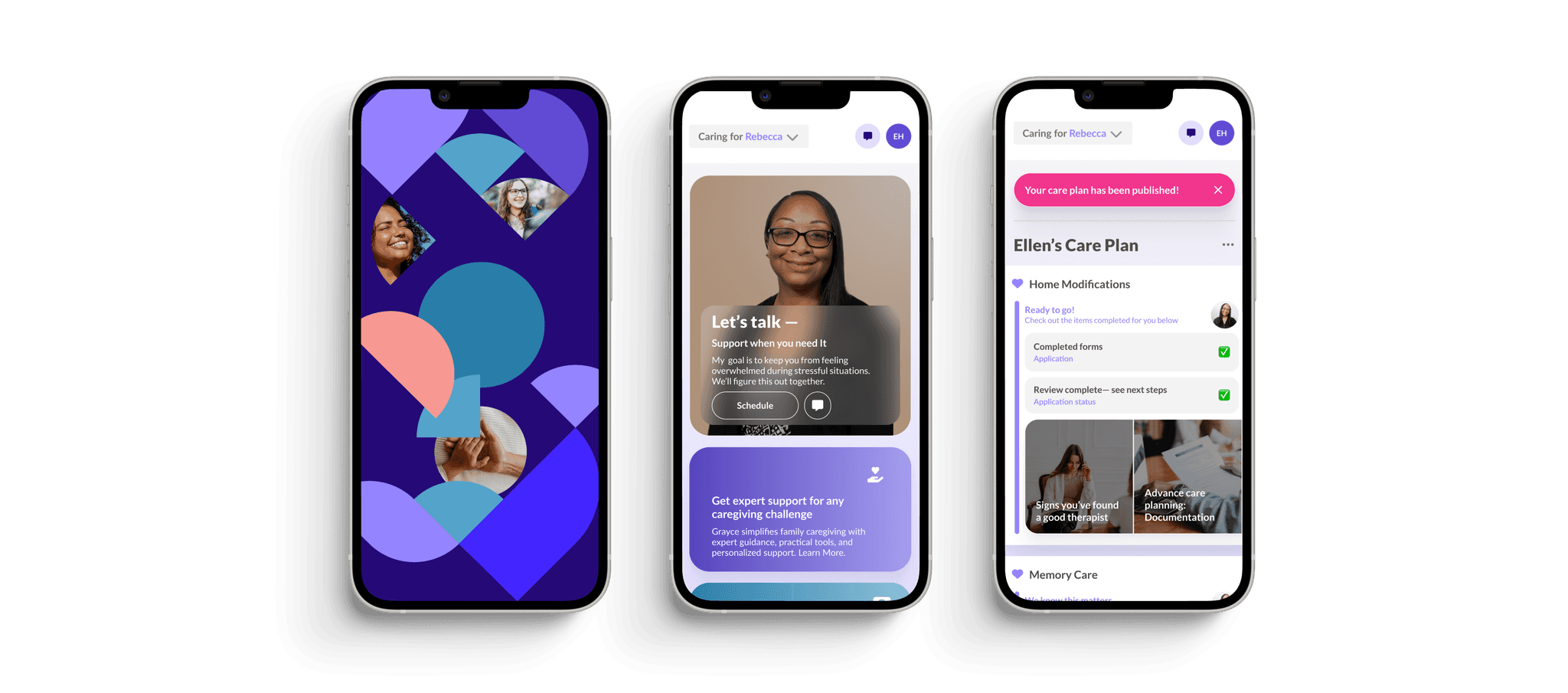
The lesson travels well beyond caregiving. When customers buy a service, some of the work happens out of sight. Software should make that work legible: what is being handled, by whom, and what happens next. A family already managing uncertainty has little appetite for another mystery, particularly one with a password.
For a worried family, “someone is working on it” needs a visible next step.Our reading of Grayce’s care-plan design
The employer paid for the unfinished work
Grayce sold through a business-to-business-to-consumer model: the employer was the buyer, while employees and families received support. In a 2024 interview, Kipp described a platform fee followed by charges for employees using the service. Coaching had moved from hourly sales to unlimited support. The product combined an ongoing relationship with tools and community resources.
That arrangement gave Grayce a reason to identify caregivers inside a workforce. It also posed a delicate product question: how does a service remain easy to remember in a crisis without demanding constant attention? A care app should earn its place when needed. Making someone open it every day is a peculiar substitute for making their day easier.
DocuSign was a named customer. In Grayce’s account, its benefits leader described discovering through employee surveys and conversations that people needed more help caring for aging, ill or vulnerable loved ones. The attraction for a benefits team is straightforward: someone can help the employee turn existing benefits and outside resources into usable support.
The company announced a $10.4 million Series A in June 2024, led by Maveron. Its stated plans included improving its employer offering and member experience and entering the payer market. That was capital for developing the business. A care service still had to prove its usefulness one family, one plan and one resolved task at a time.
Leave gives you time. The calls remain.
Grayce’s 2024 research made its case for employers particularly clear. Working with Talker Research, it surveyed 2,000 full-time employed Americans who had taken time away to care for themselves or someone else. Among that selected group, 45% reported taking several days off per month for caregiving. Some 71% said support would have helped avoid or reduce time away.
2,000 full-time employed Americans with care-related time away; surveyed April 25-May 1, 2024. Self-reported answers, not measured effects of using Grayce.
The distinction matters. Those answers describe experiences and beliefs within the survey sample. They do not establish how many days a particular benefit would save across every workforce. But they suggest a useful question for an employer: when someone asks for leave, do they need more hours, help arranging care, or both?
Flexibility and leave remain necessary. Yet an afternoon off may simply become an afternoon on hold. Grayce’s proposition was that practical assistance could change what happened during those hours. The copyable idea is to ask about the task behind the absence and offer help that reaches that task.
The final task was continuity
On November 13, 2025, Grayce and Cariloop announced a partnership formally referring all Grayce clients to Cariloop. The public statement framed the arrangement around continuity of care. The announcement presented Cariloop as the recommended provider for employers continuing their caregiving programs.
“I wholeheartedly recommend Cariloop,” Sebastien said. The handoff puts a further question on the buyer’s desk: how will families keep receiving support when the supplier changes? Anyone selecting a care benefit can copy that question too. Ask about the transition of access, outstanding tasks and ongoing relationships before a transition becomes urgent.
Grayce’s story leaves a practical standard for the category. A family should finish an interaction knowing which problem comes first, who will work on it and what happens next. That is a modest promise to write in a benefits brochure. It is a considerable relief to deliver on a Tuesday afternoon.
Follow the care
For the current referral route: Cariloop’s Grayce page. Grayce’s public presence: website, LinkedIn, X and Facebook.
Read further: the founders’ caregiving experience; Kipp on the employer model; the care-plan design account; the 2024 funding announcement; the leave survey announcement; the service-status listing.