A restaurant can need another pair of hands at half past twelve and have little use for them by three. A student can have precisely that gap between lectures. Stint has built its business around the possibility that these two inconveniences might cancel each other out.
The London company connects hospitality operators with local workers for short shifts, usually aimed at the daily rush. It also organises recurring teams and now markets AI workforce software. The unifying idea is unusually concrete for a technology company: put enough people on the floor when the customers arrive, without stretching every extra shift across the quiet hours.
That sounds straightforward until the person taking the shift needs a worthwhile journey, the manager needs someone who knows the room, and the existing staff need help rather than another colleague to supervise. Stint’s evolution is a story about those practical complications. The clever match is the beginning.
A business hiding between lectures
Brothers Sam and Sol Schlagman developed the idea while studying at University College London. In Stint’s own account, they approached more than 1,000 businesses before launching in 2018. The earliest matching happened through WhatsApp. Students had fragments of available time; hospitality businesses had fragments of unmet demand. A conventional part-time job did not neatly join them.
The founders made expensive choices in time and opportunity before the platform acquired scale. In a 2020 interview with Startups Magazine, they said Sol had turned down a City job and Sam had left university. They identified Edinv, the family office of property businessman Graham Edwards, as their investor.
By September 2020, the Evening Standard reported more than 20,000 students on the platform and 40,000 completed Stints. Those early numbers describe a working service, already being used beyond a friendly campus experiment. They also show why registration and completed work need separate columns in any account of its growth.
Company-reported scale, viewed September 2026. Registrations are cumulative; they do not measure how many people are working today.
Stint’s current story page reports more than 250,000 accounts created and a waitlist exceeding 60,000. Its workforce pages use a different figure: more than 100,000 Stinters. A student downloading an app, a worker available locally and a person completing tonight’s shift are three different commercial facts.
The lunch rush has a shape
Stint’s customers include the kinds of businesses where a sudden queue is both good news and an operational nuisance. Its website features PizzaExpress, Pret A Manger, GAIL’s, Honest Burgers and SSP Group. Its help centre describes work across restaurants, bars, hotels, cafés and events, with occasional office assignments too.
The staffing proposition is to supplement a core team during concentrated peaks. Experienced employees can spend more time on the work that needs their familiarity and judgement. Students get assignments small enough to fit around other commitments. The business buys a narrower block of labour instead of automatically buying another long shift.
Extra hands, timed to the queue.
The distinction matters because reducing labour cost is not always a matter of paying a lower hourly rate. It can mean paying for fewer hours outside the useful window. Equally, a superficially efficient rota can become expensive if inexperienced staff slow service or experienced colleagues repeatedly stop to explain the basics.
Familiar faces are part of the product
Stint’s answer is a branded Team. The company shortlists nearby candidates; businesses select people for trial shifts, then decide whom to retain. Its workforce page describes two trial Stints before that decision. Workers return to a business whose routines they can learn, rather than starting from scratch in a different room every time.
For applicants, the current student offer begins with a short introduction video, lasting 30 to 60 seconds. The website says a CV and prior experience are unnecessary. Applicants still face selection and a trial. That is a lower-friction application route, with a real decision at the other end.
The company’s press pack describes training videos, practical tips, health and safety information and in-app qualifications. It also describes ratings after shifts. The repeated assignment is commercially important: learning the layout, the job and the team has a cost, and that cost is easier to justify when the worker comes back.
An Associated Press report in 2021 followed Gabrielle Walker, a UCL student who had struggled to find part-time work before discovering Stint on TikTok. After an introductory course, she picked up a one-day assignment polishing cutlery at a Michelin-starred restaurant. Her subsequent shifts fitted around classes. The account captures the attraction more plainly than a registration total: someone without an established hospitality career could find a paid way into the industry.
It also explains why the first assignment deserves attention. A clear brief and a welcoming supervisor can make an unfamiliar workplace manageable. Confusing instructions can consume a large share of a short shift before the new arrival has contributed much.
Flexibility comes with a weekly promise
The student page advertises shifts of two to four hours and the ability to fit work around university life. Its Teams terms, updated in July 2026, describe a more structured relationship: workers commit to a minimum number of shifts each week over a fixed term. Available shifts are released weekly and selected on a first-come basis.
Both can be true. Choosing among short assignments offers flexibility, while a recurring commitment gives the restaurant something to plan around. A student should therefore think about next month’s timetable as well as tomorrow’s free afternoon. A Team place is a relationship with expectations.
Stint advertises next-day access to up to 70% of earnings through Onsi. Its key information document describes normal payment in the following week. It lists a default total rate of £12.71 an hour, with age-related differences in how holiday pay is treated. Individual Team rates can differ. The worker’s rate is also distinct from the hourly price charged to a business.
The bill is bigger than the hourly rate
Stint’s partner terms define an agreed per-hour price under the business’s payment plan. That supplies the basic revenue mechanism for staffing. The company separately markets workforce software through a sales conversation. For a restaurant evaluating the service, the useful calculation starts with the full charge for the work actually needed.
Consider an illustrative operation that needs two extra people for a three-hour lunch peak. That is six worker-hours. Scheduling those same two people for six hours creates twelve worker-hours. Halving the time does not automatically halve the cost: the rates may differ, and training, supervision and other charges still matter. But it makes the source of the potential saving visible.
6 worker-hours
Compare the complete cost of covering the peak, then check service quality. A shorter shift is useful only if the work gets done.
Geography adds another test. In a hypothetical two-hour assignment, an hour’s total travel adds half as much unpaid time as paid work. That can make a shift unattractive even before fares. Stint’s emphasis on nearby students is fundamental to its economics: short work needs a sufficiently short journey.
From filling the rota to helping write it
The current business website puts Stint AI alongside its workforce offer. It describes forecasting, scheduling and step-by-step guidance for managers, drawing on the company’s experience operating flexible labour. The proposed advantage is practical knowledge of the work being scheduled, combined with people available to perform it.
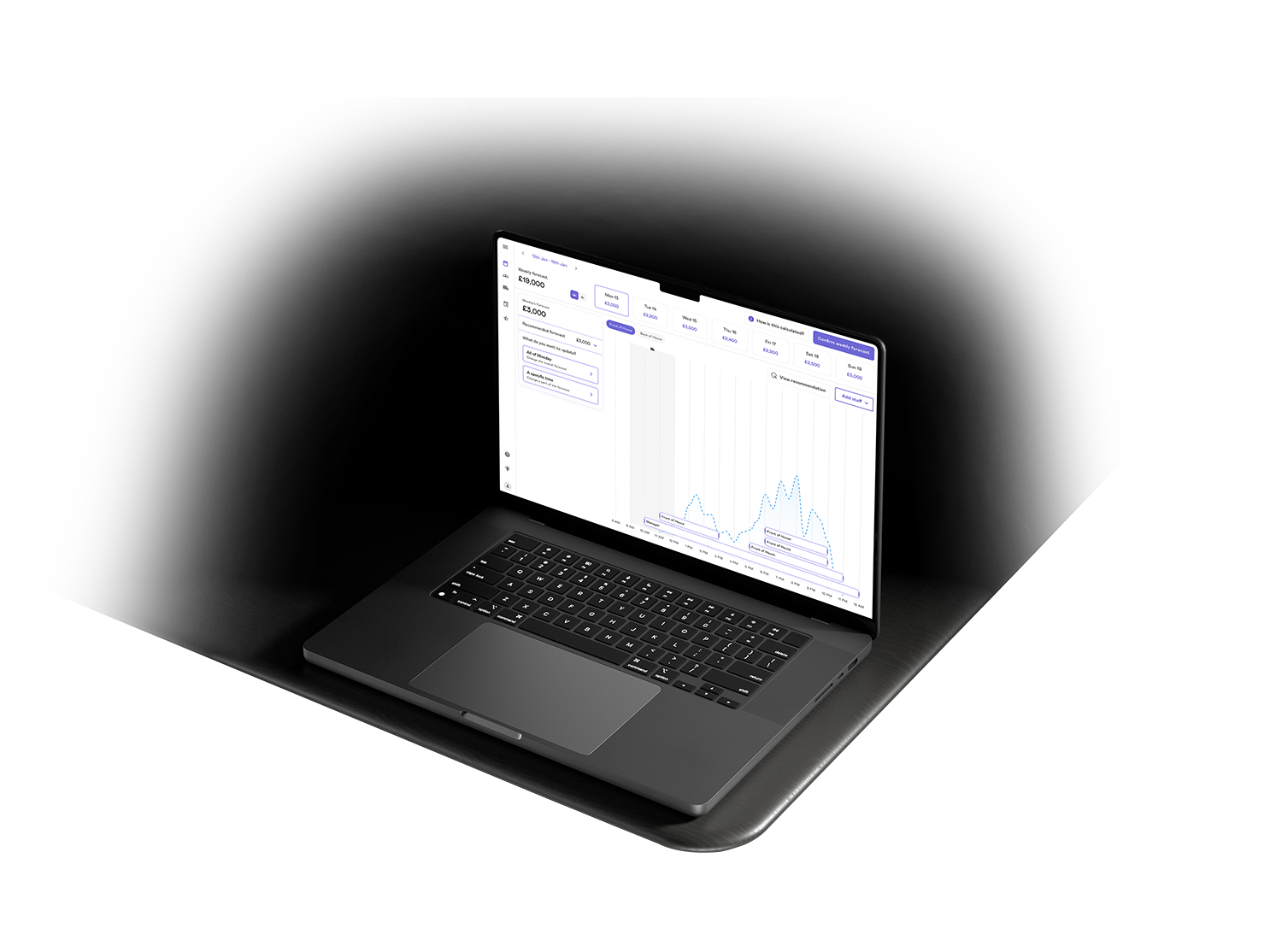
This places Stint between several purchasing decisions. Operators can recruit directly, use temporary staffing services such as Indeed Flex, or manage their own teams with rota software. RotaCloud, for example, offers scheduling, attendance and leave management for hospitality. Stint’s pitch brings a supply of short-shift workers into the same conversation as planning.
The distinction is a combination of services, rather than ownership of the idea that staffing should follow demand. RotaCloud’s own hospitality guidance advises refining shifts around hourly fluctuations. Stint has to make its particular combination worth adopting: useful software, appropriate workers and manageable day-to-day operations.
The hard part was never just the app
The founders’ early account named technology and infrastructure as constraints on scaling. Lockdown then struck the underlying market: hospitality partners cut operations, and Stint did too. That episode exposed a dependency any staffing platform shares with its customers. When venues cannot trade, matching available workers more efficiently has limited value.
Its present emphasis on repeat teams and planning shows a broader operational approach than the early job-posting app. The company says its software reflects sustained collaboration with hospitality managers. Read as a business trajectory, it suggests that filling a gap in the rota leads naturally to questions about how that rota was constructed.

Stint’s employer-authored culture profile emphasises how colleagues treat one another alongside their drive to grow. A machine-learning vacancy describes an office-first team in Camden, with attendance three to four days a week. The company selling flexible shifts has its own distinct working arrangements.
“Kindness, Ambition, Energy and Integrity.”Sam Schlagman / Stint’s stated values
A shorter shift still requires skill
There is a legitimate argument about what this model asks of hospitality workers. In 2021, Eater interviewed four workers who disputed the idea that customer-facing support amounted to simple, unskilled tasks. Greeting someone, clearing a table and handling impatience can all require judgement. The critique challenges an easy assumption behind rapid onboarding.
For an operator, the useful lesson is to test a narrow peak before redesigning the entire workforce. Define the assignment, select locally, train people properly and bring successful workers back. Measure waiting times and the pressure on existing staff alongside spending. Those are operating choices a business can copy without copying Stint’s technology.
The conditions matter. A remote venue, a highly specialised role or a worker who needs predictable long shifts may be a poor match. Students’ spare hours must overlap with the business’s busy ones. Stint’s proposition becomes persuasive where those details line up: a manageable journey, a familiar workplace and useful work that ends before the next lecture begins.