The warehouse had already tried the new idea. It had found capable workers through Veryable. Then a manager left, the remaining manager put cost ahead of reliability, and the marketplace went largely unused for nearly a year. This detail appears in Veryable’s own account of a regional logistics customer. It is an unusually useful detail for a company selling flexibility: access to workers had not been enough to keep the customer using the service.
- Veryable connects industrial businesses with workers for specific opportunities, called Ops.
- The lasting asset is a pool of familiar people a facility can invite back.
- Its planning software asks whether those people are being deployed against sound numbers.
The average is a very expensive invention
Averages are tidy. Warehouses are less obliging. Staff for a middling workload and a busy day produces overtime, missed deliveries or an accumulating backlog. On a quiet day, the same staffing level buys hours the operation cannot use productively. The average may be mathematically correct while making a poor appointment secretary.
Mike Kinder and Noah Labhart founded Veryable in 2016 around this mismatch. Kinder brought manufacturing operations and industrial advisory experience; Labhart brought manufacturing IT and mobile technology. Their preferred verb, “variablize,” is ungainly but precise: make capacity adjustable in small increments as demand changes. The ambition is to let industrial businesses respond without rebuilding their permanent workforce each time orders move.
That argument attracted a $31.9 million Series A announced in August 2021, led by Gigafund with Trust Ventures participating. The money was intended for U.S. expansion and product development. Veryable now describes thousands of operations served nationwide. Manufacturers, distributors and logistics businesses are its territory; its customer testimonials include Made In Cookware, ADAC and RTIC Outdoors.

The useful part is who comes back
Businesses post work with a rate, schedule and required skills. Workers, called Operators, bid; managers choose among them. Completed work produces ratings, and effective Operators can be invited back. Veryable’s industrial focus and the connection between its labor pool and planning software define its pitch. Background checks alone do not distinguish it: competitors such as Traba also offer vetted industrial workers.
Courier Express illustrates why repeat invitations matter. During the pandemic, new business strained its warehouse capacity. Temporary staffing brought an expensive nuisance: someone would be trained, then fail to return, leaving the company to begin again. Strategic project manager Py Stills started with a few warehouse Ops to test Veryable’s claims against actual performance.
In the company-published case study, Stills says the worker rankings matched what her team observed during the first week. She expanded into specialized work and night shifts, using Favorites to keep proven workers close. At peaks, she could invite 20-30 Operators each week. The attraction was familiarity combined with an adjustable schedule, rather than an endless parade of introductions.
“Having consistency allows us to meet our customer metrics.”
Py Stills, Courier Express
When the spreadsheet lost the argument
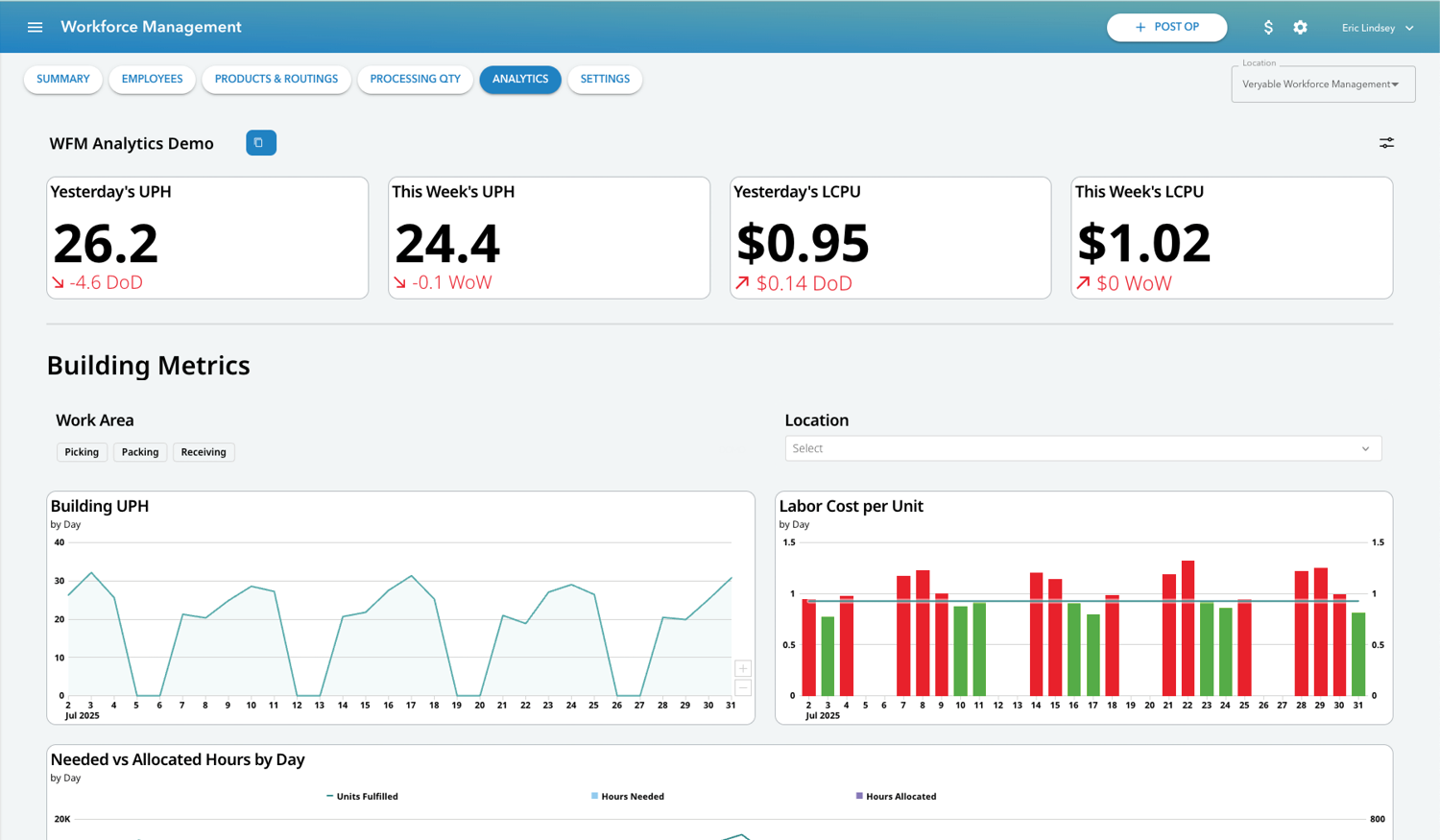
Return to the regional logistics customer. The restart came with Workforce Management, Veryable’s separate planning product. Its implementation exposed a discrepancy between managers’ reported units per hour and actual productivity. Dashboards and automated daily reports gave leadership a clearer view. The operation subsequently expanded use of both products across two facilities and three work areas.
Veryable reports a 44% efficiency improvement year-to-date in 2025 and a 40.9% reduction in cost per unit. These are vendor-published customer results, not a forecast for the next warehouse. The more transferable finding is the sequence: management could connect labor decisions to measured output. A fee that looked unattractive in isolation became easier to assess against completed work.
Company-published case study; results depend on the operation.
WFM converts production demand and processing rates into labor needs by area and shift. It tracks scheduled and actual hours, attendance and performance. ShiftWorks gives employees mobile access to schedules and absence reporting. A precision manufacturer described another sequence: establish consistent planning first, introduce on-demand labor afterward. Veryable reports a 22% throughput increase there. Buying hours was easier once the business trusted its calculation of how many it needed.
The company’s operational bent extends behind the marketplace. In a Checkr interview, Labhart described background-check review shrinking from six hours a day to 30 minutes while handling more checks. That is a different sort of capacity problem: administrative work can obstruct the supply of workers before anyone reaches a factory. Veryable’s stated culture draws on running plants and supporting shop-floor systems, and its Lean Center of Excellence offers guides, templates and coaching. The emphasis is on the routines surrounding the software.
The bill, without the poetry
The standard marketplace charges a 35% service fee on top of worker pay, after completed work, with no subscription or minimum usage. Consider an illustrative eight-hour opportunity paying $20 an hour: $160 for the worker, $56 for the fee, $216 altogether before applicable extras. W-2 engagements and late cancellations may carry additional charges.
WFM is sold separately, with published Basic, Premium and Enterprise tiers of $6, $10 and $15 per active worker per month. The relevant comparison includes idle capacity, overtime and retraining, as well as the platform bill. A higher price per hour can still produce a lower price per finished unit; the customer has to demonstrate that arithmetic.
For workers, flexibility has its own accounting. Veryable’s standard model uses independent contractors who choose opportunities and handle their taxes, insurance and benefits. Select states have a W-2 model. Branch provides daily payout options, with fees for certain transfers. Choice over working time is valuable, but it does not supply the benefits of a conventional employee arrangement.
Start with the work, then buy the hours
The practical starting point is modest: define one work area, establish a credible production standard, run a small pilot and invite effective workers back. Measure cost per unit alongside attendance and quality. Managers still have to post opportunities, select people and review performance. A labor pool develops through repeated use; it does not materialize fully acquainted with the facility.
Location, skills and notice matter. Veryable says attendance and fill rates are strongest with 12-24 hours’ warning. Extra hands cannot repair missing materials or a broken machine. Its Vendor Network extends the offering into supplier discovery, but the original lesson remains grounded: understand the constraint before buying capacity. The average day can stay in the spreadsheet. Tomorrow’s shift needs an actual plan.