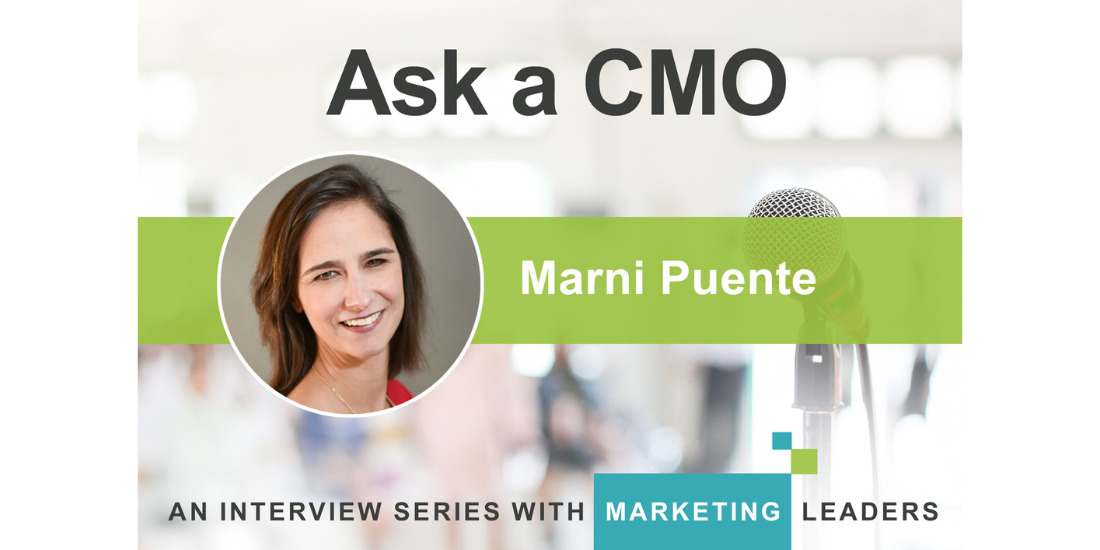
Before the dashboards, before the account plans, before anyone called her a chief marketing officer, Marni Puente learned to pay attention to an audience. Her first press job was an internship at the Kennedy Center in Washington. The raw material was performance: artists, programs, institutions and the delicate work of helping the public understand why a particular evening mattered. She later moved into public affairs at the Smithsonian, including work around the National Air and Space Museum. It was communications in a literal hall of complexity, where the objects carried histories far larger than any caption could hold.
That opening act explains more about Puente’s current job than the contrast suggests. Today she is senior vice president and chief marketing and communications officer at SAIC, a government technology company whose work spans defense, space, intelligence and civilian agencies. The nouns changed. The central task did not. She still has to translate expertise for people who do not wake up thinking in the institution’s internal language.
Only now the translation has to do more than earn attention. It has to help a large public company grow.
The roundabout path was the training
Puente has called her route into marketing roundabout. After the Kennedy Center and Smithsonian came a succession of roles that moved her closer to the business of government services: UNICOM Government, BearingPoint and Booz Allen Hamilton. At Accenture, she worked in integrated marketing for public service. At Eagle Hill Consulting, she served as marketing director. Then six years at KPMG carried her through market development, commercial advisory and enterprise innovation.
Viewed as a résumé, the sequence crosses museums, consulting firms and federal contractors. Viewed as a craft, it is consistent. Each organization sells something difficult to see before it is experienced: cultural meaning, expert judgment, technology integration, institutional trust. Puente learned to make intangible work legible.
& public affairs
services
growth system
There is an old frustration in professional-services marketing: the product walks out of the building every evening. Puente puts it more directly: “When you market professional services, you’re marketing your people.” The implication is demanding. A campaign cannot rely on product specifications alone. It needs credible ideas, useful content and proof that a group of people can solve a problem together.
Mentors mattered along the way. Puente has described keeping a roster of people she can still call, while mentoring others in return. She also sought the assignments that felt slightly too large. Her favorite compact line is “With challenge comes growth.” It sounds like career advice, but it doubles as her operating theory.
A new CMO walks into a sea of sameness
Puente joined SAIC in March 2024. Seven months later, she described two pieces of unfinished business. The first was to build a growth-marketing capability, moving beyond awareness into account and deal-based programs that worked beside business development. The second was a brand refresh built around SAIC’s role as a “mission integrator.”
Government contracting makes differentiation unusually slippery. Competitors often arrive with similar capability lists, similar promises and the same dense vocabulary. Puente has spoken about the resulting sea of sameness. Her answer was not louder language. It was an outside-in investigation of customers, competitors and areas where SAIC could credibly occupy clearer ground.
“My job is to align with the corporate and business strategy.”Marni Puente
Mission integration became the organizing phrase. It describes the work of connecting existing government systems with emerging technologies so that data, environments and people can operate together. For marketing, it also offered a discipline. A strong position is not simply the sentence on an advertisement. It is a filter that helps a sprawling company decide which stories to tell, which opportunities fit and how different teams explain the same value.
The research behind the position was substantial. Puente’s team later reported analyzing more than 600,000 market data points and collecting feedback from nearly 200 customers and prospects. The scale is striking, but the useful move was compression. Data became an argument. The argument became a position. The position became something sales, leadership and delivery teams could repeat.
By 2025, that approach was visible in SAIC’s Mission Integration campaign, customer-focused deal programs and partner ecosystem work. The company reported that the campaign exceeded its benchmarks and improved relevance among senior defense and civilian decision-makers. More important than the campaign metrics was the organizational test: did the position travel beyond marketing? Puente later described tight positioning as a decision filter across the company. The brand was becoming a shared operating language.
The launch window added another layer of judgment. Puente arrived during a presidential election year, when federal contractors were preparing for new appointees and changing priorities regardless of the result. She saw the transition as a moment to reintroduce the company around the problems its customers would inherit. Timing, in this view, was part of positioning. A clear story reaches further when the audience is actively reconsidering what comes next.
That is also why repetition matters. Large organizations are full of well-meaning edits. Every division wants its nuance represented; every expert can name one more capability worth adding. The result can be accurate and unusable. A durable position asks leaders to protect simplicity without flattening the work behind it. Puente’s research supplied the confidence to do that. The evidence made a shorter story possible.
The transformation was a learning program
Puente’s second big operating bet was artificial intelligence. In marketing, AI stories tend to split into spectacle and anxiety. Her version was more practical. SAIC’s marketing and communications group established an AI committee and ran “30 Days of AI,” a structured rollout with peer mentoring, prompt-engineering training and office hours. The aim was not to perform futurism. It was to help people use the tools well enough to improve research, content, workflows and measurement.
That distinction is easy to miss. A license can be bought in an afternoon. Judgment has to be built through repetition. Office hours tell employees that questions are part of adoption. Peer mentoring makes learning social. A fixed sprint gives experimentation a beginning and enough urgency to create a habit. The program was later taken up as a broader SAIC practice.
This is where Puente’s two projects meet. Positioning reduces strategic ambiguity: it gives everyone a clearer story. AI reduces some of the mechanical drag: it can speed research, first drafts and routine analysis. Neither works by itself. Automation without a position produces more material that says less. Positioning without an operating system remains a slide.
Puente wants marketing measured closer to the business. She has emphasized marketing-influenced wins, movement down the funnel and the function’s contribution to revenue. In a federal market built on regulation, relationships and long sales cycles, attribution will never look as neat as an online checkout. That makes discipline more important, not less. The CMO has to connect a body of signals into a credible account of influence.
“Leadership is about turning strategy into sustained impact.”Marni Puente
Curiosity compounds
In 2025, Puente hosted and keynoted the first North American Marketing Leadership Summit in Phoenix. The program put her alongside marketing leaders from consumer and technology companies, an unusual position for a government-contracting CMO. She later joked that meeting someone from TikTok earned temporary “cool parent” status at home. The funny part works because it reveals the larger instinct: look beyond the immediate industry for ideas, then translate what fits.
That instinct runs back to the beginning. The Kennedy Center taught audience. The Smithsonian taught stewardship of complex stories. Professional-services firms taught that people and ideas are the product. Commercial advisory work sharpened the connection between marketing and growth. SAIC gave those lessons a large system in which to collide.
Puente’s career advice is to stay open to possibility and never stop learning. It would be generic if her résumé did not provide the evidence. She has repeatedly moved into an adjacent room, carried forward an old strength and learned the missing vocabulary. Arts to public affairs. Public affairs to government consulting. Government services to commercial advisory. Commercial practice back to federal technology. Brand leadership into AI-enabled operations.
The aspiration now is visible in the system she is building: a marketing group that learns faster, understands the customer more precisely and can show how its work changes the business. In a company devoted to integrating complicated technologies, Puente’s own contribution is another kind of integration. She is connecting story with evidence, brand with opportunity, and curiosity with repeatable work.
The lesson is refreshingly usable. If a market sounds the same, listen before rewriting. If a tool feels unfamiliar, create a small social system for learning it. If a brand cannot guide a decision, sharpen it. And if the next assignment stretches beyond the comfortable outline of the job, there may be a career hiding inside the stretch.