Five days before a game famous for turning half-minute commercials into civic monuments, Shahar Aizenberg and the Artlist team chose an awkward moment to begin making one. The deadline was already blinking. The product they intended to advertise was also the product they intended to use. There would be no comfortable distance between the promise and the proof. If Artlist’s AI tools were as quick and capable as the marketing said, the commercial would make air. If they were not, the missed opportunity would provide its own rather less flattering copy.
Aizenberg, Artlist’s chief marketing officer, made the wager public. The in-house creative group split into smaller teams and pursued different concepts at once. Their eventual spot riffed on commercials that had just appeared around the Big Game, a choice that planted a timestamp inside the joke. Months of advance production could not plausibly have produced references to work that had only just aired. The campaign had to be finished, cleared and broadcast-ready in days.
It was, and it later collected Gold in AI and Silver for creative use of budget at the 2026 Drum Awards. The reported production budget was approximately $5,000. Those numbers make pleasant confetti, but the more revealing detail is structural: the method was the message. Artlist did not merely announce that production had become faster. Its marketing department accepted a deadline that could embarrass the product in public.
The education of a measurable mind
The flourish of a televised stunt can obscure how numerate Aizenberg’s route into marketing was. At Bar-Ilan University, he studied economics and business administration. He later completed an MBA focused on finance and financial management at Ono Academic College. Between those chapters, his working life began far from an edit suite: six years as a senior consultant in Israel’s Office of the Prime Minister, followed by a move into user acquisition at MCR, a mobile-content distribution business.
User acquisition is marketing with the curtains pulled back. Spend goes in, cohorts emerge, and the arithmetic is rarely sentimental. A former collaborator later described Aizenberg as analytical, comfortable with numbers and alert to the shape of the digital ecosystem. Their shared work involved bringing Artlist into mobile and YouTube. The description fits the career that followed: he did not leave measurement behind when he entered the creative business. He carried it further inside.
Aizenberg joined Artlist in May 2016. The company’s proposition was then closely associated with a recurring irritation for filmmakers: finding good music and securing a license simple enough that the legal paperwork did not outlive the edit. He eventually came to oversee worldwide marketing and brand strategy, leading across performance, growth, product marketing, brand, marketing technology and data. It is a broad list, but breadth is the point. Artlist itself was getting broader.
A career widening with the product
One promise, a much larger toolbox
Royalty-free music led to sound effects, footage, templates, editing products and a larger library of creative assets. Generative tools for images, video, music and voice widened the frame again. Each addition made Artlist more useful and its explanation more difficult. A single-purpose product can introduce itself in an elevator. A creative ecosystem risks arriving with luggage.
Aizenberg’s durable phrase has been “freedom to create.” In 2019, explaining a partnership between Artlist and computer-maker MSI, he located the overlap in both companies’ desire to give creators that freedom. Years later, while presenting AI products with far more computational drama, the language remained. Tools changed. The user’s desired condition did not.
This continuity saves the brand from worshipping its own machinery. Filmmakers do not wake in the night longing for another dashboard. They want a track that makes a scene breathe, a piece of footage that saves a shoot, a voice that fits, or a way to see the strange picture in their head before budget and physics file their objections. Technology earns attention by shortening the distance between an intention and an artifact.
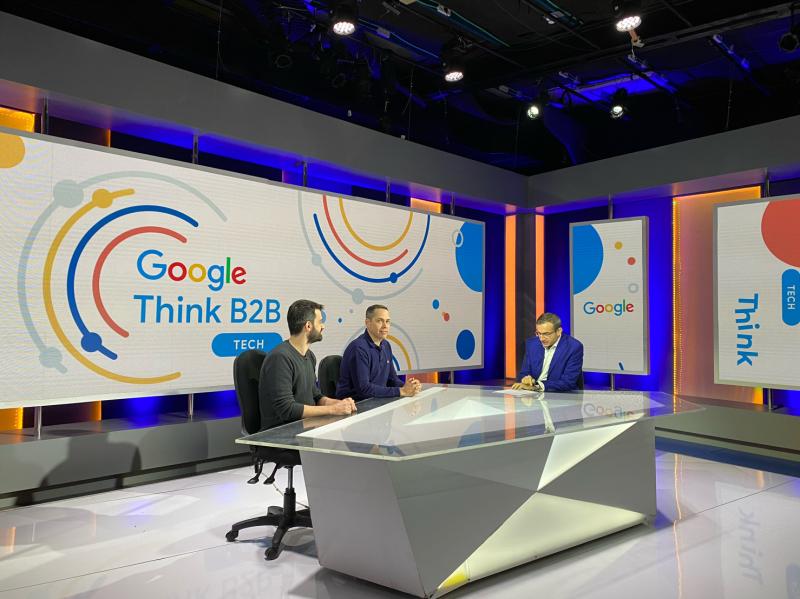
In 2020, Aizenberg appeared at Google Think B2B to talk about Artlist’s growth during a year when creative work, conferences and customer acquisition had all been rearranged. The online format drew participants across 12 countries. On the set, he looks less like a showman than an operator invited to explain a machine already in motion. The picture is a useful counterweight to the later Big Game spectacle. Before there was a public race against the clock, there was the quieter discipline of explaining how growth works.
“AI can generate endless options, but it can’t tell you which one will move an audience.”Shahar Aizenberg, Artlist AI Trend Report 2026
The abundance problem
Aizenberg’s neatest line about AI is also a warning to his own profession. “AI can generate endless options, but it can’t tell you which one will move an audience.” It sounds obvious until one considers how much marketing software is sold by making abundance look like an answer. More variants, more formats, more concepts, more tests. The buffet grows to the dimensions of the dining room, while somebody still has to decide what should be served.
His distinction shifts the value of the marketer. When production is slow and costly, access to production is power. When production becomes fast and plentiful, selection acquires the premium. Taste is not decoration applied after the model has done the serious work. It is the decision about what the serious work is. Audience knowledge, timing, empathy and a willingness to discard polished mediocrity become the useful restraints on an engine that never tires of offering another version.
Output rises. Judgment concentrates.
A visual model of Aizenberg’s argument: abundance moves the bottleneck from making to choosing.
The Big Game sprint was an attempt to make this philosophy operational. Teams could explore several complete creative directions rather than sand the corners off one precious concept for months. Speed permitted divergence. Judgment still had to force convergence. The winning idea needed to be timely, legible and funny enough to survive beyond the novelty of its production method.
That last condition matters because the campaign entered a charged argument about creative labor. Aizenberg acknowledged reactions that ranged from excitement to anxiety. His answer was to show the people behind the workflow: a small in-house group using AI to stretch what it could attempt under pressure. His claim is not that software wakes up with comic timing. It is that capable creatives can use faster tools to try ideas that schedules and budgets once killed in the meeting.
A CMO in the proof business
There is a trace of acquisition logic in all this. The campaign behaves like an experiment with unusually expensive attention. Set a constraint. Run competing approaches. Observe whether the system delivers. Yet brand work introduces a complication no dashboard entirely resolves: the public remembers the emotional residue, not the elegance of the test design.
Aizenberg appears comfortable in that overlap. He praises his creative team freely. Sharing a musical Motion Array commercial in 2022, he called himself fortunate to work with them and made the team the subject of the post. In comments about the award-winning AI work, he again placed the leverage in creative hands: the tools might supply unusual power, but the people must still know what to make.
This is less a compromise between art and analytics than a productive quarrel. The analyst asks whether the work performs. The creative asks whether it deserves to. The product marketer asks whether it demonstrates the tool. The brand steward asks whether anyone would care if the logo vanished. A modern CMO inherits all four people and, on difficult mornings, must get them to share a calendar.
Artlist’s expansion gives that quarrel real stakes. In 2026, Aizenberg announced an ecosystem including the AI Toolkit, Artlist Studio and the company’s Original 1.0 model. He later shared that Artlist had crossed $300 million in annual recurring revenue and announced a first full-length feature-film collaboration, Terrarium, integrating the platform into a cinema-grade production pipeline. The company is no longer simply helping a filmmaker find a song. It is asking to sit much closer to the making of the scene.
The closer a tool moves to authorship, the less persuasive feature lists become. Creators want evidence that the product will widen their choices without flattening their voice. Aizenberg’s public answer is to make the work in view of the customer and accept the criticism that follows. A live demonstration invites objections along with applause. That is its value. Nobody mistakes it for a brochure.
“Even with an unstoppable idea and the right tools, you still need to know what to make.”Shahar Aizenberg, after Artlist’s 2026 Drum Awards wins
The scarce thing
Aizenberg’s decade at Artlist can be read as a movement from buying attention to staging proof. The early skills remain visible: quantify, test, learn, repeat. What changed is the object being measured. A subscription library became a creative platform. A growth leader became the custodian of a larger promise. The spreadsheet did not disappear; it acquired a soundtrack, a production schedule and, occasionally, a polar bear joke.
His current aspiration is contained in the same phrase he used years ago: creative freedom. AI makes that freedom materially larger by reducing certain costs of execution. It also makes freedom noisier. Endless options can feel like liberty right up to the moment someone must choose one. The marketer’s work begins there, in the unfashionable act of saying no to almost everything the machine can do.
The five-day campaign is memorable because the clock made every choice visible. There was no time to confuse indecision with rigor. Artlist’s tools accelerated the making, the team supplied the point of view, and Aizenberg attached the brand to the result. For a CMO trained in numbers, it is a surprisingly romantic conclusion: the scarce resource is not content. It is conviction.