At twenty-one, Mark Collins was working as a commercial diver in the North Sea. His current occupation involves persuading people that a small box, a cartridge of powder, and some water belong in the future of household electricity. There is a distance between those two jobs. Both, however, reward attention to what happens when a system has to work.
Collins is the co-founder and CEO of Emission Free Generators, the San Diego company developing ZenH2, a portable generator built around hydrogen produced on demand. His son Chase is its co-founder and chief technology officer. Their partnership runs through the company’s leadership and into its intellectual property: public patent applications carry both names.
The appealing version of this story would move briskly from an inventor’s idea to a finished appliance. Collins’s actual story has more interesting stops. There are legal offices in San Diego, a question sent to California energy officials, a utility auditorium in Alabama, and morning television. A generator, it turns out, needs quite a supporting cast before it can have a quiet life at home.
Twenty-one, and working beneath the North Sea
In his account of his early working life, Collins connects commercial diving with discipline, teamwork, and a measured approach to risk. These are the habits he says he carried into business. He subsequently founded companies in six countries and completed three exits, according to his public biography.
His later experience includes inventions across mechanical, electrical, and chemical disciplines, along with establishing manufacturing lines and developing production methods. That combination matters for his present undertaking. A new way to produce hydrogen has to become something that can be assembled, handled, supplied, and understood.
There is an unromantic attraction to that sort of experience. An invention can be elegant on a drawing. A production line asks whether the elegance can be repeated. A customer asks where the replacement part goes. Neither question can be answered by admiring the drawing a little longer.
“Ability to see problems as opportunities for improvement and innovation.”
Mark Collins, on his approach to problem-solving
Two Collinses on the drawing
The father-and-son relationship is the most immediately recognizable detail of EFG. The technical record gives it substance. A hydrogen-composition application with a 2017 priority date names Mark Collins, Chase Collins, and Ertan Siddiqui. A later application, published in January 2026, names Mark and Chase on an apparatus for generating electricity.
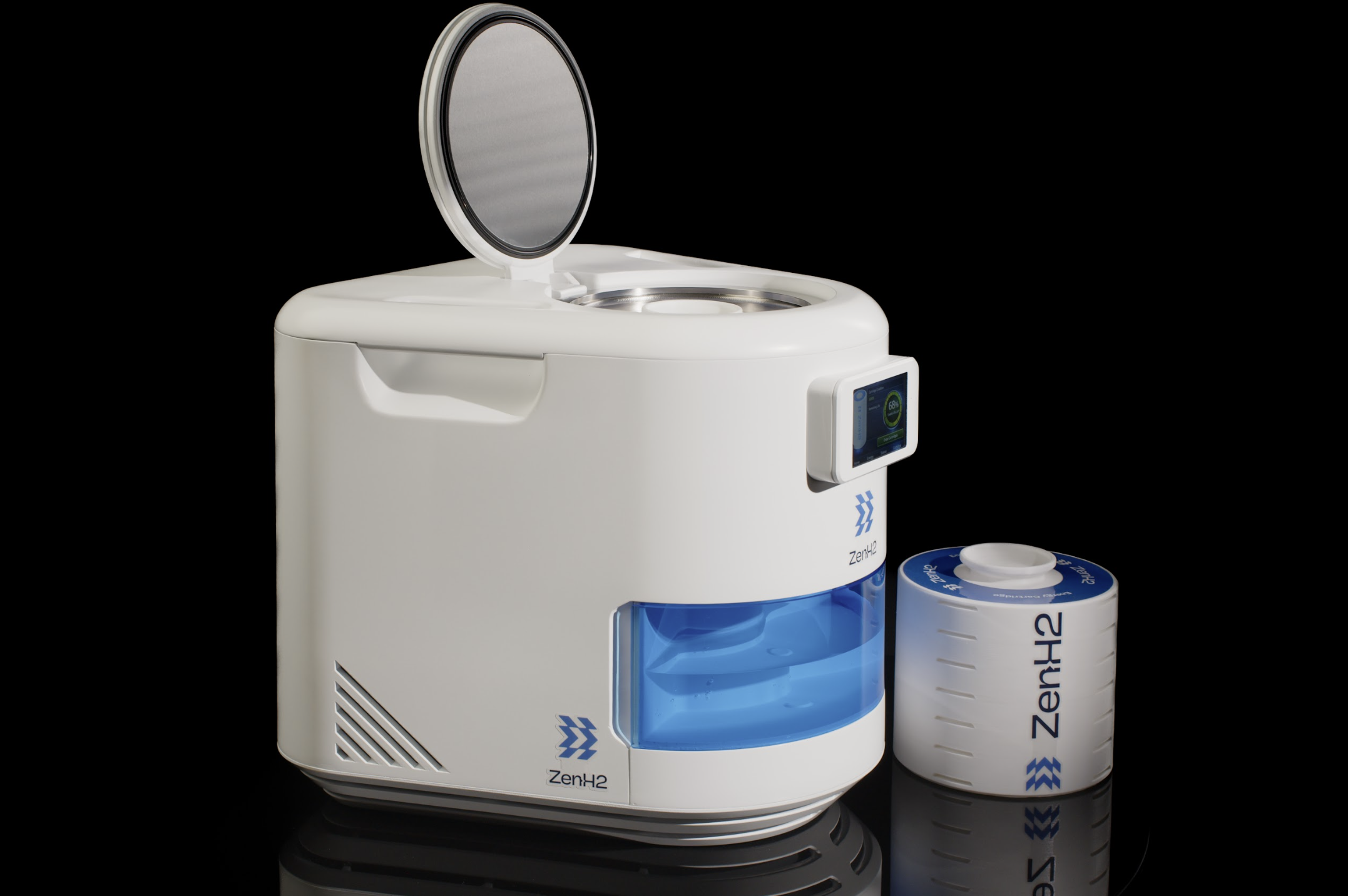
That later document describes a housing, a cartridge containing powdered fuel, a fluid reservoir, and a processor controlling the movement of fluid and gas. It puts several parts of the consumer proposition into one system. The reaction, its control, and the delivery of electrical power have to cooperate.
An application is a record of an invention being put forward for protection. It is a different milestone from a patent grant or a product arriving at someone’s door. For Collins’s story, its value is concrete: the family partnership appears in the engineering paperwork as well as the company introduction.
Mark’s role is CEO; Chase’s is CTO. The titles give the collaboration a formal shape. The shared inventorship shows why a profile of the father keeps returning to the son. Chase belongs inside the account of how the technology developed, with a technical role of his own.
A cartridge has to leave the laboratory
ZenH2 is designed to make hydrogen when power is needed, using a proprietary solid fuel and water, then convert the hydrogen into electricity. EFG presents the system as a portable alternative for indoor backup and off-grid use. It describes quiet operation, automatic monitoring, and shutoffs as parts of that design.
The cartridge is central to the experience. It has to fit into the generator, support a controlled reaction, and be replaced when its usable energy is exhausted. For the owner, the chemistry becomes a small sequence of physical actions. For the engineers, those actions are requirements that the entire system must accommodate.
- 01LoadSolid fuel cartridge + water
- 02ReactHydrogen produced on demand
- 03ConvertFuel cell produces electricity
- 04UseSupply the connected device
Collins put the distinction into a practical question in May 2023. Writing to the California Energy Commission, he described hydrogen production using metal hydride and water, then asked whether a funding request admitted methods other than water electrolysis. His examples included electricity for household appliances, communications, and work tools.
It is a revealing piece of correspondence because it deals with the category an invention falls into. Funding programs have definitions. An inventor must explain where the work fits. Collins was asking whether the door was open to his particular method, using the language of a company trying to get its technology considered.
The question also places everyday uses beside the chemistry. The destination is a device doing a job for someone. A communications tool running off-grid is a more comprehensible ambition than a diagram of a reaction, even when the diagram is essential to making it happen.
An inventor makes room for other people
In May 2024, EFG joined Procopio’s LaunchPad incubator, one of four startups selected for that year’s class. The program provided office space at the law firm’s Del Mar Heights location, together with corporate and intellectual property support. For Collins, it placed legal expertise close to the work of building the company.
The program’s nine-month structure included education on funding, valuation, employment, and intellectual property. Those subjects are less photogenic than a new generator. They are also among the things that determine whether a company can protect an invention, take investment, and keep developing it.
Collins spoke about the value of getting help with startups, finance, investor preparation, and partnerships. His account of EFG’s progress makes room for specialists. The inventor is present, but so are the people who understand the structure around an invention.
By September 2024, Procopio was reporting two further developments: a Caltech Rocket Fund grant and EFG’s selection for the Southern California Gas research development and demonstration program. The firm identified corporate partner Mike Kinkelaar and intellectual property partner Pattric Rawlins among the attorneys working with the company.
There were further local connections, including EFG’s membership in the Southern California Energy Innovation Network through Cleantech San Diego. Taken together, these relationships describe a company finding places to develop, obtain advice, and be evaluated. The inventor’s work was acquiring a wider institutional setting.
“Our benefits in LaunchPad include patent protection, access to experts, early funding and office space.”
Mark Collins, September 2024
A room full of people who know electricity
EFG joined the fall 2025 cohort of the Techstars Alabama EnergyTech Accelerator. One of the program’s settings was an internal Demo Day at Alabama Power’s Birmingham headquarters, where six startups presented to nearly one hundred employees from Alabama Power and Southern Company.
The audience included people working in a business whose daily obligation is supplying power. Company presenters were introduced by utility mentors. Feedback from that room formed part of the preparation for a subsequent event with prospective investors and partners.
For EFG, it was another audience for the same underlying proposition. The legal office had questions about protection and company structure. The utility setting brought the invention into a conversation about energy services and customers. The public demonstration required an explanation that could be followed without an engineering background.
Collins’s supporting team has also included consumer and financial experience. EFG’s fundraising materials identify Tom Buday, formerly Nestlé’s global head of marketing, and Andrew Singer, with Toyota and BP experience. The company’s April 2026 filing lists Buday as CMO alongside Collins as CEO and Chase as CTO and founder.
The demonstration moves to the living room
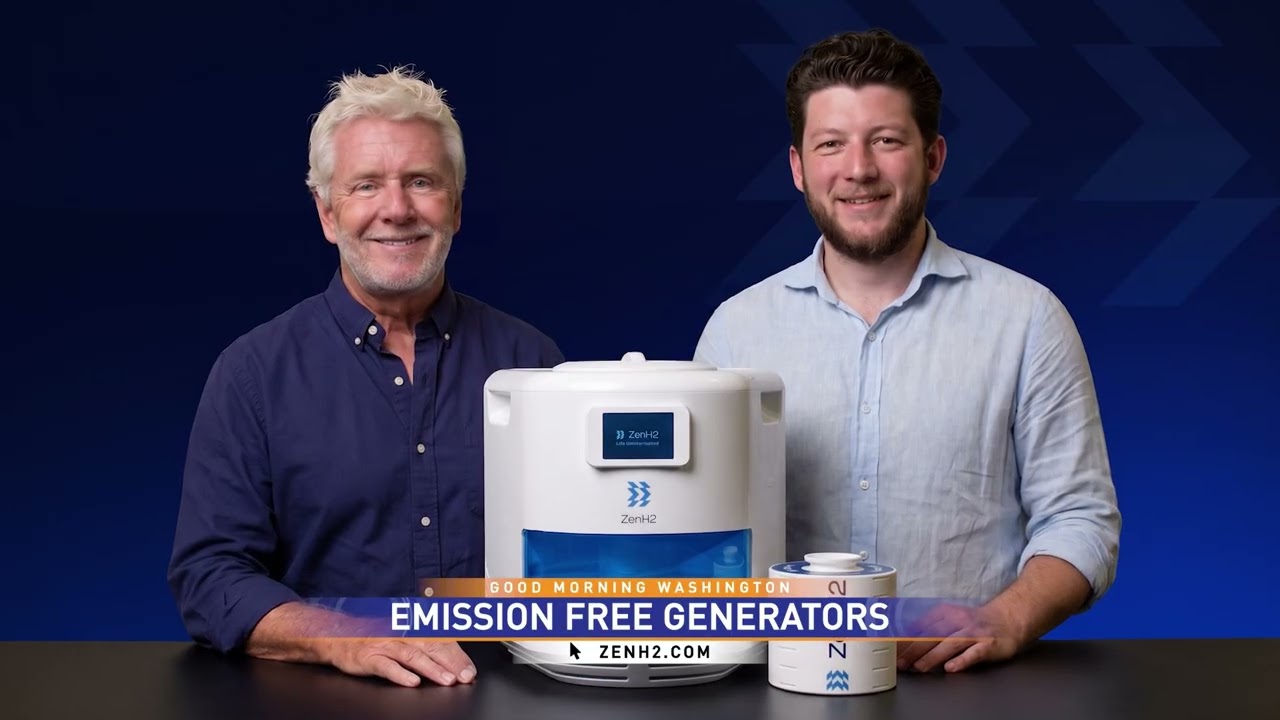
During 2026, Collins appeared on Portland’s AM Northwest to demonstrate ZenH2 and explain its cartridge system. EFG also published television appearances from other cities on its YouTube channel. The product was entering a setting where a viewer could ask a very ordinary question: what would I actually do with this?
That is a useful test for a founder’s explanation. The audience has no obligation to admire the technology. A demonstration has to show an action, a result, and a reason to care. Morning television is an efficient place to discover whether a technical explanation has remembered the person listening.
EFG opened public pre-orders in April 2026. By October, its investor feed was reporting more than $1 million raised from 511 investors in the current Wefunder round, alongside work on beta units. Kingscrowd listed Collins among the presenters for its October 20 Washington showcase. These are steps in commercialization, with development and production work still central to the company’s updates.
The ambition extends to portable power beyond the first generator. For now, the revealing task is close at hand: making the first product understandable and usable. Collins began in a profession where functioning equipment mattered immediately. His present project asks for a different kind of reliability, delivered through a machine intended to fit into everyday life. The interesting destination is the moment its owner can stop thinking about the invention and get on with the day.
Follow the work
- EFG: the technology and team
- Mark Collins on LinkedIn
- The April 2026 conversation
- Watch Collins on Good Morning Washington
- Watch the father-and-son San Antonio appearance
- EFG’s public development updates
- Procopio’s grant and research-program announcement
- The electricity-generation patent application