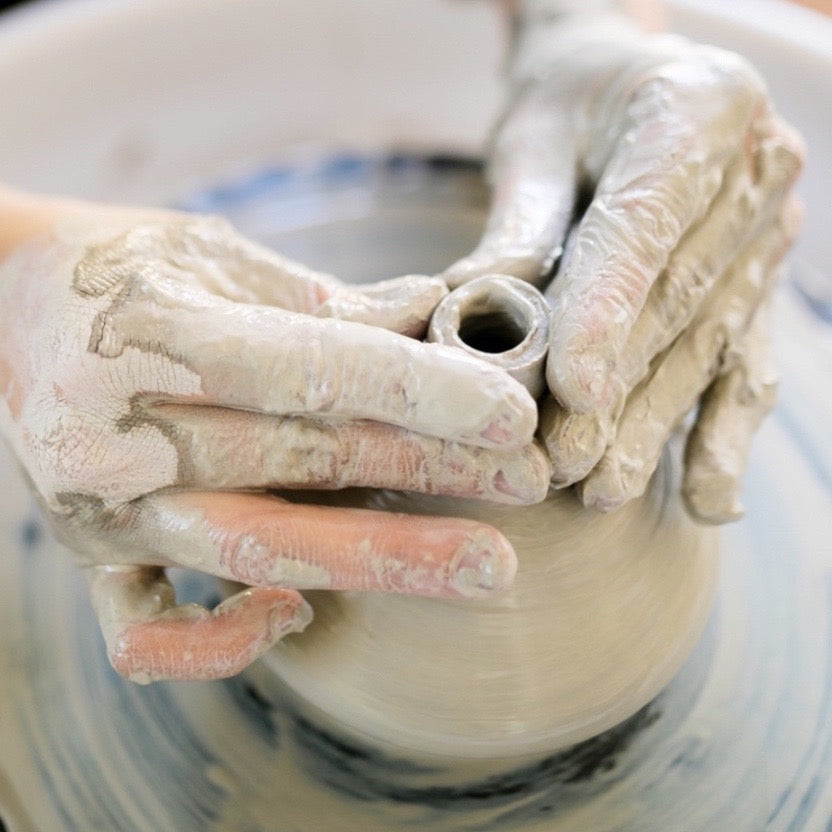
The first surprise was not that Janet Kim left television news. Reporters leave television all the time, worn down by strange hours, stranger weather, and the indignity of explaining to a producer that a hurricane has declined to respect the rundown. The surprise was what happened when Kim sat at a pottery wheel. The clay left her.
It flew across the room. More than once. This was not the polished opening to a tasteful second act. It was mud with velocity.
For ten years, Kim had chased wildfires, hurricanes, criminals, and national stories as an anchor and reporter. Her public career, under both Janet Kim and Janet Kwak, took her through Texas television and into KNBC in Los Angeles and KGTV in San Diego. The tools of the trade were speed, clarity, and readiness: write cleanly, stand by for the live shot, be early enough that the technical crew never has to wonder where you are. Former colleagues remembered that preparedness.
Clay offered a less accommodating edit. Push too hard and the wall buckles. Lose the center and the wobble announces itself. The material does not care that you once made deadline.
The assignment that did not need a live truck
Kim has said she hung up the microphone to chase her little ones and try something new. Her franker explanation is better: she wanted time to herself. At the wheel, solitude arrived with a task. Center the clay. Keep the pressure even. Pay attention to what is actually beneath your hands, not the next item shouting for airtime.
She learned the small comedy of being a beginner in public. A reporter may conceal uncertainty behind a composed stand-up; a collapsed bowl has no media training. Yet repetition did what repetition does. The mound stopped escaping. Kim began making pieces that carried the marks of hands without looking accidental, and she found language for the process: ceramics, she said, was about patience and centering yourself first.
Her studio became Garden Study Ceramics, perched in the 4S Ranch and Del Sur area of San Diego, facing a canyon that erupts in wildflowers with the seasons. The setting sounds suspiciously designed by a lifestyle editor. The practice was more rigorous. Kim reclaimed and reused material, recycled what she could, and ran even the kiln on solar power. Ceramics requires heat at punishing temperatures; attaching that appetite to the California sun made the studio's environmental ethic tangible.
The useful habits of a reporter
Before there was a studio, Kim's professional record was a map of the local-news apprenticeship. She worked in a Los Angeles newsroom, reported in Abilene, anchored and reported in San Antonio, returned to Los Angeles for NBC, then reached San Diego's ABC affiliate. At KTXS she appeared in the civic rooms that rarely become glamorous television: school-board meetings, official briefings, the patient machinery of a place deciding what to do next. At WOAI, her byline sat atop reports about the immediate trouble of the day. At KNBC, she covered stories that could be compressed into a minute but not always understood in one.
A 2013 KGTV report followed San Diego prosecutors introducing an iPad tool for courtroom exhibits. It was a modest technology story about an institution changing its method. In retrospect, it has a pleasing rhyme with Kim's later work. She would eventually become the person explaining a new tool of her own, except the exhibit would be a stack of plates and the courtroom would be a dining room.
Television also trains a particular form of observation. The reporter must notice which detail can carry the rest: the overlooked document, the object in a witness's hand, the sentence that reveals what the official paragraph avoids. Pottery rewards the same eye at a smaller scale. A rim is either resolved or it is not. A glaze records thickness, temperature, gravity, and luck. The camera may forgive a fraction of an inch. A lid will not.
None of this means Kim was secretly preparing for ceramics while standing in front of a satellite truck. Careers look inevitable only when viewed backward, with the awkward parts edited out. The better connection is simpler. She had learned how to stay composed near uncertainty. Clay provided a daily supply.
A cabinet full of understudies
Then Kim noticed a domestic absurdity. Kitchens are crowded with objects hired for one-day engagements: the cake stand that performs twice a year, the serving board awaiting a sufficiently photogenic cheese, the baking dish too homely for the table, the platter too grand for Tuesday. Each item consumes space while auditioning for a moment.
Her response was not another prettier plate. It was a system. Kim designed ceramic pieces and wooden accessories that could reverse, stack, fold, and combine. A plate might bake, serve, display, or become part of a raised tablescape. Bowls and mugs could join towers rather than forming separate, inefficient colonies in the cupboard. The pieces were meant to work alone and together, for a quiet meal or a gathering.
Patents are where whimsy goes to acquire figure numbers. Kim's application describes a reversible, multi-configuration dinnerware, cookware, and serveware apparatus. Beneath the magnificent legal noun pile is a simple proposition: if an object occupies your home, it should earn its keep.
The earliest priority claim dates to November 2019. Kim filed the international application a year later. In 2023, the first United States patent was granted and assigned to Chapter Ceramics, the California company she founded and operates as Ollo. A further patent followed in March 2025. The patent family also traveled to Canada and South Korea, an oddly fitting itinerary for an idea built around configurations.
The drawings make the concept wonderfully literal. A shallow ceramic form meets removable legs. A board becomes a support, a cover, or a surface. Pieces that normally insist on being stored with their own kind are asked to cooperate. The system treats the tabletop as a set of relationships rather than a lineup of fixed products. It is domestic choreography, with the added benefit that the dancers can go in the oven.
That versatility also places a burden on design. A multifunctional object must not feel like a compromise in every function. It has to stack without becoming ungainly, reverse without looking upside down, and appear composed when the mechanism is visible. The patent can protect the arrangement. It cannot make dinner guests admire it. That remains the potter's problem.
How an unruly idea became an object
- Center the clay and learn what the material permits.
- Notice how many kitchen pieces wait for a single job.
- Design forms that flip, stack, fold, and combine.
- Protect the system, then prepare it for the table.
The old story inside the new object
Ollo is more than a hardware solution to cabinet congestion. Its emotional center is a box of love letters written by Kim's grandparents roughly a century ago. The company frames its work around craft, connection, family, and the tables where ordinary days accumulate into memory. That can sound lofty for a bowl, but bowls have witnessed more family history than most monuments.
The brand's Korean references keep that history particular. A handled stoneware bowl pays homage to the ttukbaegi, the enduring earthenware vessel of the Korean kitchen. Its pale, semi-matte glaze is described in lunar terms. Seasonal pieces have included a hanok gingerbread house and kimchi ornaments. These are playful objects, but the play has roots.
Kim's journalism did not vanish here. It changed material. A reporter takes a confusing event, finds the structure, and gives an audience a way in. Ollo takes a crowded category, identifies the needless divisions, and asks one piece to tell several stories. The editing instinct survives. So does the interest in other people's lives. A table is merely a newsroom where everyone is allowed to eat.
Two clocks, one discipline
The newsroom clock is tyrannical and precise. The kiln clock is mysterious and precise. One counts backward from air; the other proceeds through firing and cooling on terms that cannot be bullied. Kim has worked under both. That may be why her reinvention feels less like an escape than a transfer of attention.
Her old work asked her to arrive before the story broke open. Her new work asks her to remain after the exciting part, through prototypes, applications, assignments, production questions, and the long middle between “patent pending” and patent granted. Inspiration is charming company for an afternoon. Product development moves in and asks for a drawer.
As of 2026, Ollo describes its Do-It-All Dinnerware as coming soon, made with wood and recycled porcelain. The phrase is cheerful; the years behind it are not concealed. The system has taken time. Meanwhile, the studio sells small-batch pieces, runs workshops, and keeps building a world in which Korean memory, California light, and practical modern design may share a shelf.
There is temptation to turn any career change into a sermon about courage. Kim's story is more useful without one. She wanted quiet. She was bad at something. She stayed. She saw a problem in the objects around her and kept refining an answer until the patent office could draw arrows through it.
The clay that once crossed the room now sits at the center of a company. It still requires patience. It still occasionally cracks. The difference is that Kim no longer has to chase the story. She can put it in the kiln, close the door, and let the heat do its work.