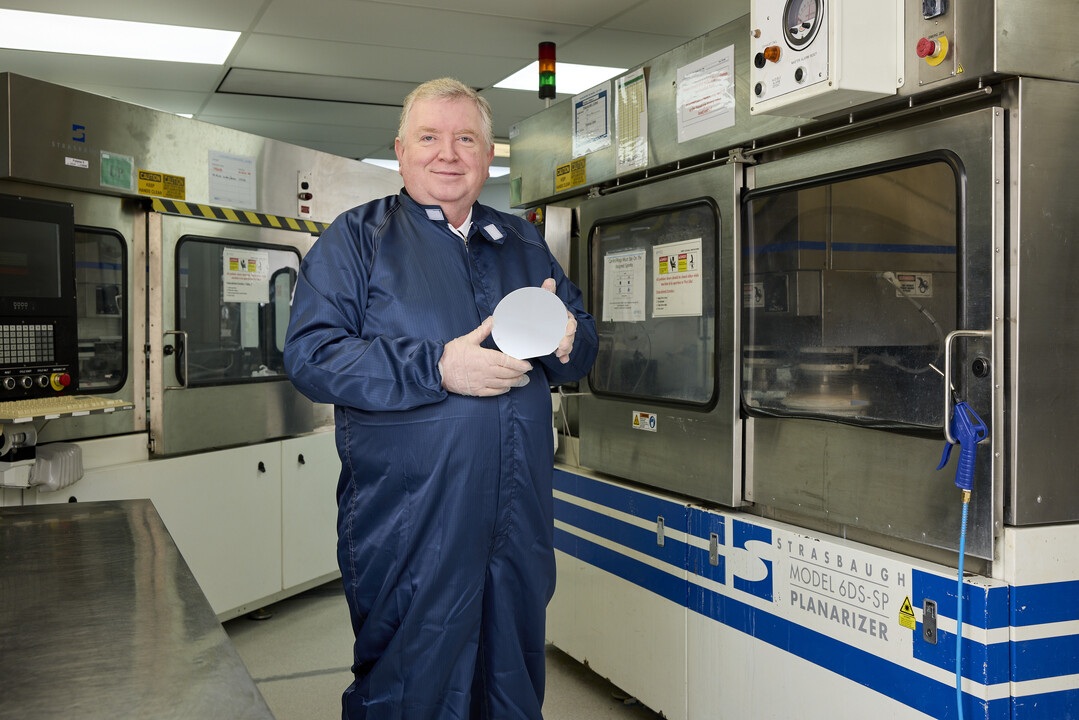
A silicon wafer has the glamour of a very pale dinner plate, until somebody explains what is being asked of it. It may have to help a Swiss watch ignore magnetism, tell a car what is happening around it, cut wasted electricity inside a data centre or behave itself in space. Sam Anderson has spent his career making that unshowy disc accept increasingly theatrical responsibilities.
Anderson is an engineer by training and a company builder by repetition. Born in Northern Ireland and originally from Ballymena, he studied electronics at Ulster, physics at Queen’s University Belfast and microelectronics at Arizona State University. Then came 14 years in Motorola’s semiconductor operations, followed by corporate business development at ON Semiconductor. The curriculum moved from lecture theatre to cleanroom to boardroom without ever quite leaving the physics behind.
In 2004, he founded IceMOS Technology. The company is American at headquarters, Northern Irish at the factory door and Japanese at the design table. Its research and innovation work sits in Arizona; its manufacturing centre occupies Hannahstown Hill in west Belfast; its power-device design operation is in Tokyo. It is an arrangement that sounds inconvenient until one sees the logic. Each place does a particular job. Together they make a semiconductor business.
Three cities, one wafer
The founder’s map is also a portrait of his life. Northern Ireland supplied the beginning and, later, the manufacturing base. Arizona supplied postgraduate study, corporate headquarters and the place Anderson now calls home. Japan supplied a deep semiconductor design culture and access to customers across Asia. The connections are not sentimental decoration. They are operating decisions.
The IceMOS operating map
A factory was the crucial choice. Semiconductor founders can sell designs while somebody else owns the machinery, but Anderson argued that control of manufacturing mattered to the kind of specialised products IceMOS wanted to make. Its Belfast equipment could handle silicon-on-insulator wafers, direct wafer bonding, cavities for microscopic structures and the odd requests that arrive when customers are inventing at the edge of an established process.
Direct bonding sounds almost domestic, like joining two pieces with glue. At wafer scale it is closer to arranging a marriage between surfaces that must be exquisitely flat, clean and compatible. The bond can create sealed cavities and precisely engineered layers, useful foundations for MEMS sensors whose moving structures are measured in micrometres. IceMOS also kept supporting older wafer sizes while investing in 200-millimetre production. That willingness to maintain established processes matters to customers whose products may remain in service far longer than a fashionable gadget. Anderson once framed the promise plainly: the manufacturer intended to be “here to stay.”
One such request came from Swiss watchmaking. Mechanical watches traditionally relied on steel parts that could be nudged off their manners by magnetic interference. IceMOS adapted silicon components for the job. A company working on sensors and power devices found itself helping very expensive watches keep better time. There is a pleasing mischief in this: the newest fabrication methods enlisted to improve one of the oldest portable machines.
Our sensing and power technologies are paving the way for more energy-efficient and CO2-saving solutions.Sam Anderson, on IceMOS’s purpose
The useful life of an old material
Silicon is the familiar material of the chip industry, which can make it sound exhausted. Anderson’s wager is that familiarity is an advantage if you know where to look. IceMOS’s recent power-device work combines micro-electro-mechanical systems manufacturing methods with super-junction transistor structures. In plain terms, the company is applying the craft used to make tiny mechanical features to the problem of moving substantial electrical power efficiently.
The resulting platform, called mSJMOS, is intended to work across several high-voltage classes. The target markets have a contemporary ring: artificial-intelligence infrastructure, cloud and edge computing, wind and solar power, electric vehicles and aerospace. Yet the basic complaint is ancient engineering. Energy disappears as heat. Heat demands cooling. Cooling consumes more energy. A better switch interrupts that expensive little tragedy.
Anderson has more than 80 patents to his name. The number is impressive, but the more revealing fact is variety. His documented work ranges across semiconductor substrates, high-voltage devices and sensing structures. One application, filed with colleague Hugh Griffin, described a semiconductor biosensor. Other patents licensed to power-conversion company Vicor concern the design, manufacture and interconnection of super-junction field-effect transistors.
He has also spent much of his career between companies, not solely within one. Anderson became a Vicor director in 2001. He chaired Advanced Analogic Technologies until its sale to Skyworks. From 2002 to 2015 he led Great Wall Semiconductor, which was acquired by Intersil. These overlapping roles reveal an operator comfortable with the semiconductor industry’s long development cycles and its fondness for intricate alliances.
They also show why “founder” is only one of his useful labels. Research must become a repeatable process; a process must become a product; a product needs customers who trust a supplier with their own production schedules. Anderson has worked at every junction. His career in business development put him near markets, while his education and patents kept him near the device. The ability to translate between those two rooms may be less visible than invention, but a wafer fabrication plant cannot live on elegant equations alone.
Fourteen years in Motorola’s semiconductor operations.
Vice president of corporate business development at ON Semiconductor.
IceMOS establishes its west Belfast semiconductor operation.
Appointed MBE for services to economic development in Northern Ireland.
IceMOS closes a $22 million Series E at a $110 million post-money valuation.
A homecoming measured in jobs
The cleanest line through Anderson’s public career is environmental efficiency. In the 1990s he advised the United Nations Environment Programme and co-authored technical guidance on the environmental aspects of semiconductor manufacturing. He later consulted for the United Nations Industrial Development Organization on semiconductor and printed-circuit-board manufacturing in India. His LAF philanthropic institution supported science and technology research and education related to energy saving and environmental progress.
That concern also gave IceMOS its commercial argument. Sensors help machines understand the physical world; power transistors help them use less electricity while acting on it. Anderson’s vocabulary tends toward decarbonisation, reliability and useful performance, rather than silicon for silicon’s sake. It is the engineer’s version of idealism: give the aspiration a data sheet and insist that it can be manufactured.
The local consequences are easier to see. IceMOS placed skilled manufacturing jobs in west Belfast and recruited from the region’s engineering base, including Queen’s graduates. In 2004, Anderson said Northern Ireland’s experienced engineers could advance the company’s research. Twenty years later, the official recognition arrived. He received an honorary Doctor of Science in Economics from Queen’s in 2023, then was appointed MBE in the 2024 New Year Honours for services to economic development in Northern Ireland.
The honour followed other public markers. Anderson was named Business Personality of the Year at the 2021 AIB Business Eye Awards. In 2024, IceMOS won the manufacturing category in the British government’s Made in the UK, Sold to the World awards. By then, the company said 99 percent of its business was exported outside the British Isles and that it served more than 150 customers.
The fortunate meeting
Industrial companies usually grow in increments too technical for folklore. Then, occasionally, a neat story appears. At the Northern Ireland Investment Summit in September 2023, Anderson met a London-based investor. The encounter developed into financing announced in April 2025: a $22 million Series E from 57 Stars and earlier American investors, valuing IceMOS at $110 million after the investment.
Chance deserves its small bow, but not the whole stage. The meeting worked because Anderson could point to two decades of IceMOS manufacturing, a patent portfolio, global customers and a new product architecture. The money was earmarked for additional Northern Ireland production, device design, application engineering, sales and marketing. The company said its global workforce would grow beyond 100 people.
The timing also joined several threads. In 2023, IceMOS had been selected for a UK Space Agency-backed project to develop radiation-tolerant, high-voltage power electronics. The work aimed at electrical distribution for orbits near Earth and farther into space, with possible applications back on the ground in data centres, vehicle charging and solar generation. The wafer, ever obliging, was being asked to leave the planet.
Anderson was 68 in 2025, an age at which some founders acquire a vineyard and begin issuing opinions about patience. He closed a growth round instead. The decision suits the career. His story is not built around a single dazzling consumer object or a sudden exit. It is built around compounds: education plus manufacturing, patents plus customers, Arizona plus Belfast plus Tokyo, mature silicon plus another idea.
The objects themselves will remain mostly invisible. A sensor element will sit inside a larger assembly. A transistor will switch without applause. A sliver of silicon will keep time, conserve power or tolerate radiation. Anderson’s work has been to improve these quiet intermediaries and to build a company sturdy enough to repeat the improvement. In an industry obsessed with smaller dimensions, that is a surprisingly large ambition.