The Generator You Can Run in the Bedroom
A father-and-son engineering team wants to replace the gas generator with a box that makes hydrogen from powder and water - quiet enough to sit next to a CPAP machine.
The gas generator has barely changed in a lifetime. It is loud, it burns fuel you have to store, and it produces exhaust that keeps it stuck outdoors and away from windows. For decades that was simply the deal: if you wanted backup power that ran for hours, you accepted the noise and the fumes. Emission Free Generators, Inc., a small company in San Diego, is betting that deal is finally negotiable.
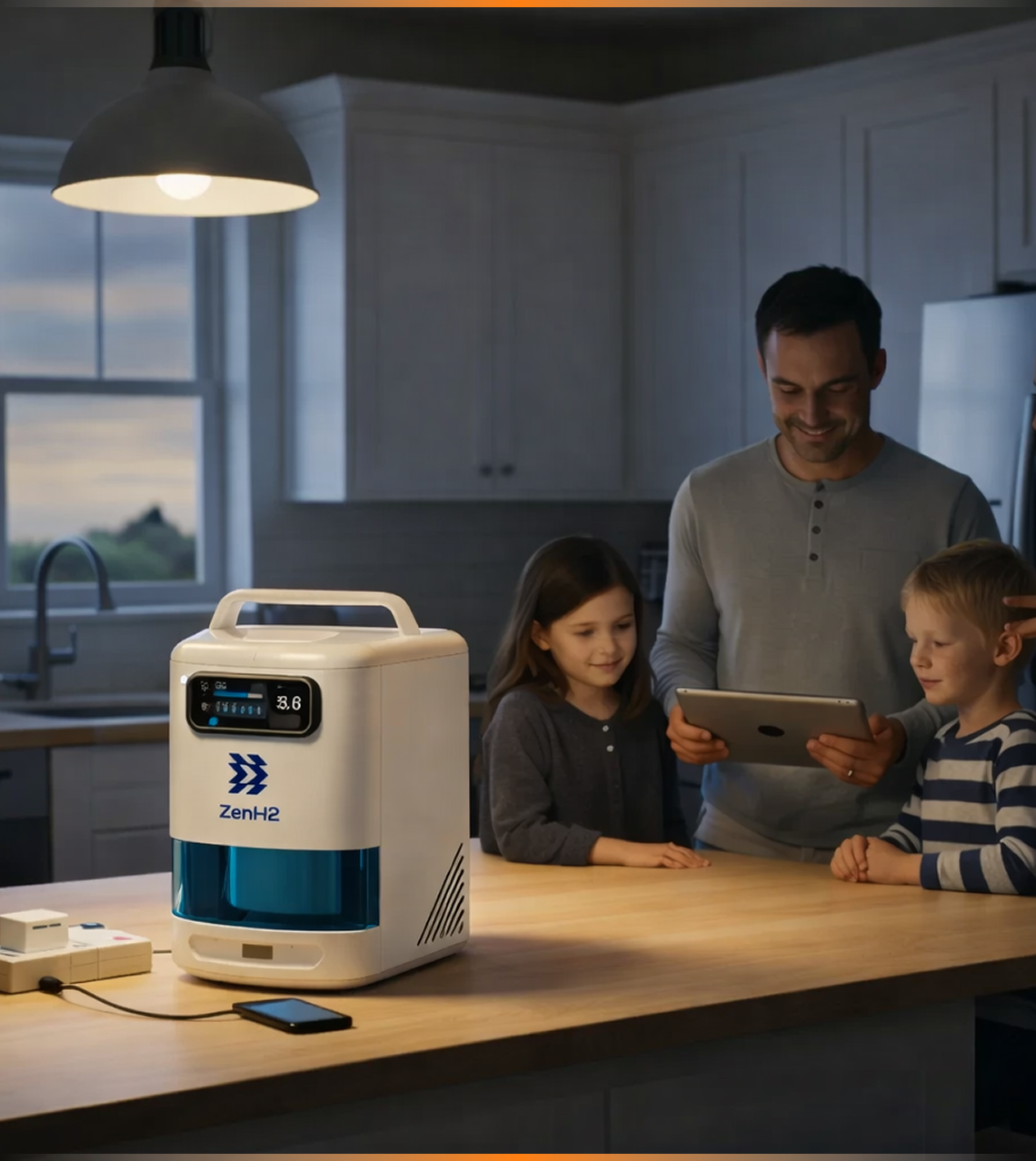
Its product is called ZenH2, and the elevator version sounds almost like a magic trick. You slide a cartridge of dry powder into the unit, add water, and the machine produces hydrogen on demand, converting it directly into electricity. Nothing combusts. There is no tank of pressurized hydrogen sitting in the closet. And because there is no flame and no exhaust, the company says the unit is quiet and clean enough to run indoors - even in a bedroom, next to a sleeping person's CPAP machine.
01 / The ideaPowder, water, electricity
The chemistry is the whole pitch. Traditional hydrogen power means storing a flammable gas under high pressure - a non-starter for a consumer product you keep in the house. ZenH2 sidesteps that by never storing hydrogen at all. The gas is generated only in the instant it is needed, from a stable powder that is safe to handle and, notably, safe to ship. The cartridges are approved for standard mail delivery, and they are designed to be returned, refilled, and reused rather than thrown away.
How ZenH2 works
One design choice is worth pausing on, because it doubles as the company's efficiency argument. ZenH2 does not spin up to a fixed output and idle. It generates only what the connected device pulls. Plug in a phone and it produces a phone's worth of power; plug in something hungrier and it scales up. Collins frames it as the opposite of a gas generator's all-or-nothing roar.
02 / The customerWho actually needs this
Backup power is a crowded aisle, so the interesting question is not who might buy ZenH2 but who needs precisely what it offers. The company points to a few groups. Homeowners and apartment dwellers who want blackout insurance but cannot safely run a gas unit near the building. RV and van-life users chasing quiet, off-grid electricity. Emergency-response organizations. And, most pointedly, medically dependent households - people who rely on in-home devices like CPAP machines and oxygen concentrators, where a silent, fumeless power source that can sit in the bedroom is not a luxury.
That last group explains the "run it next to the bed" framing that recurs in the company's pitch. It is a narrow claim, but a valuable one: it is the use case that gas generators and even many battery stations cannot comfortably serve, and it is the reason the water-source flexibility matters. In an emergency, ZenH2 is designed to run on whatever water is around - the company lists rainwater, greywater, seawater, and pond water alongside the tap.
How far one energy cartridge goes
Relative illustration. The 80W / 20-hour figure is the company's stated benchmark; other bars are directional.
03 / The differenceNot a battery, not a gas can
ZenH2 lands in the gap between two familiar products. Battery power stations - the EcoFlows and Jackerys of the world - are silent and indoor-safe, but their runtime is capped by the cells inside, and recharging them during a multi-day outage is its own problem. Gas and propane generators deliver long runtime, but only outdoors, and only with fuel you have to buy and store. ZenH2 aims for the overlap: long runtime from swappable cartridges, plus the silence and indoor safety of a battery.
04 / The moneySell the razor, mail the blades
The business model is a hardware classic. The generator is the razor - the company has floated a target price around $2,250, with a $99 fully refundable reservation to hold a spot in the production queue - and the cartridges are the blades, an inexpensive, recurring consumable referenced around a few dollars each. Every household that owns a ZenH2 becomes a repeat cartridge customer, which is the kind of recurring revenue that hardware investors like to see attached to a physical product.
It is a premium position, and the company knows it. A gas generator with comparable output costs less up front. Emission Free Generators is deliberately competing on the things gas cannot offer - silence, indoor safety, zero fumes - and betting there is a large enough set of buyers who will pay for them. The 1,000-plus preorders and 400-plus investors gathered through its Wefunder community round are the early evidence that the bet has takers.
05 / The teamA diver, his son, and a Nestle marketer
The company was founded in 2022 by a father-and-son engineering team. Mark Collins, the CEO, is a serial entrepreneur who began his working life as a commercial diver in the North Sea, went on to found companies across six countries, and has exited three of them. His son, Chase Collins, is the CTO. The founders are credited collectively with 28 patents. On the commercial side is Tom Buday, the CMO, who spent years leading marketing and consumer communication at Nestle before joining the startup.
That mix - deep hardware engineering paired with consumer-marketing pedigree - is unusual for a six-person cleantech startup, and it shows in how openly the company builds. Collins has said the crowd of early investors has functioned as a live focus group, shaping the roadmap through their comments and needs. The stated mission is plain enough to fit on a cartridge: safe, easy electricity for everyone, whenever and wherever they need it, for as long as they need it. The internal shorthand is "Life Uninterrupted."
06 / The validationTechstars, a utility, and a lab
For a company that has not yet shipped, Emission Free Generators has assembled a notable stack of outside validation. It was accepted into the Techstars EnergyTech Accelerator. It has collaborated with the R&D and Applied Technology teams at SoCalGas on distributed-power alternatives, joined the Southern California Energy Innovation Network, and been featured at the National Renewable Energy Laboratory's Industry Growth Forum. On the engineering side, Unlimit Ventures has worked as a partner on the mechanical design, fluid dynamics, controls, and industrial design needed to move ZenH2 from prototype toward production.
Total funding stands above $1.4M, including a venture round closed in early 2026. The company has said it is targeting pre-production and an initial production launch in 2026 - the point at which the pitch, the preorders, and the physics all have to meet a shipping product.
07 / The catchWhere it has to prove out
The honest part of any pre-launch story is the list of open questions. ZenH2 is not yet in customers' hands, so the field performance, the durability, and the real-world cost per kilowatt-hour of the cartridges are still to be demonstrated at scale. The premium price will keep it out of reach for buyers who only need occasional, outdoor power and can grab a cheap gas unit instead. And a consumable-fuel model only works if the cartridge supply chain - manufacturing, mailing, returning, refilling - runs as smoothly as the pitch deck promises. The company's answer to all of it is the same: ship in 2026 and let the product argue for itself.
What is clear is the shape of the opportunity. If backup power keeps growing as grids strain and weather gets less predictable, the buyer who wants long runtime and indoor safety and silence has, until now, had nowhere to go. That narrow, valuable middle is exactly where Emission Free Generators has planted its flag.