BREAKING: YouSolar rebrands as LEITNIUM PowerBloc runs on a constant 400-volt DC bus TIME names it among America's Top GreenTech Companies of 2024 ~$6.5M raised from retail investors on StartEngine Made in America: inverter MN · electronics Monterey · modules San Jose Each home avoids an estimated 70-120 tons of CO2 over ten years Founder Arnold Leitner previously ran SkyFuel BREAKING: YouSolar rebrands as LEITNIUM PowerBloc runs on a constant 400-volt DC bus TIME names it among America's Top GreenTech Companies of 2024 ~$6.5M raised from retail investors on StartEngine Made in America: inverter MN · electronics Monterey · modules San Jose Each home avoids an estimated 70-120 tons of CO2 over ten years Founder Arnold Leitner previously ran SkyFuel
Company Dossier · Clean Energy Hardware · Est. 2010

Leitnium / formerly YouSolar

A physicist's plan to give every home its own grid - and stop asking the utility for permission.

The PowerBloc is a modular solar-plus-battery nanogrid built on a constant 400-volt DC architecture. When the grid fails, the lights don't flicker - because the grid never touched them in the first place.

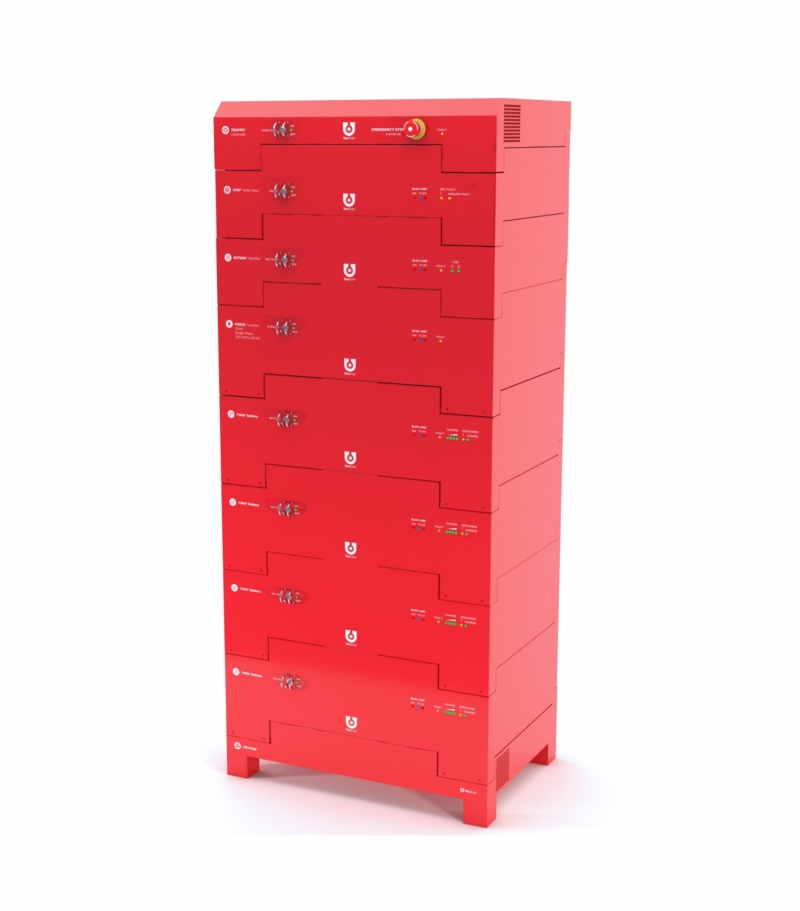
Leitnium PowerBloc solar-battery nanogrid unit
THE BOX THAT WANTS TO BE A GRID — A PowerBloc stack, the private power plant Leitnium sells one garage at a time.
400V
Constant DC bus
2010
Founded (as YouSolar)
~$6.5M
Crowdfunded on StartEngine
70-120t
CO2 avoided / home / decade
~11
Employees
The Thesis

Solar That Doesn't Ask the Grid for Permission

Here is a fact about most home solar systems that almost nobody tells you when they sell you one: cut the utility line, and the panels on your roof go dark too.

This is one of those quietly absurd facts about the energy business. You spend tens of thousands of dollars to put a power plant on your roof, and then, during exactly the moment you most want power - a storm, an outage, a wildfire shutoff - the system politely switches itself off, because the grid it's tied to went down and it doesn't know how to run alone. The panels are fine. The sun is out. And you are sitting in the dark, holding a flashlight, next to your very expensive solar array.

Arnold Leitner has spent a good chunk of his life annoyed by this. He is a physicist - University of Colorado at Boulder, doctorate, the whole thing - who as a teenager helped his family build one of Germany's first super-efficient "passive" houses, back in 1991. He later authored a U.S. Department of Energy study called "Fuel from the Sky," founded a concentrating-solar company called SkyFuel, and won an R&D 100 Award with a national lab. So when he asks the question that anchors his current company - "if the sun shines everywhere, why is solar power still dependent on the grid?" - it is not a marketing slogan so much as a decades-old irritation finally turned into a product.

That product is the PowerBloc, and the company, founded as YouSolar in 2010 and recently rebranded to Leitnium, is essentially one long argument for a single engineering decision: build the whole thing on constant direct current, at 400 volts, and let the box - not the utility - be the grid.
"If the sun shines everywhere, why is solar power still dependent on the grid?"ARNOLD LEITNER, FOUNDER & CEO
The Machine

What a PowerBloc Actually Does

A nanogrid is a small, self-contained power system: a solar array, a battery, and the electronics that form a grid for your house. The trick is who sits in the middle.

☀️

Solar In

Panel-level MPPT feeds the DC bus directly - no wasteful conversions.

🔋

Battery Core

Lithium-ion storage stacks modularly - scale it up as you need more.

🧠

Smart Bus

Constant 400V DC bus and intelligent management juggle every source.

🏠

Home Out

Delivers AC and DC. The grid feeds the box, not your load.

The architectural sleight of hand is in that last step. For a customer with a utility connection, the grid only tops up the PowerBloc - it no longer connects directly to the lights and appliances. So when the grid drops, there is no switch-over, no glitch, no dark moment. The house was already running on its own private grid. It just keeps going.

The Offering

One Product, Taken Seriously

Leitnium doesn't sell a catalog. It sells a private power plant and the intelligence to run it.

FLAGSHIP

PowerBloc

A patented, fully-integrated solar-plus-battery nanogrid. Combines solar, lithium-ion storage, and optional grid or generator inputs into one modular box on a 400V DC architecture.

POSITIONING

HVDC Nanogrid

Marketed under Leitnium as the first commercially available high-voltage DC residential nanogrid - delivering both AC and DC power, flexibly and scalably.

SOFTWARE

Intelligent Management

Remote monitoring, energy forecasting, and "see anywhere" control so the system decides in real time what to draw, store, and dispatch.

RESILIENCE

Always-On Power

Because the grid feeds the box rather than the home, outages pass without a flicker. Backup isn't a mode - it's the default state.

The Money

Crowdfunding a Power Plant

Leitnium didn't wait for one big venture check. It built a crowd - one of StartEngine's most-funded campaigns - alongside a Series A.

Series A (2018)
$4.0M
StartEngine (cum.)
~$6.5M
Campaign valuation
~$71.2M
Series A backers included Meyer Global, Gan Kapital, and Keiretsu Forum Northwest. Crowdfunding figures are cumulative across multiple StartEngine campaigns (2020-2025); valuation is self-reported.
In Their Words

On Conviction and Made-in-America

"Innovation requires conviction long before it receives validation."

— ARNOLD LEITNER, ON THE LONG ROAD

"The PowerBloc is proudly built in America."

— ARNOLD LEITNER, ON THE SUPPLY CHAIN

"If the sun shines everywhere, why is solar power still dependent on the grid?"

— THE FOUNDING QUESTION

The Made-in-America line isn't just patriotism; it's a logistics map. The inverter comes from Minnesota, the power electronics from Monterey, California, and the solar modules from San Jose. For a hardware company selling energy independence, a domestic supply chain is both a marketing story and a real, load-bearing set of trade-offs.

The Record

From SkyFuel to Leitnium

2005

SkyFuel

Before YouSolar, Leitner founds SkyFuel and reinvents concentrating solar power technology.

2010

YouSolar founded

Dr. Arnold Leitner starts the company to build a high-power modular solar-battery nanogrid.

2018

Series A

Roughly $4M raised to advance the PowerBloc toward commercialization.

2020

First StartEngine campaign

Over $1M raised from retail investors in the first equity crowdfunding run.

2022

PowerBloc commercialized

The 400V DC nanogrid ships, built on a Made-in-America supply chain.

2024

TIME GreenTech + rebrand

Named among America's Top GreenTech Companies; begins the shift from YouSolar to Leitnium.

2025

~$6.5M cumulative

Continued campaigns push total retail-investor funding to roughly $6.5M.

Watch & Demo

See the Nanogrid in Motion

Interviews and product demonstrations - straight from the company and its founder.

Common Questions

The Short Answers

What is Leitnium?
Leitnium, formerly YouSolar, is a clean-energy hardware company that makes the PowerBloc, a modular solar-plus-battery nanogrid for homes and small businesses.
What is the PowerBloc?
A patented, fully-integrated nanogrid that combines solar panels, lithium-ion batteries, and optional grid or generator inputs on a constant 400V DC architecture, delivering seamless power even during grid outages.
Who founded the company?
Physicist Dr. Arnold Leitner founded YouSolar in 2010. He previously founded SkyFuel and authored the U.S. DOE study "Fuel from the Sky."
Why did YouSolar become Leitnium?
The rebrand reflects a repositioning from solar-plus-storage toward full decentralized power infrastructure, marketed as a high-voltage DC residential nanogrid.
How has Leitnium been funded?
Through a roughly $4M Series A plus equity crowdfunding on StartEngine, cumulatively raising about $6.5M from retail investors, with backing from investors like Keiretsu Forum Northwest.
Connect

Find Leitnium