The robot arm on R7's website is not there to wave hello. It is there to work. Across the Chicago venture firm's portfolio, machines lift, see, map, tow, test and measure. Range Energy puts intelligence and electric power in a commercial trailer. Reshape builds robots for the repetitive chores of microbiology. Bedrock maps the ocean floor at far higher resolution. Pila Energy turns a wall outlet into the starting point for modular home backup power. These are businesses whose demos cannot live forever in a slide deck. Eventually, something must move in the real world.
That requirement is R7's organizing idea. The firm describes itself as an early-stage investor in physical AI and hardtech, and its home page offers an even broader destination: “the next generation of the industrial economy.” The language catches a shift under way in venture capital. The first software wave digitized information. The current one is trying to make physical systems more perceptive and autonomous - a considerably messier job.
01 / What the firm actually sells
Capital, patience and a tolerance for prototypes
R7 is not an industrial operator and it does not sell a single machine. It manages private venture funds. Limited partners supply capital; R7 selects young companies, takes equity positions and works with founders as those companies try to reach commercial scale. The hoped-for payoff comes when that equity becomes more valuable through later financings, an acquisition or a public listing. The firm's fee and carried-interest terms are private, but the model is the familiar venture bargain: investors accept illiquidity and failure risk in exchange for a share of unusual growth.
The other customer is the founder. For a technical team, money is only one part of the offer. A physical product drags along manufacturing plans, field tests, component suppliers, regulatory questions, executive recruiting and a sales cycle that may begin with one skeptical industrial buyer. R7's public positioning promises company-building support around those problems. Its own team mixes investment experience with engineering and operating backgrounds, a relevant distinction when a board conversation turns from monthly recurring revenue to thermal performance or flight certification.
02 / A portfolio of verbs
See, move, make, power, map
The cleanest way to understand R7 is not by industry but by verb. AEye and Oculii help machines see, using lidar and radar perception. Roam Robotics and Happy Droid help machines or people move, through exoskeletons and humanoid robots. Reshape helps laboratories run repetitive experiments. Bedrock maps the seafloor. Soil Action measures agricultural conditions in real time. Ammobia rethinks clean ammonia production, while Eztia develops materials for cooling without power. Each starts with a physical bottleneck and adds intelligence, a new material or an automated mechanism.
The customers of those portfolio companies are correspondingly varied: laboratories, manufacturers, freight carriers, utilities, farmers, defense buyers, households and other businesses. This is why R7 can appear scattered in a conventional sector database. A philanthropy platform such as Overflow shares little surface resemblance with an autonomous mining drone or a spinal treatment. But the core portfolio tilts toward systems that turn an expensive, slow or poorly observed physical process into something more measurable and scalable.
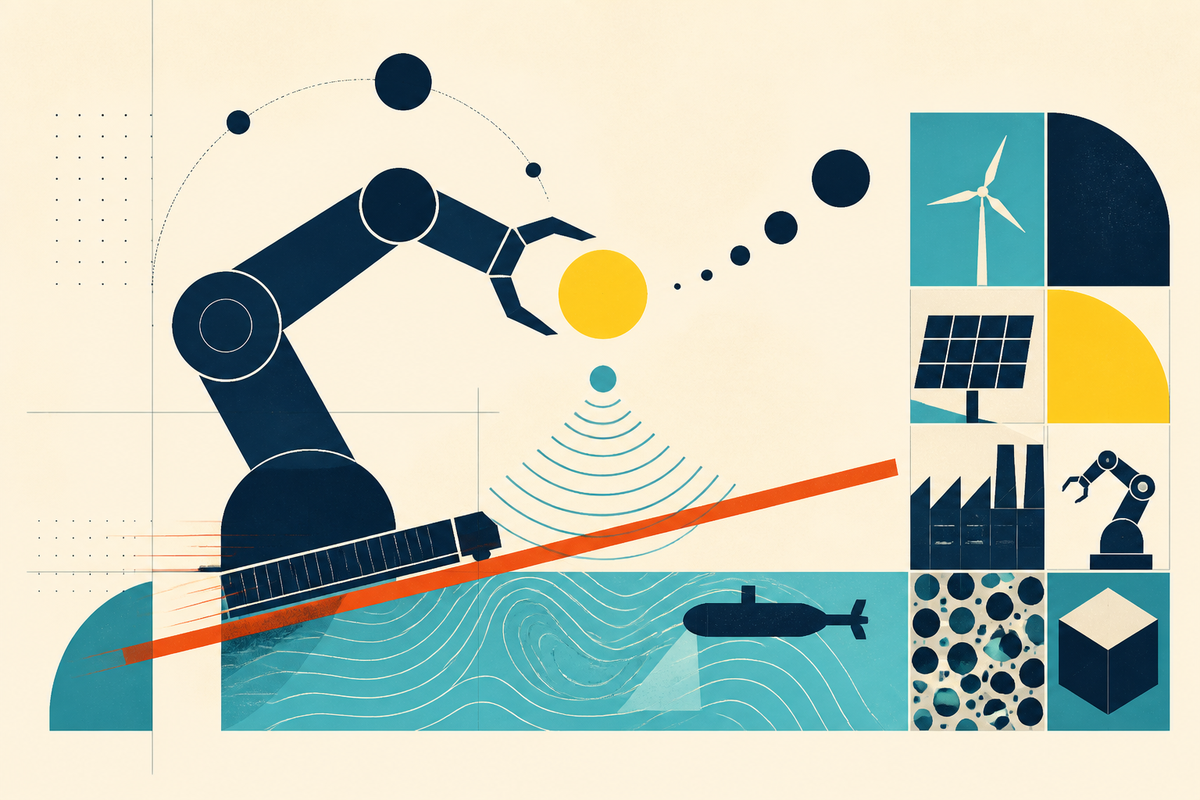
An editorial map of R7's visible portfolio themes
03 / Why the niche matters
The hard part is hiding behind the AI
“Physical AI” is an efficient label, perhaps too efficient. It can make a robot sound like a language model with wheels. In practice, intelligence in the physical world needs sensors that cope with glare and dust, actuators that do not tire, energy systems that fit within weight limits and software that behaves predictably when a prototype meets a pothole. A model can improve in a data center. A trailer still has to survive winter roads.
That complexity is also the opening. Generalist investors often prefer products that can be shipped to another thousand users at negligible cost. Industrial technology carries hardware margins, inventory and longer timelines. R7 competes with specialists such as DCVC, Eclipse, Lux, Construct, Engine and climate-focused funds for founders willing to accept that burden. Its differentiation is the coherence of its physical-world lens and a record that predates the current enthusiasm for embodied intelligence.
That prescription also clarifies what someone can do with R7. A founder can use the portfolio as a fit test before making contact. If the pitch depends on an engineering breakthrough, sells into an industrial or regulated market and can name the physical result it improves, the conversation is plausible. If the moat is mainly a prettier interface, it is probably not. Limited partners can use the same portfolio as a look-through: they are not buying generic exposure to “AI,” but a basket of early companies whose economics depend on hardware execution and industrial adoption.
Strategic buyers and prospective co-investors can read R7 as a scouting network. The portfolio surfaces capabilities that larger companies may need but cannot develop quickly - radar resolution, autonomous flight software, laboratory automation or distributed energy controls. That pattern helps explain why partnerships and acquisitions matter so much in this corner of the market. A startup does not always have to replace an incumbent. It may become the specialized intelligence layer that makes the incumbent's platform more capable.
The model also creates a specific risk profile. Hardware consumes cash before revenue appears. Supply chains break. Certification clocks do not care about a fund's ten-year life. Industrial buyers can admire a prototype and postpone a purchase. The portfolio therefore depends on follow-on investors, strategic partners and customers who can support commercialization. R7's broad reach may help it recognize technical patterns across sectors, but every sector carries its own route to market.
04 / Evidence in the exits
When a specialized capability finds a larger machine
Two portfolio outcomes show how hardtech value can surface. In 2021, semiconductor and computer-vision company Ambarella acquired Oculii, whose adaptive software increased radar resolution. Ambarella later reported total purchase consideration of $355.7 million. The logic was strategic: combine radar perception with the processing platform around it. In 2024, Joby Aviation acquired Xwing's autonomy division after Xwing had accumulated hundreds of autonomous flights and worked through aviation's demanding certification path. Again, the scarce asset was not a generic AI model. It was a working technical stack, a trained team and evidence gathered in the field.
Public markets offer a second route. R7 lists AEye as a portfolio company that went public in 2021. Such listings are milestones, not tidy endings; public hardtech companies remain exposed to adoption cycles and capital needs. Still, they demonstrate the range of outcomes a focused early investor is trying to create.
Recent financings keep the thesis current. In October 2025, Pila Energy announced a $4 million seed round that included R7, Toyota Ventures, Refactor Capital and GS Futures. Pila's pitch is almost domestic in its simplicity: a battery that plugs into a standard outlet and can scale room by room. One month earlier, Vector announced that it had raised $61 million since its founding, with R7 in a broad defense-technology syndicate. The two companies sit far apart in end market but close together in R7's worldview - intelligent hardware built for consequential physical needs.
05 / Where R7 fits
A small firm at the heavy end of venture
R7 is a compact manager by its own LinkedIn description, which lists a company size of two to ten employees, even though broader directories count a larger circle of partners and affiliates. Its headquarters is Chicago, with New York also named on the firm's site. That footprint is apt. The portfolio participates in coastal technology networks but speaks to an industrial economy spread across freight routes, farms, laboratories, utilities and manufacturing centers.
For founders, R7 is useful when the company is early, the technical work is inseparable from the business and the market is large enough to justify patient engineering. A pure consumer app will struggle to fit. A robot that removes a laboratory bottleneck, a material that eliminates an energy load or a sensor that reveals what operators could not previously see is much closer to home.
The firm's portfolio is ultimately an argument about software's unfinished business. Offices and media were easy terrain because information was already digital. The rest of the economy is made of molecules, torque, weather, regulations and people working around machines. Updating it takes longer. It may also produce companies that are harder to copy, because the lesson is embedded not only in code but in test rigs, supply relationships and thousands of encounters with reality. R7 has chosen that inconvenience as its market.