A summer internship usually comes with an implied ending. The student returns to school; the company reclaims a desk. Kyle Gano’s internship at Neurocrine Biosciences took a less conventional turn. He arrived in 2001, between his first and second years of business school. On October 11, 2024, he became the company’s chief executive. Twenty-three years is an admirably thorough way to assess whether a summer job is a good fit.
The company’s human resources team has apparently noticed. At a Citi conference in 2024, Gano described how his early employment had become material for welcoming subsequent classes of interns. As he recounted the line: “This could be you in 25 years if you stick around long enough.” Recruiting departments spend considerable effort finding an engaging career story. Here was one already on the payroll.
The joke offers a convenient opening, but the intervening work gives it substance. Gano moved through marketing analytics, business development and strategy. His education included organic chemistry and finance. By the time the board chose him, he had accumulated experience across the organization and years of responsibility for its external relationships. Read his career this way and the surprise changes shape: the appointment becomes easier to understand than the original internship.
Four degrees before the corner office
Before San Diego, there was a substantial stretch of the West Coast’s university system. Gano earned a chemistry degree at the University of Oregon in 1994, followed by a biochemistry degree at the University of Washington in 1996. UCLA came next: a doctorate in organic chemistry in 2000, then an MBA from its Anderson School in 2002. His student years supplied two bachelor’s degrees and two rather different ways of approaching a difficult problem.
The dates make the internship more revealing. He entered Neurocrine with a doctorate already completed and an MBA still in progress. Calling him an intern is accurate, though it leaves quite a bit out. He was a scientist learning business, with academic training behind him and another course of study underway. The beginning of his company career sits directly between those two parts of his education.
A small piece of that earlier life survives in UCLA’s program for its June 3, 2000 Organic Chemistry Graduate Symposium. Gano appears among the graduating researchers, associated with the Myles, Garrell and Monbouquette group. His scheduled presentation was titled “User-Defined Patterning at the Molecular Scale.” It is a pleasingly precise reminder that before he discussed corporate strategy in public, he had a different sort of presentation to prepare.
The program ends with a reception, pizza and a party. Even a day devoted to molecular-scale questions needs to make room for dinner. The detail belongs to the event rather than to any claim about Gano’s private habits, but it gives the academic setting a welcome human dimension. A future CEO occupies one slot in a full day of talks, surrounded by other students finishing their own long projects.
There is no need to turn four degrees into a prophecy. Plenty of educated people never run a company. What the sequence does establish is the range of subjects he had studied before his responsibilities widened. Chemistry asks for close attention to particulars. Finance introduces another set of constraints. His subsequent career would put him in jobs where both scientific understanding and commercial decisions were part of the working environment.
An apprenticeship in other people’s expertise
Gano’s first work at Neurocrine was on the marketing side, including market research and analytics. In his account of those years, he singled out the company’s collaboration with Pfizer as an opportunity to learn. That is an interesting starting point for someone with an organic chemistry doctorate. His entry into the company placed him near questions about markets and partnerships, alongside people whose expertise differed from his own.
He later moved into business development. A University of Oregon alumni update from 2011 describes the work in useful detail: evaluating products and technologies, licensing arrangements, and collaborative research agreements, with worldwide or regional scope. The description is less glamorous than the phrase “making deals.” It is also more informative. Before a partnership can become an announcement, someone has to understand what is being exchanged and how the relationship will work.
In 2011, he became Chief Business Development Officer. In 2020, strategy joined the title. Those two promotions bracket a long period of work on the company’s relationships with other businesses. Among the partners he executed or managed arrangements with were AbbVie, Mitsubishi Tanabe Pharma, Takeda, Voyager Therapeutics and Xenon Pharmaceuticals. The geographical range of those companies helps explain why a San Diego-based career could have an international scope.
There is a distinction worth preserving between having a long tenure and having a broad one. The first can be measured with a calendar. The second requires examining the assignments. In Gano’s case, the record contains a succession of commercial responsibilities rather than one unchanged position. His public account also emphasizes work across functions. The company name stayed familiar while the questions he was expected to answer expanded.
At the Cantor Fitzgerald conference in September 2024, shortly before the handover, he described that experience as a way to understand both organizational pitfalls and opportunities worth pursuing. These were his explanations of what he brought to the job, rather than independent verdicts on how he would perform. They are still useful: the incoming chief executive chose to emphasize practical knowledge of the place he was about to lead.
“Beyond talking about me, I’d like to spend the rest of the time talking about Neurocrine.”Kyle Gano, September 2024
Then he moved the conversation along. The turn away from autobiography, at a moment when an incoming CEO might reasonably linger over his qualifications, makes the passage memorable. It offers a brief glimpse of his public manner: establish the background, explain why it matters, and return to the company. It would be excessive to build an entire personality from one conference appearance. The moment itself is enough.
A handover with a long memory
The succession was announced on May 28, 2024, with an effective date more than four months away. Kevin Gorman would retire as chief executive in October and remain on the board. Gano would take the top job and join the board at the same time. The timetable made the transition a defined process, with a named successor and a specific day on which responsibility would change.
Gano called Gorman a mentor when the appointment was announced. That relationship matters to the story because the outgoing CEO did not disappear from the company’s governance. The arrangement brought a new executive into office while retaining his predecessor as a director. For Gano, the promotion meant assuming formal responsibility in an organization where many of the people and working relationships were already familiar.
A filing made when the change took effect gives the handover its least romantic detail: the employment agreement. Its effective date was October 11. The annual base salary was $900,000, with an initial target cash incentive equal to that base pay. Those are terms for the role, rather than a statement of personal wealth. They put a contractual edge on a story otherwise easily softened into a tale about patience and belonging.
The central tension of an internal succession is straightforward. Experience helps a leader understand how an organization works; authority requires deciding what it should do next. Familiarity alone cannot settle those decisions. Gano’s career gives him a particular starting position, and his work as CEO has to be judged from there. The internship explains how he arrived. It does not write the rest of the business plan.
The company beyond the corner office
In his 2025 corporate responsibility letter, Gano emphasized employee training, development and engagement. He also described the company’s move into its new San Diego headquarters. These are useful details to set beside the promotion story. An executive who spent more than two decades moving through one organization was now writing about the conditions in which other employees would work and develop.
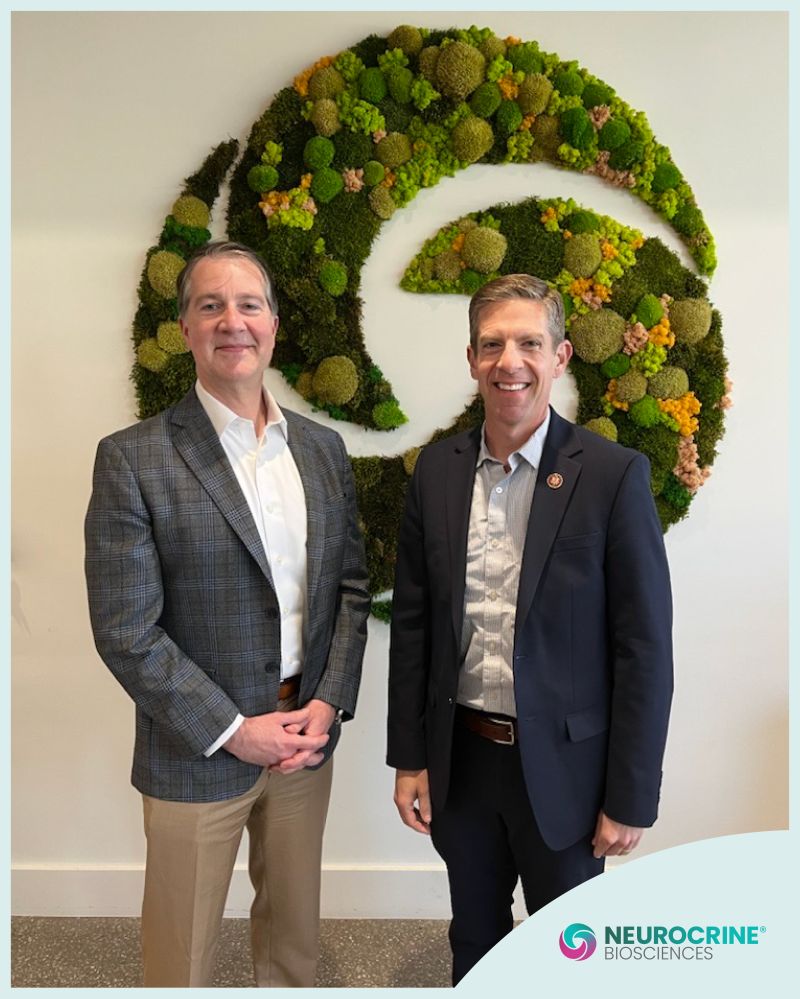
The public-facing work extends beyond employees and investors. Neurocrine shared a campus visit in which Gano welcomed Biocom, industry leaders and Congressman Mike Levin for a roundtable about innovation and the local economy. He also serves on PhRMA’s board. These appearances place the CEO in conversations about the wider business environment, where representing an organization involves more people than those who report to it.
By May 18, 2026, another development had given his tenure a concrete corporate milestone: Neurocrine completed its acquisition of Soleno Therapeutics. The cash offer was $53 per share, and Soleno became a wholly owned subsidiary. This was an acquisition completed while Gano was CEO; the distinction matters more than a casual assumption that one executive personally negotiated every part of it. The business-development background now sat within a broader leadership responsibility.
His record, viewed across these dates, suggests a useful question about career progress: how much can change while the employer stays the same? In this case, quite a lot. The sequence runs from a temporary student assignment through analytical work, partnerships and strategy to the chief executive’s office. Each stage can be described concretely, without pretending that the final title was inevitable from the first day.
The HR joke will probably remain the easiest version to remember. It has a beginning, a punch line and a remarkably long interval between them. The fuller account asks for more attention: universities, unfamiliar disciplines, changing assignments, colleagues, partners, a mentor and a scheduled handover. Gano’s summer job lasted because it ceased to be the same job. By October 2024, the intern was responsible for what came next.