Consider the pocket in a pair of jeans that seems too small to be useful. Tandem Diabetes Care sees room for an insulin pump. Its Mobi device holds 200 units of insulin, connects to a glucose sensor, and takes instructions from a compatible phone. A little pocket becomes a surprisingly good place to begin understanding a company: the engineering has to fit around the person.
- Tandem builds insulin pumps and software that automate parts of diabetes management.
- Its distinguishing choices include remote updates, different pump formats, and partner glucose sensors.
- Users still need training, supplies, meal boluses, and a workable insurance arrangement.
A screen is a clinical decision
Tandem’s first commercial pump, t:slim, arrived in 2012 with a color touchscreen. That might sound like an aesthetic preference. For a device used to deliver insulin, finding the right control and confirming the right dose have consequences that extend beyond convenience. A confusing menu can become a medical problem.
The company’s published human-factors research gets wonderfully specific. Patients and clinicians helped decide which information belonged on the home screen. Other exercises tested task priorities, terminology, icons, and colors. These were decisions the company could have left to its engineers. Instead, it brought the people who would use the device into the design process.
A later Tandem-sponsored study compared t:slim with an older Medtronic Revel pump in simulated tasks. Among 72 adults, training time was 27% lower and use-error rates 65% lower with t:slim. The comparison concerned those devices and that experiment. It cannot settle a contest between today’s pumps. It does show why a screen deserves a place in the clinical conversation.
The corporate predecessor was incorporated in 2006. Founder Paul DiPerna designed the initial product; Kim Blickenstaff joined as CEO in 2007. The distinction matters because the story is bigger than a single charismatic founder. It includes mechanical engineering, interface research, and the unglamorous work of commercializing a regulated device.
The upgrade that stays on your belt
In 2016, Tandem introduced t:slim X2, designed to receive new software through a personal computer. Medical devices tend to live on an insurance timetable. Software moves on a different clock. An updatable pump offered a way to bring approved features to existing hardware.
“outside of the typical insurance pump replacement cycle”
Kim Blickenstaff, then CEO, describing remote updates in 2016
That description of the X2 became more interesting when the software began making decisions. Control-IQ combined compatible continuous glucose monitoring with an algorithm that adjusted insulin delivery. The pump could respond while its wearer was occupied with something else.
In a six-month randomized trial published in 2019, 168 people with type 1 diabetes, ages 14 to 71, used either Control-IQ or sensor-augmented pump therapy. Average time in the target glucose range rose from 61% to 71% in the Control-IQ group; the control group stayed at 59%. The adjusted difference between groups amounted to about 2.6 hours a day. Those are group results from the original technology, not a forecast for every user of today’s Control-IQ+.
Mean time in 70-180 mg/dL. Six-month 2019 trial; 168 participants. Control group remained at 59%.
Two ways to carry the same idea
The intended audience has widened, too. In February 2025, Control-IQ+ received U.S. clearance for adults with type 2 diabetes. That expanded an approach long associated with type 1 diabetes. It also gave Tandem another reason to make a complex treatment understandable to someone arriving from daily injections.
Today’s range gives users a physical choice. The t:slim X2 keeps a touchscreen on the pump and holds 300 units. Mobi, commercially launched in 2024, is smaller, holds 200 units, and moves routine control to a compatible smartphone. It also has a physical bolus button. Sometimes the useful feature is the one you can press without opening an app.
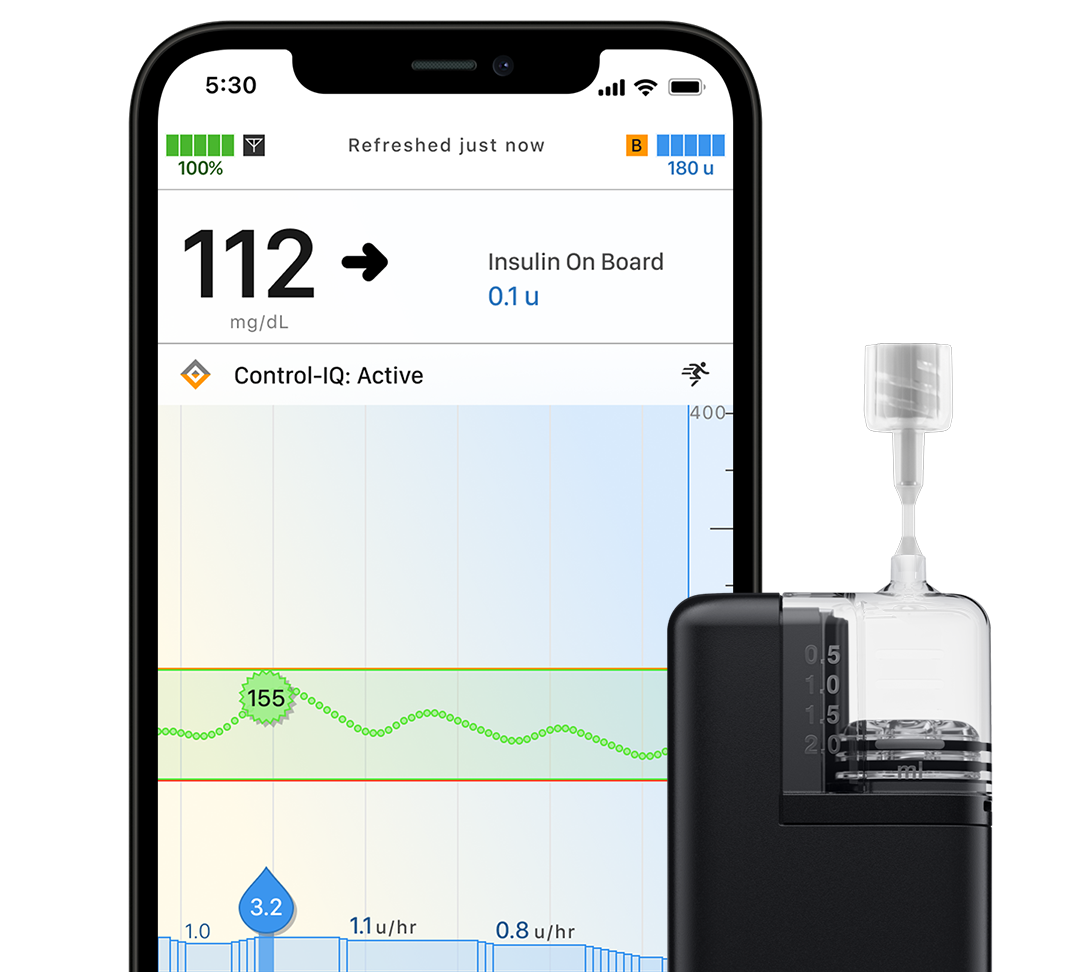
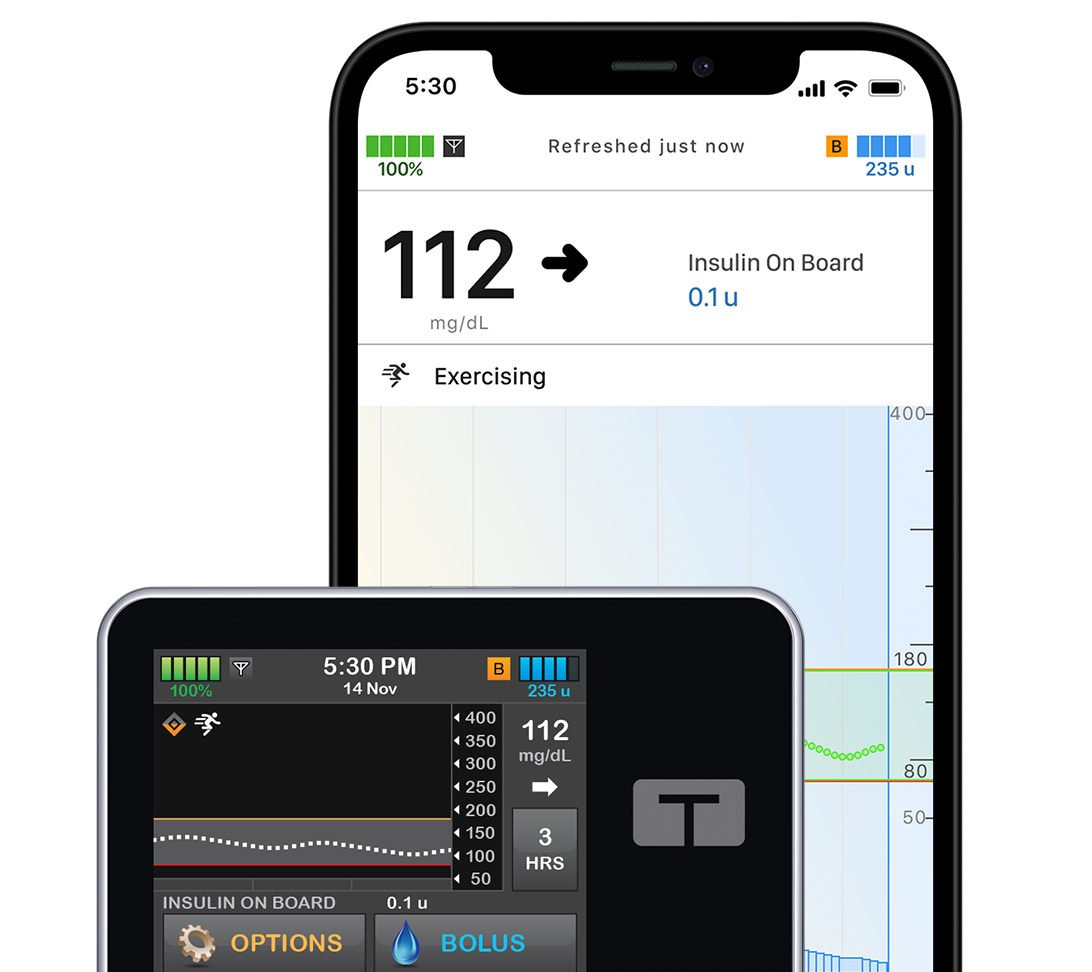
Both sit inside a larger system: sensors from partners such as Dexcom, infusion sets, cartridges, software, and support. X2 also supports Abbott sensor options in applicable markets. Tandem Source organizes therapy data, supply orders, and software updates. Compatibility depends on the pump, software, phone, sensor, and country. A brand name alone is insufficient.
Alternatives include Insulet’s tubeless Omnipod 5 and MiniMed’s 780G. Automatic insulin adjustment is shared territory. Tandem’s position rests on its combination of interfaces, wearing options, integrations, and updates. People still announce meals, maintain infusion sites, replenish insulin, charge hardware, and respond to alerts. Automation removes some work; it leaves a job description.

The bug that reached the battery
The vulnerability of this connected arrangement became visible in 2024. Version 2.7 of the iOS t:connect app could crash and relaunch repeatedly. That loop generated excessive Bluetooth communication, which could drain the paired X2 pump’s battery. A phone-software fault could end with interrupted insulin delivery.
The FDA classified the correction as a Class I recall. It recorded 224 reported injuries as of April 15, 2024, and no reported deaths. Some battery problems persisted after the first update; version 2.8.2 followed in August. The sequence makes the engineering obligation concrete: test the relationships between components, including what happens when one repeatedly misbehaves.
The insurance card is part of the interface
Tandem earns money from pumps and continuing supply purchases. It reported roughly $1.015 billion in 2025 sales, alongside a $204.7 million net loss. Research and development expense was $193.1 million, before a separate acquired-research charge. Building and supporting this technology consumes substantial money even at scale.
For a customer, the relevant bill depends on coverage, supplies, insulin, and glucose monitoring. In 2026, Tandem began moving pharmacy access toward a pay-as-you-go structure, spreading pump reimbursement across continuing supply purchases. Lower upfront expense may open the door for some patients. Coverage and ongoing payments still determine whether they can stay.
By the second quarter of 2026, pharmacy represented 10% of U.S. sales. In September, Mobi reached 12 countries outside the United States. Phone support and sensor options still varied by market. Expanding the map does not make every version of the experience identical.
Make the ordinary things work
The transferable lesson is practical: observe actual tasks, redesign around the errors, and budget for the product after it ships. For someone considering a pump, the corresponding questions are equally concrete. Will it work with your phone and sensor? Can you manage the supplies and alerts? What will your plan pay? The tiny pocket matters. So does everything needed to keep the machine inside it working.
Website · Mobi · t:slim X2 · Interactive pump demos · Company blog · News
LinkedIn · X · Instagram · Facebook · YouTube
↗ Watch: Mobi deep dive with Diabetech and diabetes educator David Mina