Before the customer journey became a diagram full of arrows, it was a box of stone crabs traveling north from Miami. Early in Maria Robinson’s career, a successful local restaurant wanted to build a takeout business for its snowbird regulars. The customers had gone home; their appetite had not. Robinson helped shape the restaurant’s first ecommerce site so a celebrated Miami meal could follow them.
The technology now sounds quaint. The instinct does not. A customer wanted something, distance stood in the way, and a digital experience closed the gap. Robinson has spent more than two decades refining that equation across consumer and enterprise businesses. The channels multiplied. The dashboards grew more elaborate. Her basic question stayed usefully plain: what is the customer trying to do, and how can the business make it easier?
Today Robinson is chief marketing officer at Airship, where she oversees global marketing and partnerships. The company’s territory is the modern version of that Miami delivery problem: customers drifting among apps, websites, email, text messages, mobile wallets and physical places while expecting the brand to remember where the conversation left off. Robinson’s job is partly to market the platform and partly to articulate the problem it solves. In her telling, the campaign is becoming too small a frame. The journey is the canvas.
A front-row seat to the work
Marketing arrived early in Robinson’s life. Her father was an advertising and marketing executive, and she watched him balance an exacting career with being present at home. What stayed with her was not merely the industry’s polish. It was the grit behind it: the preparation, judgment and repetition required to make an idea land. She later described him as the foundational inspiration for her own career.
She studied Sociology and Global Studies at Alverno College, an apt pairing for someone who would make a profession of watching people and connecting systems. Her first agency work in Miami covered retail, travel and hospitality brands. Those are unforgiving classrooms for abstraction. A guest books or does not. A shopper returns or wanders off. A crab either arrives fresh or becomes a customer-service story no one wants.
Her route into software passed through Intuit, Citrix and LogMeIn/GoTo, companies that put her close to digital distribution, subscription economics and the awkward seams between product, sales and marketing. At Imperva, she became vice president of growth strategy. Her brief spanned brand, digital, demand, web, account-based marketing, sales development and a transition to SaaS. She also founded the Imperva Women’s Network, extending the work of connection beyond the revenue engine.
The pattern is visible in hindsight. Robinson gravitates toward the handoff: consumer intent into an experience, marketing signal into a sales conversation, a complex product into a story a buyer can use. Handoffs are where organizations tend to expose themselves. Each department can perform beautifully in isolation while the customer receives a small bureaucratic scavenger hunt.
The first-CMO assignment
In August 2020, Nitro hired Robinson as its first chief marketing officer. A first CMO inherits a title and a blank page, often in unequal measure. Nitro sold document productivity and electronic-signature software, a category moving quickly toward subscriptions and more urgently toward remote work. Robinson was responsible for global growth and awareness. Airship later credited her Nitro tenure with helping the company achieve more than 60 percent growth in annual recurring revenue.
The number matters because Robinson’s view of marketing is allergic to ornamental activity. She likes ideas, but she likes ideas with consequences. A campaign should change a behavior. Positioning should improve a choice. An experiment should teach the next experiment. This is where one of her favorite business books enters the story.
Robinson heard Eric Ries speak and participated in a workshop led by the author of The Lean Startup. The framework altered how she thought about speed, learning and the willingness to pivot when the evidence objects. It gave a name to an operating preference already present in her career: shrink the distance between hypothesis and useful feedback.
Goodbye to the lonely lead
At Reltio, Robinson’s team applied that instinct to one of business marketing’s favorite inherited objects: the marketing-qualified lead, or MQL. The model imagines a person accumulating enough engagement to be passed to sales. The difficulty is that expensive business software is rarely purchased by a solitary person traveling obediently through a funnel. Buyers arrive in committees, with different questions, authority and timing.
Reltio began exploring an alternative after team members encountered the idea of organizing the revenue process around buying groups and opportunities. Months of research and discussion followed. In December 2022, the executive team agreed to proceed. By January 2023, 60 days after the decisive push began, the new process was live.
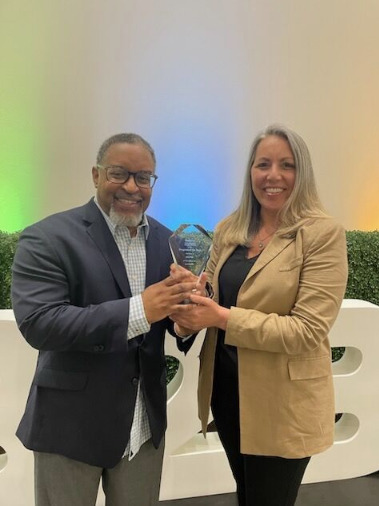
The transformation produced more than a new vocabulary. Reported results included a 20 percent increase in actionable sales pipeline, opportunities advancing 24 percent faster than the year before, and a 50 percent reduction in closed-lost opportunities. In June, the work received the 2023 Program of the Year award for demand and account-based marketing. Robinson summed up the value in two words that seldom coexist by accident: quality and velocity.
A trophy makes a tidy photograph. The more transferable achievement was organizational. Sales, marketing, business development and operations had to agree on the unit of attention and the moment it became actionable. The team did not simply improve a campaign. It changed the company’s shared description of a buyer.
The journey becomes the product
Robinson joined Airship’s executive team in March 2025. The appointment put her in a company built around a problem she had been approaching from several directions: how to make customer interactions feel connected when the machinery behind them is fragmented. Airship works across notifications, apps, websites, email, SMS and mobile wallets. Robinson’s emphasis is not on sending more things through more pipes. It is on coordinating the pipes around the person.
The Robinson operating loop
The loop matters more than any single channel. Each interaction should make the next one more relevant.
She argues that mobile deserves special attention because it is where customers often begin the day and where a brand can respond to immediate context. But “mobile-first” is not a demand that every interaction squeeze onto a small screen. It is a clue about continuity. The phone moves with the customer. A useful experience should move with them too.
This is also where her interest in AI becomes practical. Robinson talks about using AI and no-code tools to help marketers test messages, audiences, journeys and digital experiences without waiting in a developer queue. The promise is speed, but disciplined speed: more chances to learn what helps, fewer weeks spent defending an assumption in a conference room.
Her caution about fragmented systems has sharpened in conversations about retail. An all-in-one promise sounds soothing, but the modern marketing stack keeps expanding. Robinson favors modular systems that can move data and coordinate experiences without pretending one vendor can perform every job. Zero-party data, information a customer chooses to provide, is especially valuable because relevance built with permission is sturdier than personalization assembled by surveillance and hope.
A leader at the seams
People who have worked with Robinson describe a leader who gives teams room to experiment, publicly supports their work and keeps business outcomes in view. Recommendations on her professional profile repeatedly mention the same pairing: strategic transformation and care for people. It is easy to call those separate virtues. In practice they reinforce each other. A team experiments more honestly when a failed hypothesis is treated as information rather than a small moral crisis.
Recognition followed the work. Robinson was named among FINITE’s influential SaaS marketers in 2023 and Women We Admire’s Top 50 Women Chief Marketing Officers in 2024. Her LinkedIn honors also include a 6sense Breakthrough 24 award for efficiency expertise. These belong on the record, but they are not the most revealing details.
More revealing is the consistency of her curiosities. She speaks Italian. She would like to have dinner with Simon Sinek and talk about the “why” behind professional choices. She returns to customer insight, rapid experimentation and sales-and-marketing alignment with the patience of someone who knows management problems do not disappear when they acquire fashionable names.
In June 2026, when Airship appointed Laura Zwahlen as chief revenue officer, Robinson described the CRO as her most important partner in the pursuit of growth. The comment fits her career. Marketing, in Robinson’s version, is neither a decorative layer nor a sovereign island. It is a connecting function, valuable in proportion to how well it helps a company see and serve the same customer together.
That brings the story back to Miami. The stone-crab restaurant did not need an ecommerce strategy for its own sake. It needed to remain useful to customers who had moved. Every new channel since has made that simple obligation easier to forget. Robinson’s work is a long argument for remembering it: find the customer, understand the moment, remove the distance, and make the next interaction worthy of the last.