Maria Chatzou Dunford once fitted 167 investor meetings into two months. The arithmetic makes an impression before the money does. There were 117 meetings in an initial sweep, then another 50 as the conversations became more serious. Eventually, Lifebit raised more than $3 million. A calendar, under sufficient pressure, can begin to resemble a business model.
She was still explaining herself between appointments. An early interview caught her walking through Angel in London, speaking on the move. Each conversation required another version of the explanation, adjusted to what the listener understood. The exercise was as much about making a technical proposition intelligible as persuading anyone to write a cheque.
Her advice from that period was admirably plain: “Be as honest as possible. Investors can totally see through you.” It is a useful opening to her story. Here is a scientist who entered business and discovered that the audience, the explanation and the relationship all needed their own kind of attention.
Two months. More than $3 million raised.
An itinerary before a company
Long before the appointments in London, there was Artemis, the Greek town where Chatzou Dunford says she went through primary and secondary school. Her route outward took her through university, then Sweden, Barcelona and eventually Britain. She describes a sequence of changing occupations: engineer, bioinformatician, researcher, entrepreneur. Each stage gave her another way to work on a difficult question.
As a child, she had imagined working in space, perhaps as an astronaut or studying the cosmos. That early ambition supplies a welcome detail in a career otherwise crowded with computing terms. She liked large questions before she knew which discipline would let her pursue them. The job description changed; curiosity survived the journey.
Her academic path included a bachelor’s degree at the University of Thessaly, completed in 2008, followed by master’s study in bioinformatics associated with Athens and Stockholm. She completed her doctorate at Pompeu Fabra University in Barcelona in 2016 and continued as a postdoctoral researcher at the Centre for Genomic Regulation.
The moves also shaped her practical understanding of where to build. When Lifebit began, Cambridge offered proximity to research institutions and prospective clients. The wider triangle connecting Cambridge, Oxford and London mattered to her. For someone accustomed to moving for work, location was a decision about access to people, expertise and conversations.
The work that travelled without her
In Barcelona, Chatzou Dunford worked on software that other researchers could use. One enduring record is the 2017 paper introducing Nextflow, a system for managing computational workflows. Her name appears alongside Paolo Di Tommaso, Evan W. Floden, Pablo Prieto Barja, Emilio Palumbo and Cedric Notredame. The paper identifies Di Tommaso, Chatzou and Floden as equal contributors.
The difficulty addressed was reproducibility. A calculation can behave differently when software, databases or computing environments change. Nextflow helped organise work across those environments, using containers to make the computational process more stable. It tackled the unglamorous details on which confidence in a result can depend.
That is a revealing achievement for a future CEO. Useful infrastructure often recedes from view precisely when it works. The user gets on with the task, while someone else’s careful engineering holds the process together. A publication leaves an author’s name visible; a dependable tool can become almost invisible through familiarity.
She was also explaining the technology in public before Lifebit existed. Nextflow’s presentation archive lists her talk at ISC Cloud & Big Data in 2015. The record offers an earlier glimpse of the same combination: someone close enough to the machinery to understand it, and willing to stand up and explain why it matters.
- 2015Presents Nextflow at ISC
- 2016Completes her doctorate in Barcelona
- 2017Co-founds Lifebit; joins Techstars London
A rehearsal room for entrepreneurship
Her preparation for company life included building a community. At Innovation Forum Barcelona, she helped connect local startups with peers, investors and potential partners. The organisation’s profile records her as a former president. Before she was responsible for Lifebit’s direction, she was helping other people find routes beyond their own research groups.
It was a useful place to discover the questions that appear when a scientific idea leaves the laboratory. Who might use it? Who might support it? Which introduction would help? A network makes those questions concrete, because there are actual people on the other end of them.
When she later joined Endeavor’s entrepreneur network in 2022, her account of founding remained rooted in the work she wanted to bring into the world. The company was a way to carry an idea further. Her experience at Innovation Forum had already made the distance between a technical contribution and a functioning venture less abstract.
She has encouraged scientists to join organisations where they can practise communication, networking and business. A community offers a place to try skills before the entire company depends on them. It is a modest recommendation, particularly from a founder: find a useful room, join in, and learn how the people in it get things done.
The pitch that opened another door
Chatzou Dunford met her Lifebit co-founder, Pablo Prieto Barja, while they were doctoral researchers in the same group in Barcelona. They shared computer science training and experience of the practical complications of analysing large datasets. The prospective company grew out of work they already knew, including tools that had attracted interest beyond their immediate research setting.
One early public pitch took place at the Women Who Tech Startup Challenge in 2017. Max Kelly, then managing director of Techstars London, was among the judges. He saw a fit with the accelerator and encouraged the connection. Lifebit entered Techstars that year.
That encounter sits comfortably beside her earlier community building. A pitch competition brought her into a new circle, where somebody recognised the shape of the company she was trying to create. She still had to do the work of building it. The introduction supplied an opportunity and a place to learn.
By 2018, the seed round had brought backing from Pentech and Connect Ventures, with Beacon Capital and Tiny VC also participating. Lifebit had an early product called Deploit and was adding to its engineering team. The researcher’s task now included deciding how to support a product, hire people and keep a young organisation moving.
The company is made of people
Chatzou Dunford has argued that a group can think more effectively than one person working alone. For a founder whose credentials are easy to list, the emphasis is telling. A company asks the person in charge to make other people effective, as well as to be effective herself.
She has described the team and client delivery as central responsibilities. People need a shared purpose and reasons to feel engaged in their work. Customers need something that helps them do theirs. Those two requirements meet in the everyday choices of a software company: what to build, what to explain, what to fix and whom to listen to.
Her approach to recruiting has been international. She has spoken positively about the engineering and research talent around London, Oxford and Cambridge, while identifying retention as a challenge in a competitive market. That distinction matters. Recruiting someone starts a relationship; keeping their interest requires attention after the offer has been accepted.
“The collective mind is far superior to the singular.”Maria Chatzou Dunford
A reading list with marching orders
Ask about books and another side of her management education appears. In 2020, she singled out The Challenger Sale and Predictable Revenue, reading her way into the commercial demands of a business selling to other businesses. The scientist was studying sales with the seriousness generally reserved for subjects people admit to finding respectable.
Her favourite was Extreme Ownership, the leadership book by Jocko Willink and Leif Babin. She said Lifebit gave it to people and asked them to read it. A reading recommendation became part of the company’s conversation about responsibility, culture and getting work done.
There is a recognisable habit here: when the job changes, find material that helps explain the new job. The questions of a researcher, a salesperson and a chief executive differ. Chatzou Dunford’s career has required her to keep learning the vocabulary and expectations of each.
Her public conversations return to self-development, evolution and focus. Those interests fit a career that has repeatedly widened in scope. Running a company leaves fewer opportunities to remain exclusively good at the thing that first made the company possible.
Back in the room
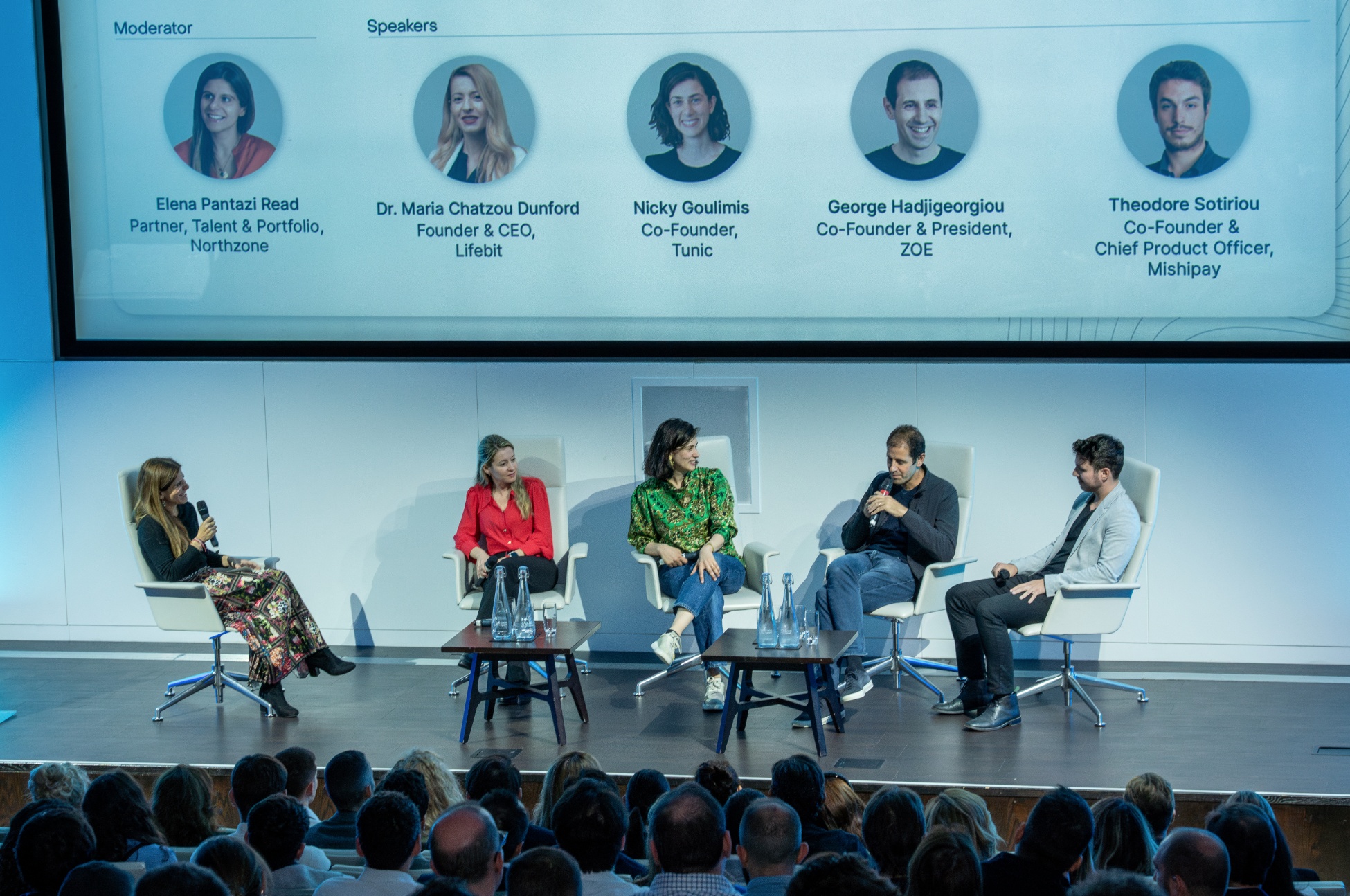
In October 2023, she appeared at a London Greeking Out discussion alongside Nicky Goulimis, George Hadjigeorgiou and Theo Sotiriou. Elena Pantazi moderated. The conversation covered entrepreneurial journeys, motivation, Greece and advice to younger selves. The researcher who had once helped other startups make connections was now contributing her own experience to that exchange.
The photograph of the panel has the pleasing ordinariness of a working conversation: chairs, microphones, water bottles and people listening to one another. Public accounts of entrepreneurship tend to favour the funding announcement. This is another part of the work, sharing what happened after the announcement and comparing it with somebody else’s experience.
Her more recent public language places security near the centre of Lifebit’s identity. In May 2026, the company announced Security Tower, a product intended to make security controls and their coverage visible across research environments. The emphasis was on seeing gaps and enforcing controls as organisations and their systems become more complex.
For Chatzou Dunford, that is familiar territory in a new organisational setting. Complexity has accompanied her from research workflows to product development to the responsibilities of a CEO. Her answer has involved tools, colleagues, customers, books and a considerable number of conversations. Somewhere between the first calculation and the 167th meeting, explaining the work became part of doing it.