The photograph has the pleasantly unhurried air of life before the pitch deck. Osamah Choudhry sits beside a table, wearing a striped polo shirt, in a local newspaper’s celebration of graduating students. It is June 2005. He is listed as the top-ranked student at Elizabeth High School, with Rutgers-Newark as his college destination. Medivis, the company he will co-found, is still eleven years away.
There is a temptation, with founder biographies, to begin at the financing announcement and work backward just far enough to locate an origin. Choudhry offers a longer view. Before the headset demonstrations, before the venture investors, before the CEO title, there was a New Jersey teenager with an activities list long enough to suggest that the school bell was more of a recommendation.
The boy with the crowded activities list
Science Club. Math League. Model U.N. The school newspaper. Peer tutoring. Varsity tennis. His academic profile made room for speaking, writing, competition, and service alongside the expected scientific interests. It recorded a first-place Model U.N. result in 2005, following second place the previous year. Even the extracurriculars had a progress report.
These details do not predict a company. They do rescue a person from the narrowing effect of a job title. An executive biography can make someone appear to have spent childhood waiting for incorporation papers. Here is a younger Choudhry participating in several different worlds, with no need to pretend that all of them were preliminary rounds of entrepreneurship.
Rutgers followed. He entered an accelerated BA/MD program and completed his medical degree at New Jersey Medical School in 2012, graduating with distinction. His academic honors included Alpha Omega Alpha and Sigma Xi. The educational path was demanding and structured. The company would emerge from a less formal arrangement: two colleagues following a shared interest.
Elizabeth High School, 2005: science, Model U.N., the newspaper, peer tutoring, varsity tennis. A wider frame for a future founder.
An idea acquires a second desk
Choudhry met Christopher Morley at NYU. Both were residents in their respective programs. Their initial collaboration was academic, and their interest in emerging visualization technology ran alongside their existing work. In Choudhry’s account, the beginnings sounded refreshingly provisional: “It was just a passion of ours on the side.”
Engineers became part of the effort. After participating in NYU’s Summer Launchpad program, the group launched Medivis in June 2016. The sequence matters. The company followed the collaboration. There were already people working together, already questions to investigate, already something that deserved another attempt. Incorporation gave that activity a more durable address.
The early technology centered on Microsoft’s HoloLens. A screen normally has an edge and a fixed place on a desk. A spatial interface asks what happens when information can occupy the room around its user. For Choudhry and Morley, that possibility had practical appeal. They wanted existing information to become more natural to see and understand in three dimensions.
It is an appealing proposition, and a difficult design assignment. People understand rooms without reading a manual. Software has to earn that same ease. A headset can supply the display; deciding what belongs in the display is the longer argument. Medivis began in the overlap between the people who understood the information and the people who could build a new way to encounter it.
New York, with the doors open
Choudhry’s attachment to NYU continued beyond that first collaboration. He valued being inside the university’s Future Labs community, where other startups offered company in both senses of the word. There were people to exchange ideas with, people working through their own problems, people whose momentum could be useful on a slow afternoon.
“I feel that we grew up here in a sense,” he said of NYU. It is a warmer description than the customary list of incubator amenities. He had met Morley there. The surrounding community remained useful as Medivis developed. Familiar ground could still introduce unfamiliar ideas.
New York also figured in his early explanation of the business. He pointed to the combination of engineering talent, financing, and specialized institutions. His emphasis was on bringing the ingredients together. Computer engineering did not require an enormous physical footprint; it required capable people who could work creatively. The city’s density offered opportunities for those people to find one another.
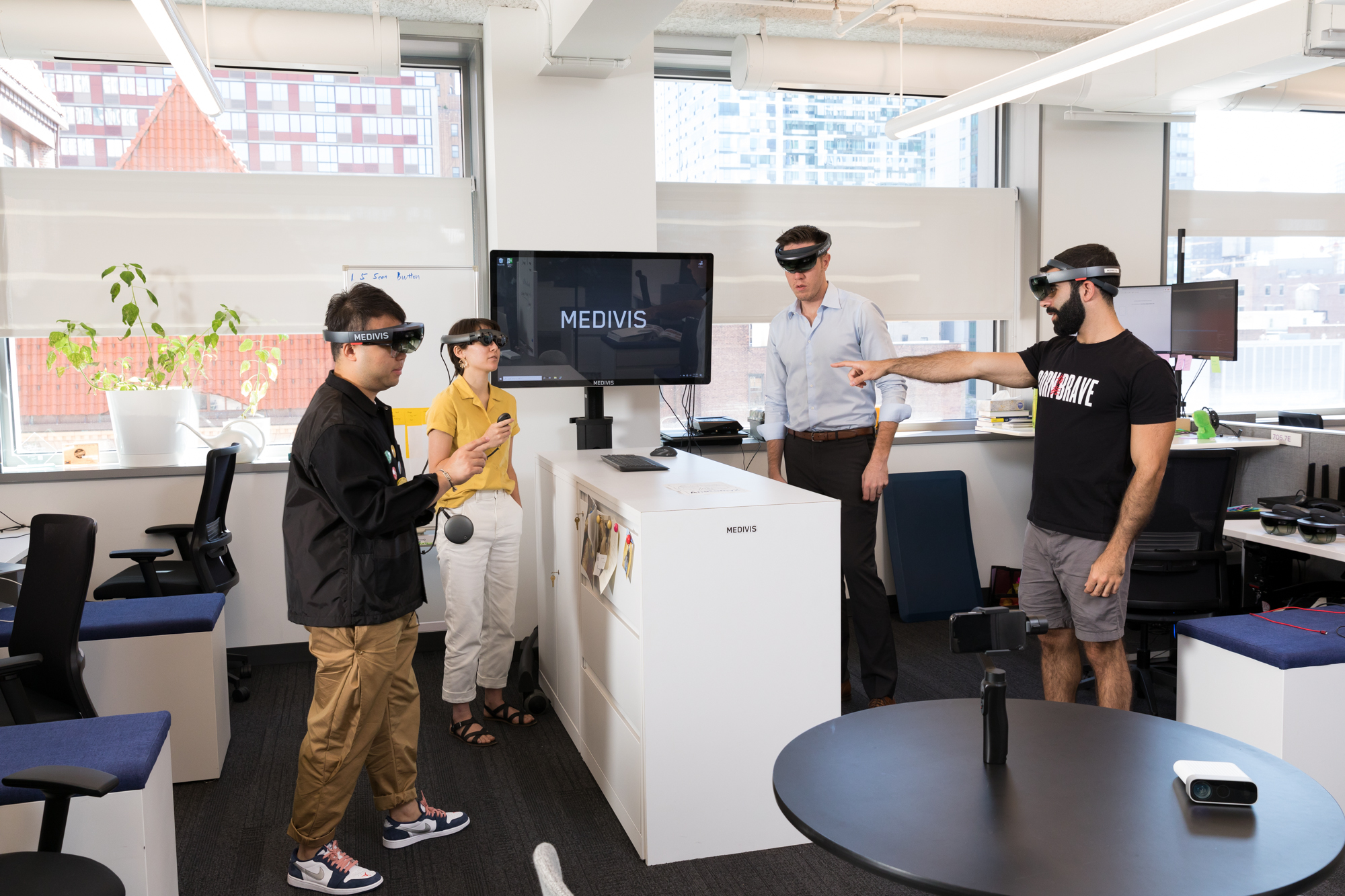
That gives his founder story a particular geography. A collaboration can be described in professional terms, but it also happens somewhere. Here, the university, the startup community, and New York’s technical and financial networks sit close together in the narrative. The office photograph makes a companionable illustration: daylight, desks, a plant near the window, and four people trying to see the same thing.
“I feel that we grew up here in a sense.”
Osamah Choudhry, on NYU
The headset gets a business plan
By February 2019, Medivis was ready for a public launch. Its announcement disclosed a $2.3 million seed round led by Initialized Capital and a Microsoft technology partnership. The company was showing its platform at a conference, moving from the relative intimacy of development into the more exposed business of presenting a product.
There is a considerable distance between making someone curious and making an organization a customer. The launch materials already addressed integration with existing information systems. That detail belongs beside the headset in any account of the company. A demonstration wins attention for a few minutes. Compatibility concerns the rest of the working week.
The business model also brought the physical and digital parts together. In 2023, Choudhry described a one-time charge for a workstation and headset package, accompanied by an annual recurring software fee. An organization was buying equipment and an ongoing relationship with a platform. For the company, that meant responsibility stretching beyond delivery day. A hardware package has to arrive and work; software has to remain useful as customers continue paying for it. The arrangement gives a concrete commercial shape to a company otherwise easy to describe entirely in terms of what a headset lets someone see.
The packaging question had appeared in Choudhry’s thinking early. He understood that even capable technology could fail if the experience of using it was wrong. The interface had to make sense to its intended user. That is a useful restraint for an enterprise built around something as visually arresting as augmented reality: the spectacle has to settle into a routine.
A founder in this position has several audiences. Engineers need a problem they can define. Users need a product they can understand. Investors need a business they can support. Choudhry’s public role sits where those conversations meet. The work of translating between them is less photogenic than a hologram, but a company has to perform it every day.
An unusually varied table of investors
In June 2023, Medivis announced a $20 million Series A led by Thrive Capital. Initialized Capital participated, as did Mayo Clinic. Other disclosed backers included Bob Iger, Hugo Barra, Coalition Operators, and Kevin Durant and Rich Kleiman’s 35V. It was the sort of investor list that could briefly make a business announcement resemble a seating plan.
The details deserve their proper proportions. Iger had invested before his return to Disney. Durant’s participation came through 35V. These were disclosed financial connections, and the company’s announcement identified them that way. The recognizable names brought attention to a business that had already been developing for years.
Seven years separated the founding from that Series A announcement. The financing was intended in part to expand engineering and commercialization. Those aims return the story to the people doing the work. More capital creates opportunities to build and reach customers; it also creates a larger set of decisions about what deserves time and resources.
Choudhry’s own language around milestones tends to leave room for the next task. His public updates acknowledge the team and describe development as something continuing. That is an especially useful perspective when the outside world encounters a company mainly through occasional announcements. A founder experiences the intervals too. The calendar contains far more working days than launch days.
- 2016Medivis founded in New York
- 2019Public launch and seed announcement
- 2023$20 million Series A announced
- 2026Choudhry listed for NVIDIA GTC San Jose
The side project keeps its day job
Alongside the executive role sits an academic career. A 2021 NYU speaker biography described Choudhry as an assistant professor and credited him with more than 50 research articles. The company did not erase the research background from which it emerged. His public appearances continued to bring the technology into conversations with technical and academic audiences.
In March 2026, NVIDIA listed him with Edward Andrews for a GTC San Jose session involving Medivis, extended reality, and conversational AI. The vocabulary had expanded since the early HoloLens experiments. Spatial displays were now sharing the discussion with software that could respond to natural language. The interface question had acquired another dimension of its own.
The ambition remains legible across that changing vocabulary: make complicated information easier for people to encounter and use. That is an aspiration, with continuing work attached. The interest in user experience visible in Choudhry’s early comments gives it a practical test. A product has to become understandable to someone beyond the group that built it.
Return to the teenager in the newspaper, and the story acquires its human scale again. The activities list is crowded. The college destination is written down. The future company is absent, as it should be. Years later, an NYU colleague and an engineering team would give a shared interest somewhere to go. A side project became a company. Choudhry has stayed with the work long enough for that modest beginning to become the opening of a much longer story.