Before there was an OpenLoop name on a downtown Des Moines building, Jon Lensing and Christian Williams were writing letters in a Hy-Vee café. Three hundred letters, by hand. A grocery store offered certain advantages as a place to start a company: when hunger interrupted proceedings, the founders could walk down an aisle, buy something, and get back to work. The catering department, at least, was sorted.
Lensing still returns to that beginning. In 2026, reflecting on how far OpenLoop had come, he recalled the café and those handwritten invitations to join what they were building. There is something pleasingly inconvenient about the image. A future technology company, attempting to make its first connections with stamps.
It is a useful place to meet him. The awards and fundraising figures arrive later. At the beginning are two people making a small, laborious wager that somebody will answer. Lensing has spent the years since learning how to make those wagers larger, how to persuade people to join them, and how to keep his business rooted in Iowa.
Third place, two hundred dollars
One early encounter happened while Lensing was studying in a coffee shop. He struck up a conversation with Dick Ferguson, the retired chief executive of ACT. Ferguson listened to the business idea and encouraged him to pursue it. A chance conversation became a mentoring relationship, and Lensing and his classmate Matt Grossman began putting a business plan together.
The campus pitch competition was rather less cinematic than the origin stories founders sometimes acquire retrospectively. Lensing entered through the University of Iowa's John Pappajohn Entrepreneurial Center, finished third, and won $200. Third place leaves plenty of room for improvement. Two hundred dollars leaves rather less room for an extravagant celebration.
The larger prize was the network around the competition: introductions, grants, advisers, and the university's Founders Club. A first version of the platform was completed in December 2019; incorporation followed in January 2020. The business initially went by Apollo. Its earliest progress depended on people willing to give an inexperienced founder a hearing.
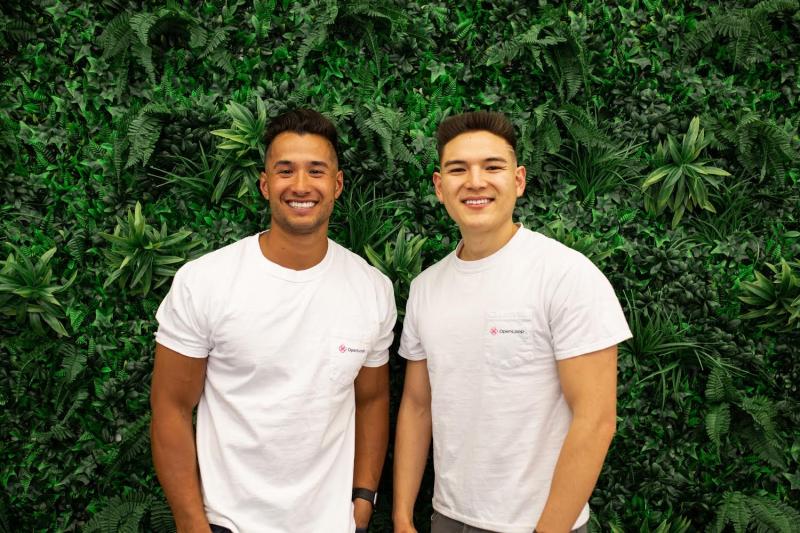
He had already tried the view from above
OpenLoop did not mark Lensing's first experiment with starting something. In 2015, he co-founded GR Drone, an aerial imagery business. Between 2016 and 2019, he led research at SwineTech, an Iowa agricultural technology startup. Before either became a line in a professional biography, there was also a lawn care company.
His education took him from Calvin College in Grand Rapids back to the University of Iowa. The return had practical attractions: family nearby and in-state tuition. He was born in Madison, Wisconsin, and grew up in Pella, Iowa. His working life would eventually settle in Des Moines.
These are unusually tangible entries on a technology founder's résumé. Lawns, aerial images, agricultural equipment: work with an observable result. They also complicate the idea of Lensing as someone who suddenly discovered entrepreneurship when OpenLoop arrived. He had already been trying out the relationship between a useful idea and somebody willing to pay for it.
When Iowa JPEC named him its Young Alumni Entrepreneur of the Year in 2022, he treated the recognition as belonging to the employees doing the work. By 2024, his university had also selected him for its Distinguished Alumni Recent Graduate Award. That year brought a Forbes 30 Under 30 listing too.
A reading list for hearing “no”
Ask a founder for a reading list and you may receive an impressive display of intellectual furniture. Lensing's early recommendations were more utilitarian. He singled out Ryan Holiday's The Obstacle Is the Way and Jia Jiang's Rejection Proof. One addresses what to do when something blocks your path. The other addresses the awkward business of asking.
His point about asking was specific. A founder needs money, introductions, advice, and help with unfamiliar decisions. Being independent enough to start a business can make it surprisingly difficult to request any of them. He described learning to ask as an important part of his company's growth.
He could also be candid about getting the mechanics wrong. In an early outbound campaign, poor data management led the company to email a partner three times in one day. Apologies followed. The team reduced its cold outreach and concentrated more closely on its product and partners.
It is an unglamorous lesson in attention: activity can be counted very easily; whether anybody welcomes it takes more care. A busy inbox is quite capable of becoming a monument to somebody else's enthusiasm.
Two hundred chances to explain it again
In 2021, Lensing made 200 pitches to investors over three months. He had hoped to raise $1.5 million. By April, the company had secured $3 million through private investors and venture capital groups.
The reason for the fundraising was concrete. There were customers and prospective customers the existing team could not support. More capital would help add people in sales, marketing, accounting, and software engineering. The gap lay between the demand arriving at the company and its ability to do the work.
That distinction gives the pitch count some substance. Two hundred presentations can sound like a test of personal stamina. Behind them was a staffing and product problem with consequences for a growing business. Each meeting was another attempt to persuade somebody that the company could turn additional resources into useful capacity.
The round also gives a different scale to the earlier competition prize. A few years of work separated $200 from $3 million. Those figures belong to different moments and different purposes, but the connecting activity is recognizable: explain what you are building, listen to the response, and decide what to do next.
The CEO job has to be earned again
Lensing's account of leadership leaves room for an uncomfortable possibility: the founder may eventually cease to be the right person to run the business. In 2021, he said he would make that transition if it served OpenLoop. Starting the company did not, in his telling, settle the question of who should lead it forever.
He talked about keeping close enough to the team that people could bring him problems and feel they belonged. His phrase for the obligation was “re-qualifying myself and my job every single day.” It is a demanding description of a title that can otherwise appear permanently attached to a founder's name.
“re-qualifying myself and my job every single day”
Jon Lensing, 2021
He has also described himself as less focused on detail than Williams, with more of his attention directed toward external relationships. Their partnership assigns room for different strengths. Lensing handles the outward conversations; Williams brings a more methodical approach to internal operations. The business needs both people to see things the other might overlook.
For a founder, admitting that division of labor is a practical step. A company cannot keep growing around the assumption that the person who started it should personally do everything.
Des Moines was part of the decision
Lensing has been consistent about where he wants to build. In 2021, he spoke about enjoying industry panels, entrepreneurship clubs, and conversations with other founders in Des Moines. Local participation was already part of the job, alongside running OpenLoop.
By January 2026, the company had grown from five employees to more than 300. Its account described an expansion into the former Bank of America building downtown, renamed OpenLoop Tower. The distance from a grocery café could now be measured in office floors.
Lensing's explanation for remaining in the city involves people and costs. He credits mentors, local organizations, and the employees the region has helped attract. He also argues that affordable operations make capital go further, while a lower cost of living gives employees more room for life outside work.
There is a business argument here as well as an attachment to home. Rent, recruitment, introductions, and the ability to retain people all show up in a company's development. Lensing speaks about Iowa as a place that supplies those ingredients, and about participating in the community that helped supply his.
Zillow, motorcycles, and a different sort of exit
His way of unwinding remains fairly industrious. Lensing enjoys remodeling and flipping houses, and fixing old motorcycles. He has described checking Zillow two or three times a day, sometimes for just a few minutes. Property listings are his version of social media. Other people scroll past photographs of dinner; he follows asking prices.
The habit has a business use. He watches how long homes remain on the market and whether sellers cut their prices, treating those observations as clues about consumer behavior. His interpretation is his own, but the underlying curiosity fits with the rest of his working life: examine something concrete, notice a change, consider what it might mean.
There is an agricultural ambition too. Lensing says he would like to return to a farm and become a cattle rancher someday. For now, he has described keeping chickens and collecting fresh eggs. He also learned to ride a unicycle in middle school, a detail that lends a little variety to the usual catalogue of founder hobbies.
In October 2026, he appeared on David Cohen's Give First podcast. Techstars also identified him as one of 13 founders featured in Cohen and Amir Hegazi's Chasing Unicorns. The café business had become material for a book about billion-dollar companies.
Yet the cattle-ranching plan gives his story a particularly human destination. The career has accumulated investors, employees, awards, and office space. His picture of a future life still includes land and animals. For somebody who began a company within walking distance of the grocery shelves, the daily production of breakfast seems a suitably practical ambition.